
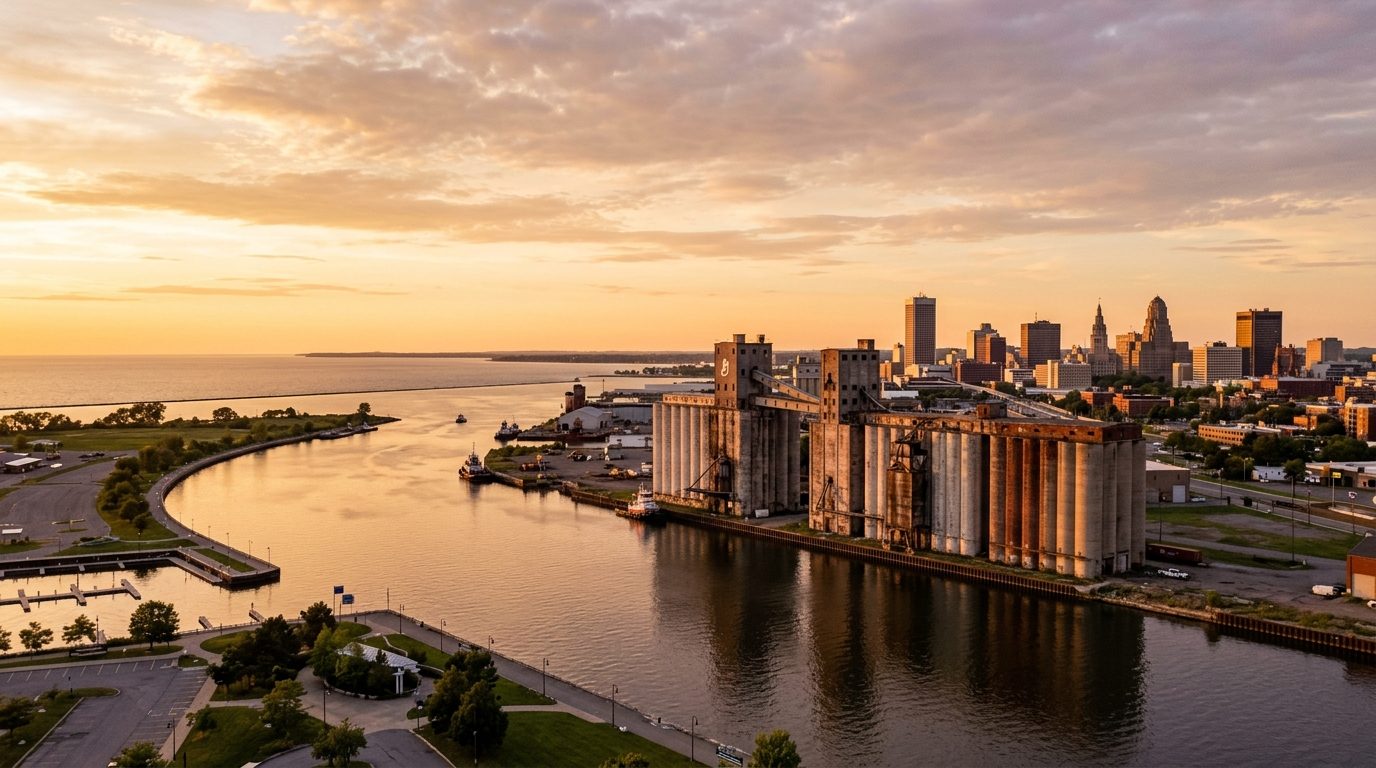
Current real estate market data, news and analysis for the Buffalo-Cheektowaga, NY metropolitan area — 1.2M residents across Erie and Niagara counties.
Data as of May 2026. Sources: Redfin Data Center, U.S. Census Bureau.
Latest Buffalo Real Estate News
Buffalo Real Estate Market Overview
The Buffalo-Cheektowaga metro occupies the Niagara Frontier at the eastern end of Lake Erie, where the Niagara River carries the lake’s outflow north toward Lake Ontario. The terrain is a level lake plain near the shoreline that gradually rises into low hills toward the metro’s southern edge, an area long known as the Southtowns. Winters are shaped by the Great Lakes: clouds and lake-effect snow are routine, while the same lake moderates summers into a comparatively mild season. Housing stock reflects the region’s layered growth. Buffalo’s core neighborhoods, laid out along Frederick Law Olmsted’s historic parkway and park system, are dense with Victorian-era homes, American Foursquares, and the city’s signature two-family "double" houses. The inner ring of suburbs built up quickly after World War II with ranch and cape-cod construction, while outer communities have continued to add new subdivisions on larger lots. Beyond the built-up area, orchard country and farmland fill out the Niagara County and southern Erie County fringe.
Within the city, walkable, architecturally distinct sections near the region’s medical and university campuses tend to draw the strongest demand, prized for historic character and proximity to downtown institutions. Outward, suburbs with newer construction, larger lots, and well-regarded schools sit at the top of the market, while small-town centers built around historic downtowns carry a similar premium tied to schools and civic character. Older industrial-era suburbs and much of the city’s East Side and Lower West Side, by contrast, are comparatively more affordable, generally reflecting older housing stock and greater distance from top-ranked school districts. Waterfront and historic-district settings, along with school quality, explain price differences across the metro more than commute time, since the region is compact enough that most drives are short.
Healthcare and higher education anchor the regional economy, led by two major hospital systems and a large academic medical center tied to the University at Buffalo, the largest campus in the State University of New York system. Roswell Park Comprehensive Cancer Center adds another major research and treatment employer downtown. On the private side, homegrown companies including a large regional bank, a food-manufacturing company, and an aerospace and defense manufacturer based in one of the eastern suburbs are long-standing employers, alongside a major energy utility and grocery chains with a significant regional presence. A federal Air Reserve installation near Niagara Falls adds a further military and government employment base to the metro.
Lake-effect snow is the region’s defining weather pattern, and its intensity varies sharply by location — communities south and east of the city, in the traditional snowbelt, see far more accumulation than neighborhoods directly along the immediate lakeshore or downtown. Buyers should check a specific address’s snow exposure and the condition of roofing and drainage accordingly. Property tax burdens vary meaningfully by school district and municipality even within the same city, so it’s worth confirming the combined rate for a specific parcel rather than assuming a single metro-wide figure. Public transit is limited to bus service and a single light-rail line connecting downtown to the university’s south campus; most of the metro is car-dependent. Buyers near the Buffalo or Niagara Rivers, or along the Lake Erie shoreline, should also confirm flood-zone status, and anyone considering one of the city’s traditional two-family homes should verify how that configuration affects zoning and financing.
Cities and Towns in the Buffalo Metro Area
Notable Communities and Neighborhoods
Buffalo Real Estate Market FAQ
How is the Buffalo metro housing market organized?
The metro runs from Buffalo’s dense, historic urban core outward through inner-ring suburbs built up after World War II to newer outer suburbs and a rural, agricultural fringe in Niagara County and southern Erie County. Housing age and style shift noticeably as you move outward from downtown.
Which parts of the Buffalo area tend to be more expensive?
Suburbs with newer construction, larger lots, and consistently well-regarded school districts generally command the highest prices, along with a handful of walkable, historic in-city neighborhoods near downtown’s medical and university campuses. Older industrial-era suburbs and much of the city’s East Side tend to be more affordable.
What should buyers verify before purchasing in the Buffalo metro?
Check the combined property tax rate for the specific school district and municipality, since rates vary meaningfully even within the same city. Confirm flood-zone status for any property near the Buffalo or Niagara Rivers or the Lake Erie shoreline, and verify zoning and financing implications if a property is one of the region’s traditional two-family, two-unit "double" houses.
How does lake-effect snow affect homeownership in the Buffalo area?
Snowfall varies dramatically by location — the traditional snowbelt south and east of the city sees far heavier accumulation than the immediate lakeshore or downtown. It’s worth checking a specific address’s typical exposure and inspecting roofing, drainage, and driveway access with that in mind before buying.
Nearby Markets