
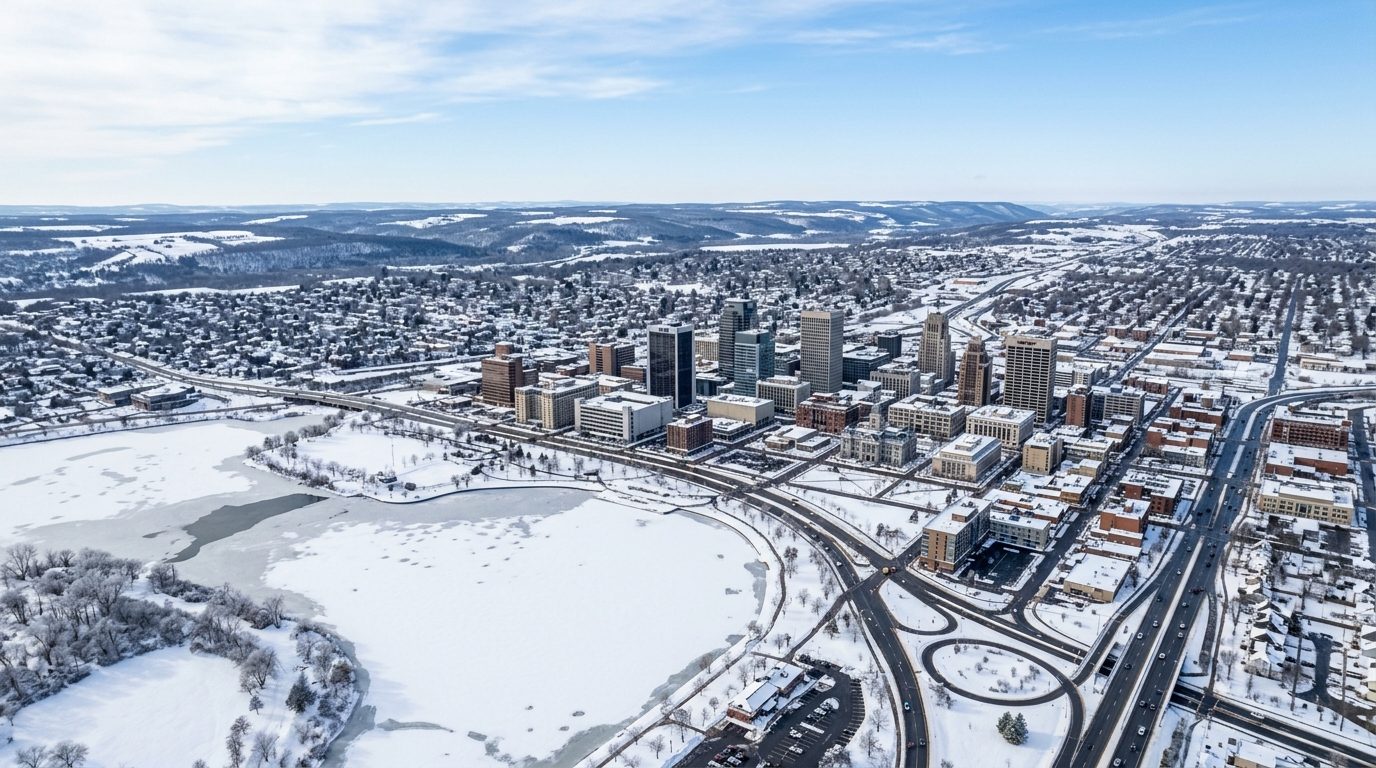
Current real estate market data, news and analysis for the Syracuse, NY metropolitan area — 652,273 residents across Madison, Onondaga and Oswego counties.
Data as of May 2026. Sources: Redfin Data Center, U.S. Census Bureau.
Latest Syracuse Real Estate News
Syracuse Real Estate Market Overview
The Syracuse metro spans Onondaga, Madison, and Oswego counties in Central New York, where terrain rises from the Lake Ontario coastal plain in the north into the rolling Appalachian foothills toward the south. Onondaga Lake sits at the urban core, Oneida Lake borders the metro to the east, and the northern Finger Lakes, including Skaneateles and Otisco, reach into its southern towns. Winters are long and marked by lake-effect snow off Lake Ontario; summers are mild and humid. Housing stock layers the region’s history: the city and inner suburbs hold dense blocks of late-19th- and early-20th-century Victorian, Colonial Revival, and bungalow homes, postwar suburbs favor ranch and split-level construction, and outlying towns mix historic village centers with farmhouses and open farmland.
Skaneateles and Cazenovia, both built around namesake lakes with walkable historic downtowns and well-regarded schools, sit toward the higher end of the metro’s price spectrum, drawing buyers seeking a small-town lake setting within reach of Syracuse. Suburban towns such as Manlius and Fayetteville also command a premium, reflecting strong school districts and short commutes to employment along Interstate 690 and Route 92; Marcellus and parts of Camillus follow a similar pattern west of the city. Housing in the city of Syracuse and in older industrial towns such as Solvay, Fulton, and Oswego tends to sit lower on the spectrum, reflecting older housing stock, longer commutes for the Oswego County towns, and the legacy of manufacturing decline. Prices in the more rural stretches of Madison and Oswego counties vary with distance from Syracuse and Interstate 81.
The economy centers on education, health care, government, and manufacturing. Syracuse University, SUNY’s Upstate Medical University, the SUNY College of Environmental Science and Forestry, and SUNY Oswego anchor the region, drawing students, researchers, and medical staff. Upstate University Hospital, Crouse Health, and St. Joseph’s Health operate major hospital campuses and employ large clinical and administrative workforces. Onondaga County and New York State government offices concentrate in downtown Syracuse. Manufacturing runs deep here: Carrier Corporation, the air-conditioning pioneer, was founded in Syracuse and still maintains engineering operations in East Syracuse, and the sector is expanding with Micron Technology’s semiconductor manufacturing project underway in northern Onondaga County. A Lockheed Martin facility near North Syracuse, the National Grid utility, and Anheuser-Busch’s Baldwinsville brewery round out the region’s larger employers.
Winter weather is the defining local factor for buyers: the metro sits directly downwind of Lake Ontario and receives heavy, highly localized lake-effect snow that can vary sharply between neighborhoods only a few miles apart, so a home’s heating system, roof condition, and snow-load history are worth checking closely. Flood risk is generally confined to low-lying land along the Oswego and Seneca rivers, the Onondaga Lake shoreline, and parts of the Oneida Lake basin, making a flood-zone check worthwhile for waterfront or riverside properties. Property taxes are a significant carrying cost in this part of New York and vary by school district and municipality, so comparing local rates for a specific address is essential. Many of the metro’s smaller towns and villages set their own zoning and land-use rules, and some outlying properties rely on private wells and septic systems rather than municipal water and sewer. Public transit is limited outside the city core, so most residents rely on cars for commutes along Interstates 81, 690, and 90.
Cities and Towns in the Syracuse Metro Area
Notable Communities and Neighborhoods
Syracuse Real Estate Market FAQ
How is the Syracuse, NY real estate market organized geographically?
The metro covers Onondaga, Madison, and Oswego counties. The city of Syracuse and its immediate inner suburbs form the urban core, a ring of established suburban towns such as Manlius, Fayetteville, Camillus, and Liverpool surrounds it, and the outer edges of the metro extend into small lake towns, historic villages, and rural farmland stretching toward Oneida Lake, Lake Ontario, and the Finger Lakes.
Which areas of the Syracuse metro tend to be pricier, and why?
Lake towns such as Skaneateles and Cazenovia and suburbs with strong school districts and short commutes, such as Manlius and Fayetteville, tend to sit at the higher end of the market. The premium reflects lake or village settings, walkable historic downtowns, and school reputation rather than any single factor, while areas farther from Syracuse’s employment core or with older industrial housing stock generally sit lower.
What should buyers verify locally before purchasing a home in the Syracuse metro?
Buyers should confirm a property’s heating system condition and age, roof and snow-load history, and whether the home relies on municipal water and sewer or private well and septic systems, which are common in the metro’s smaller towns. It is also worth checking local zoning and land-use rules, which vary by village and town, and reviewing flood-zone status for any property near a river, lake, or Onondaga Lake’s shoreline.
What is the main region-specific risk to know about in the Syracuse metro?
The dominant local risk is winter weather: the metro sits downwind of Lake Ontario and receives heavy, highly localized lake-effect snow that can differ sharply between neighborhoods only a few miles apart. This affects heating costs, roof and structural maintenance, and snow-removal obligations, and buyers should also factor in New York’s property tax rates, which vary by school district and municipality and represent a meaningful ongoing cost.
Nearby Markets