
Current real estate market data, news and analysis for the Binghamton, NY metropolitan area — 243,189 residents across Broome and Tioga counties.
Data as of May 2026. Sources: Redfin Data Center, U.S. Census Bureau.
Latest Binghamton Real Estate News
Coverage of this market is coming soon. Browse all housing market news.
Binghamton Real Estate Market Overview
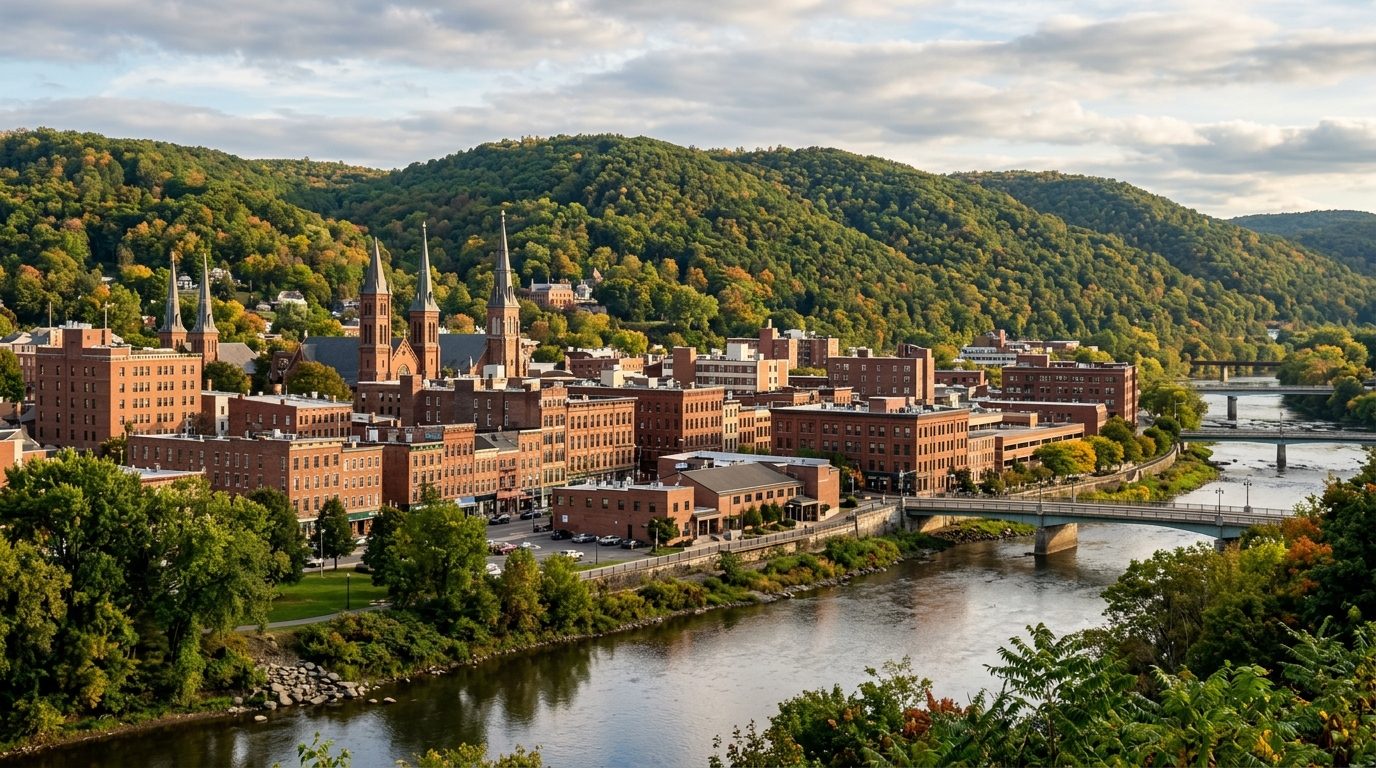
Binghamton sits at the confluence of the Susquehanna and Chenango rivers in New York’s Southern Tier, a region shaped by steep, wooded hills rising above a comparatively narrow valley floor. The metro spans Broome and Tioga counties and blends a compact urban core with close-in mill villages and a wider rural hinterland of small towns and farmland along the river valleys. Winters are cold and snowy under a humid continental climate. Housing across the region reflects its manufacturing-era growth: modest wood-frame and brick two- and three-family houses from the late nineteenth and early twentieth centuries dominate the city and its inner suburbs, while outlying towns mix older farmhouses with mid-century and newer single-family construction on larger, hillier lots.
Within the city of Binghamton, the Historic First Ward stands out for its concentration of restored Victorian-era single-family homes on tree-lined streets across the Chenango River from downtown, and the West Side draws interest for its historic housing stock and proximity to Recreation Park’s mature tree canopy. The North Side and parts of the Southside carry a more working-class, higher-density character shaped by nearness to former industrial corridors. Outside the city, hillside and ridge-top settings in the surrounding towns of Broome County command a premium for views and distance from the valley floodplain, while villages such as Owego and Waverly draw interest for intact nineteenth-century downtowns and riverside settings, even though their lowest-lying blocks share the same flood exposure found along the Susquehanna and Chenango within Binghamton itself.
The metro’s economy centers on education, healthcare, and a long-standing base of advanced manufacturing and defense electronics. Binghamton University, part of the State University of New York system, is among the region’s largest employers and anchors a research and technology corridor near the city. United Health Services operates the area’s largest hospital network, while Guthrie Lourdes Hospital, formerly Our Lady of Lourdes Memorial Hospital, serves as the other major medical center. BAE Systems maintains a substantial electronic-systems manufacturing and engineering presence in Endicott, continuing a defense-electronics lineage that traces through General Electric back to the Link and IBM operations that once dominated the village. IBM itself was founded in Endicott, and its later departure reshaped the Union-Endicott area’s economy and left behind a large footprint of formerly industrial land still being redeveloped.
Flooding is a real, recurring risk here. The Susquehanna and Chenango rivers have overtopped their banks in major floods, including a widespread flood in 2006 and a more severe flood in 2011 that damaged thousands of structures. Flood-control levees and diversion channels protect parts of Binghamton and Johnson City, but low-lying blocks outside those systems remain exposed, so flood insurance and FEMA flood-zone status are essential items to check before buying. Property taxes are another defining factor: New York’s upstate counties carry some of the highest property tax burdens in the country relative to home values, and buyers should confirm a property’s actual tax bill and eligibility for the state’s STAR school-tax exemption rather than relying on listing estimates. Public transit is limited to local bus service, so most households rely on cars. Land use ranges from dense city blocks to lightly zoned rural parcels in Tioga County, so buyers outside incorporated villages should verify septic, well, and road-maintenance arrangements with the town rather than assume municipal services apply.
Cities and Towns in the Binghamton Metro Area
Notable Communities and Neighborhoods
Binghamton Real Estate Market FAQ
How is the Binghamton, NY market area organized?
The Binghamton metro spans two New York counties, Broome and Tioga, and is anchored by the city of Binghamton along with the adjoining villages of Endicott and Johnson City, historically known together as the Triple Cities. Beyond that urban core, the metro includes smaller villages and towns such as Owego, Waverly, Whitney Point, Windsor, Deposit, Candor, Newark Valley, Nichols, Spencer, Lisle, and Port Dickinson, each governed by its own town or village board, with school district lines that do not always match municipal boundaries. Because Broome and Tioga are separate counties, tax rates, assessment practices, and some permitting or inspection procedures can differ from one side of the metro to the other even between neighboring properties.
Which parts of the Binghamton metro tend to be pricier, and why?
Higher-priced housing tends to sit on higher ground away from the Susquehanna and Chenango river floodplains, in neighborhoods and towns with intact historic housing stock, mature landscaping, and walkable access to downtown Binghamton or a village center. Lower-lying blocks near the rivers, and areas closest to former industrial corridors, tend to carry lower prices, reflecting both flood exposure and proximity to older commercial and manufacturing land uses. Hillside and ridge-top settings outside the urban core generally offer the most separation from both flood risk and city density, which supports stronger demand in those locations.
What should buyers verify locally before purchasing in this metro?
Buyers should confirm a property’s flood-zone status directly against FEMA flood maps and check with the local floodplain administrator, since flood-control infrastructure protects some areas of the metro but not others. They should also independently verify the current property tax bill, assessment, and any applicable STAR or other exemptions with the town or county assessor’s office, since New York’s upstate property tax burden is significant relative to home values and can vary by school district even within the same town. Confirming water, sewer, or septic service, and whether a property sits inside an incorporated village or an unincorporated part of a town, is also worthwhile, since services and zoning rules differ accordingly.
What is the main region-specific risk for property in the Binghamton metro?
The primary regional risk is river flooding. The city of Binghamton and several neighboring villages sit at or near the meeting point of the Susquehanna and Chenango rivers, and both waterways have a documented history of overtopping their banks and damaging homes and businesses in low-lying areas. Flood-control levees and diversion works protect some sections of the urban core, but a meaningful share of residential and commercial property throughout the metro remains in mapped flood zones, so reviewing FEMA flood maps, elevation certificates, and a property’s flood claim history is a standard part of due diligence here.
Nearby Markets