
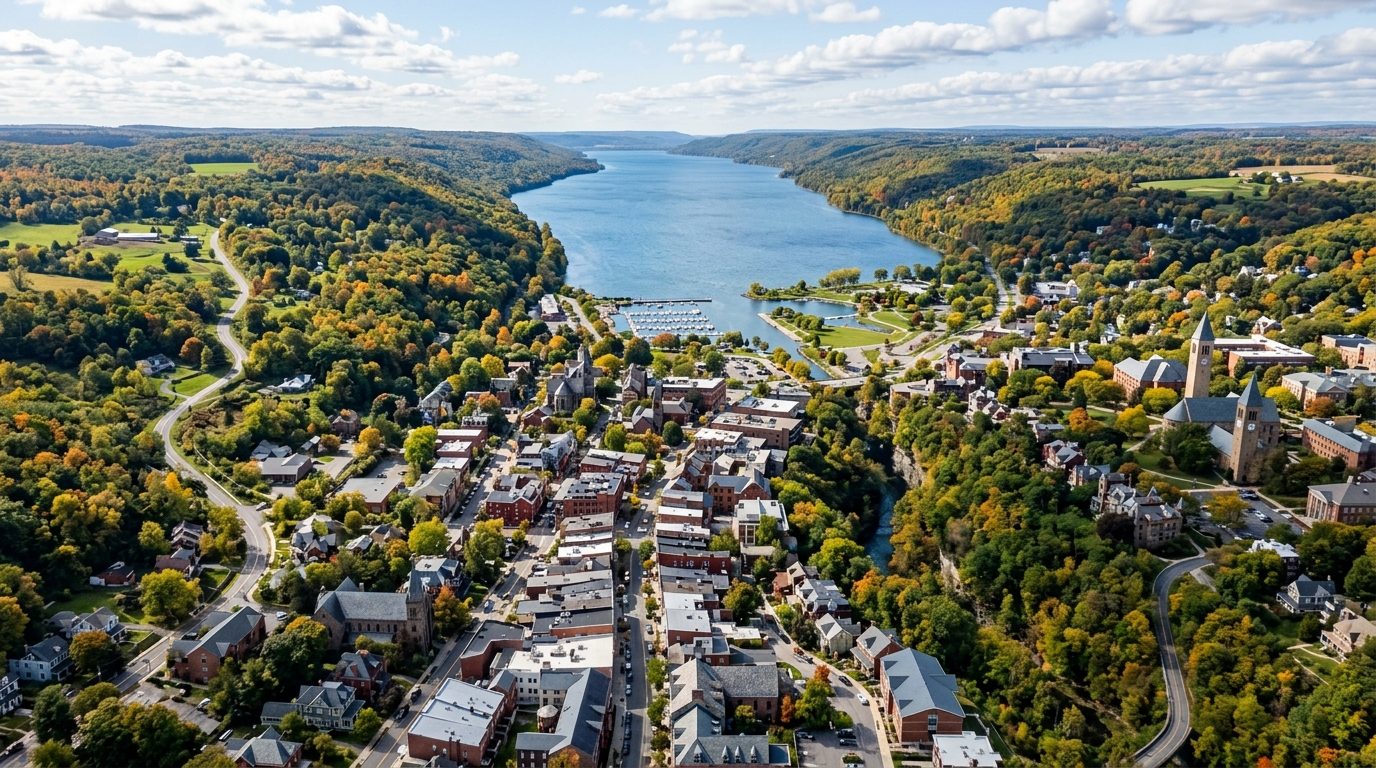
Current real estate market data, news and analysis for the Ithaca, NY metropolitan area — 104,047 residents across Tompkins county.
Data as of May 2026. Sources: Redfin Data Center, U.S. Census Bureau.
Latest Ithaca Real Estate News
Coverage of this market is coming soon. Browse all housing market news.
Ithaca Real Estate Market Overview
The Ithaca metropolitan area occupies Tompkins County at the southern end of Cayuga Lake in New York’s Finger Lakes region. The city of Ithaca sits in a bowl-shaped valley where creeks such as Fall Creek, Cascadilla Creek, and Six Mile Creek have cut deep gorges and waterfalls on their way to the lake, and this terrain shapes the housing stock. Neighborhoods near downtown tend toward dense, walkable grids of older homes and converted apartment buildings, while neighborhoods climbing East Hill, South Hill, and West Hill offer more space between houses and hillside views. Close to Cornell, streets shift quickly from single-family blocks to student-oriented apartment buildings, a pattern especially visible in Collegetown just east of campus. Outside the city, the towns of Ithaca, Lansing, Dryden, and Groton, and the village of Trumansburg, spread across farmland, wooded ridges, and lakeshore, with housing ranging from compact village lots to large rural parcels and working farms.
Some areas carry a more prestigious address than others, largely as a function of proximity to Cornell and downtown, lake access, and historic character. Cayuga Heights, above the north end of the city and adjacent to Cornell, is known for large lots, mature trees, and architecturally distinguished homes built for university faculty over the past century. Cornell Heights and Forest Home, both platted originally as faculty enclaves near campus, carry similar cachet for historic housing and walkable proximity to the university. Along the Lansing shoreline of Cayuga Lake, waterfront parcels command a premium for direct water access. By contrast, homes farther out, in outlying parts of Dryden, Groton, and rural stretches of Lansing, sit lower on the price spectrum, reflecting longer commutes and a more agricultural setting rather than any difference in land quality.
Cornell University is the dominant force in the local economy, both as the county’s largest employer and as a magnet for spending by students and researchers. Ithaca College, on South Hill, is the area’s second major institution of higher education and a significant employer. Health care is anchored by Cayuga Medical Center, the region’s principal hospital, along with the Guthrie network’s local practices. Manufacturing has a long history here too, led by BorgWarner’s Ithaca operations and smaller precision-manufacturing firms. Local government, school districts, and retailers such as Wegmans round out the major employers, and Tompkins Cortland Community College supports regional workforce training.
Because two residential colleges sit within the city, the rental market has a pronounced seasonal rhythm tied to the academic calendar, with much of the housing near campus cycling between student tenants and owner-occupants. Property taxes here, like much of upstate New York, are a significant carrying cost buyers should budget for. The gorges and steep hillsides that define the scenery also bring real hazards, including unstable slopes and flash flooding, along with long-standing gorge safety concerns worth understanding before buying near a creek or gorge rim. Zoning is evolving: the city has been rewriting its code, easing rules around accessory dwelling units and off-street parking downtown, while surrounding towns retain more traditional low-density and agricultural zoning. Buyers should verify a property’s zoning district and historic-district design review requirements, confirm well and septic status for rural parcels outside municipal service areas, and check floodplain and slope-stability status for any lot near a creek, gorge, or the lake.
Cities and Towns in the Ithaca Metro Area
Notable Communities and Neighborhoods
Ithaca Real Estate Market FAQ
How is the Ithaca-area housing market organized geographically?
The core of the market is the city of Ithaca itself, set in a valley at the south end of Cayuga Lake and cut through by several creek gorges, with denser, older housing near downtown and the Cornell and Ithaca College campuses. Surrounding towns, including Ithaca, Lansing, Dryden, Groton, and the village of Trumansburg, spread outward across farmland, wooded hills, and lakeshore, offering larger lots and more rural settings the farther one moves from the city center.
Which parts of the metro tend to be more expensive, and why?
Areas close to Cornell University and downtown Ithaca, along with Cayuga Lake waterfront locations, generally command a premium. Cayuga Heights and neighborhoods like Cornell Heights and Forest Home benefit from historic architecture, large lots, and walkable proximity to campus, while lakefront parcels in Lansing and elsewhere around Cayuga Lake are valued for direct water access and views. Areas farther from the university and the lake tend to be more affordable, reflecting distance and a more rural or small-town setting rather than any difference in underlying land quality.
What should a buyer verify locally before purchasing in this area?
Buyers should confirm a property’s zoning district and whether it falls within a historic district subject to design review, since Ithaca’s zoning code is under active revision. Outside the city and villages, buyers should verify well water and septic system status, since much of the county lacks municipal water and sewer service. It is also worth checking floodplain maps and slope-stability records for any property near a creek, gorge, or the lake, and understanding local property tax rates, which are notably high relative to national norms.
What is the main region-specific risk to be aware of?
The creek gorges that give the area much of its scenic character also pose safety and structural risks. Steep, unstable slopes above and along the gorges are prone to erosion and occasional slope failure, and the creeks themselves are subject to flash flooding, particularly in spring or after heavy rain. Properties on or near a gorge rim, floodplain, or steep hillside warrant closer scrutiny of drainage, slope stability, and flood history before purchase.
Nearby Markets