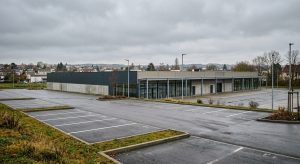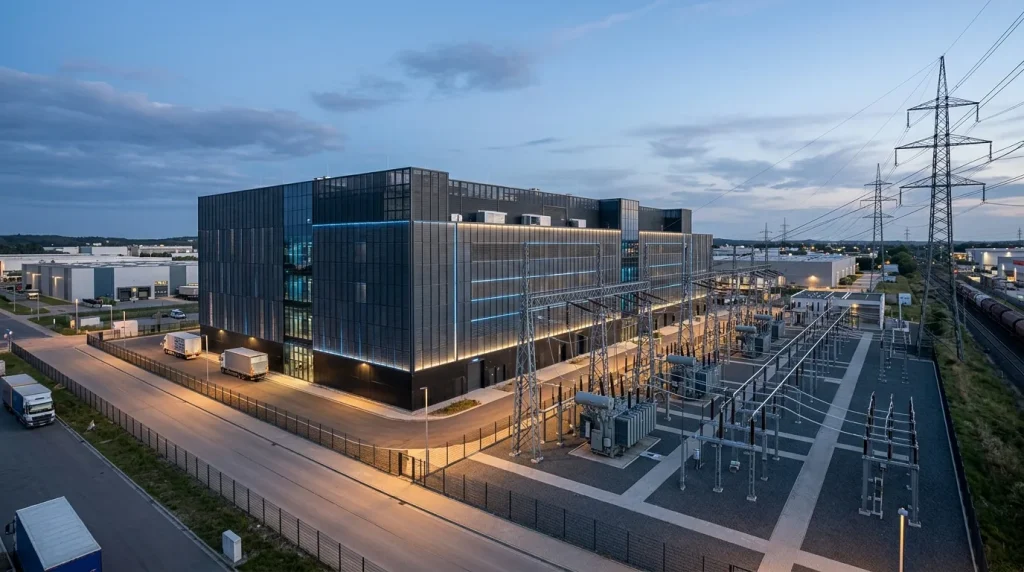
Data centers are changing how real estate investors, developers and economic-development officials think about industrial land.
For years, data center site selection focused heavily on fiber connectivity, proximity to users, tax incentives and land availability. Those factors still matter. But in the AI era, one constraint increasingly dominates the conversation: power.
Artificial intelligence, cloud computing and high-performance computing are creating demand for data centers with enormous energy requirements. As a result, power availability, delivery timelines, grid capacity and behind-the-meter generation are reshaping which sites can support large-scale digital infrastructure.
Key takeaways
- JLL says the data center sector is in an infrastructure investment supercycle requiring up to $3 trillion by 2030.
- JLL expects roughly 100 GW of new capacity to come online globally between 2026 and 2030.
- CBRE says AI demand and power constraints are reshaping data center growth.
- CBRE identifies emerging markets such as Tennessee and West Texas as gaining traction because they offer scalable land and power availability.
- JLL reported more than 35 GW of data center capacity under construction in North America.
- Power availability is becoming a real estate value driver, not only a utility issue.
Data centers are now a power story
Data center demand is no longer only about servers and land.
JLL’s 2026 global data center outlook says the sector is experiencing an infrastructure investment supercycle requiring up to $3 trillion by 2030. JLL expects roughly 100 GW of new capacity to come online between 2026 and 2030, creating an estimated $1.2 trillion in real estate asset value, with tenants spending an additional $1 trillion to $2 trillion on IT equipment fit-out.
CBRE’s 2026 global data center trends report frames the market around AI demand and power constraints, saying those forces are reshaping data center growth. CBRE also notes that emerging markets in North America, including Tennessee and West Texas, are gaining traction because they offer scalable land and power availability for large deployments.
That is a major shift. Power is not a back-end utility detail. It is becoming a site-selection filter.
Why AI changes the equation
AI workloads can require dense, energy-intensive computing infrastructure.
CBRE’s 2026 U.S. data center outlook says AI companies are driving strong demand for data centers across North America with exceptionally large power capacity to run their applications.
That demand can change the industrial real estate map. Sites with land but no reliable power may be less competitive. Sites with available grid capacity, utility cooperation or possible on-site generation may become more valuable.
For developers, the bottleneck may not be tenant demand. It may be whether a site can receive enough power soon enough.
Frontier markets are gaining attention
Traditional data center hubs remain important, but power constraints are pushing attention to new markets.
JLL reported that more than 35 GW of data center capacity was under construction in North America and that 64% of capacity under construction was located in frontier markets. JLL said this level of capacity under construction was extraordinary by historical standards.
That shift has real estate consequences. Land that was once considered secondary industrial land may become strategic if it has power access, transmission potential, water considerations, fiber connectivity and supportive local infrastructure.
Industrial markets feel the impact
Data centers are not warehouses, but they compete for many of the same inputs: land, power, zoning, construction labor, substations, transmission capacity, water or cooling resources, tax incentives and local political support.
In some markets, data centers can bid aggressively for industrial land. That can raise land values, affect utility planning and influence where logistics or manufacturing tenants can expand.
For traditional industrial tenants, power availability can also become more important. Advanced manufacturing, cold storage, automation, EV infrastructure and data center-related suppliers may all need stronger power capacity than older industrial parks were designed to provide.
What investors should watch
Investors evaluating data center-related real estate should ask:
- Is power available today?
- If not, when can it be delivered?
- Who pays for upgrades?
- Is the utility able to support the load?
- Is on-site generation possible?
- Are permits and zoning aligned?
- Are water and cooling needs manageable?
- Is fiber connectivity sufficient?
- Are there competing large-load users nearby?
- Does community opposition create entitlement risk?
A data center site without executable power is not the same asset as a site with confirmed capacity.
What this means
Data centers are turning power into a real estate asset class driver.
For developers, power can determine whether a project works. For industrial owners, power capacity may become a premium feature. For cities, data center demand can bring investment but also infrastructure pressure. For investors, the opportunity is large, but the underwriting must include energy delivery, not just land and tenant demand.
The AI infrastructure boom is not only reshaping technology. It is reshaping real estate.
FAQ
Why are data centers important to real estate?
Data centers require land, buildings, power, cooling, fiber and infrastructure. Their growth can affect industrial land values, utility planning and local development.
Why does power matter so much for data centers?
AI and cloud computing require large amounts of electricity. Power availability and delivery timelines can determine whether a site can support a data center.
How much data center capacity is expected by 2030?
JLL expects roughly 100 GW of new data center capacity to come online globally between 2026 and 2030.
Why are frontier data center markets growing?
Frontier markets may offer more scalable land and power availability than constrained traditional hubs.
Can data centers compete with warehouses for land?
Yes. Data centers can compete with industrial users for land, utilities, infrastructure and construction resources.
Sources with clickable URLs
- JLL — 2026 Global Data Center Market Outlook
- JLL — North America Data Center Report
- CBRE — Global Data Center Trends 2026
- CBRE — U.S. Real Estate Market Outlook 2026: Data Centers
- Cushman & Wakefield — Global Data Center Market Comparison
Related Articles
- Industrial Real Estate in 2026: Big-Box Leasing Is Back, but Risks Remain
- Commercial Real Estate Outlook 2026: Office Is Stabilizing, Industrial Is Rebounding, Retail Is Tight, and Multifamily Demand Is Healing
- Commercial Mortgage Maturities in 2026: Why the Refinance Wall Matters
- More Commercial Real Estate news →