Office vacancy is one of the most watched commercial real estate numbers, but it does not tell the whole story by itself.
A high vacancy rate means more empty space, weaker income and more pressure on landlords. But not all office vacancy is the same. Some buildings are recovering because they offer better locations, amenities, transit access, modern systems and workplace experience. Others remain stuck because they are older, less flexible or no longer fit how companies use office space.
In 2026, the office market is best understood as a split market: prime buildings are improving faster, while weaker assets still face structural challenges.
Key takeaways
- CBRE reported overall U.S. office vacancy fell to 18.6% in Q1 2026.
- Prime office vacancy fell more sharply, dropping to 12.7%.
- Net absorption totaled 6.9 million square feet, the strongest Q1 since 2020.
- Office completions totaled 1.3 million square feet, the lowest quarterly total since CBRE began tracking the metric in 1990.
- Tenants continue to favor high-quality assets.
- Older, poorly located or functionally obsolete buildings may continue to struggle.
What office vacancy measures
Office vacancy measures the share of office space that is empty and available for lease.
For example, if a market has 100 million square feet of office space and 18 million square feet are vacant, the vacancy rate is 18%.
Vacancy matters because office owners depend on rent income. High vacancy can reduce net operating income, weaken property value, make refinancing harder and force landlords to offer concessions.
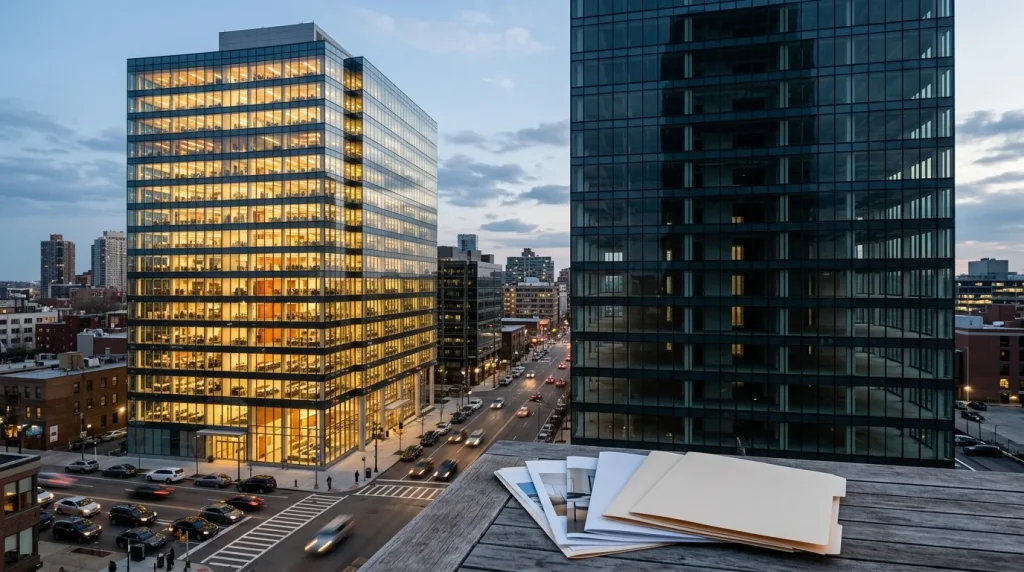
But vacancy can be misleading if it is viewed only at the national level. A trophy tower in a supply-constrained district can be nearly full while an older building nearby remains half empty.
What the latest data shows
CBRE reported that U.S. office net absorption totaled 6.9 million square feet in Q1 2026, the highest first-quarter total since 2020 and the eighth consecutive quarter of positive demand. Overall vacancy fell by 10 basis points to 18.6%.
The more important detail is the quality split. Prime vacancy fell by 80 basis points to 12.7%, while Midtown Manhattan’s prime vacancy rate fell to 2.9%.
That shows demand is not absent. It is concentrated.
Why prime buildings are recovering faster
Prime office buildings often offer the features companies now prioritize: strong location, transit access, modern building systems, high-quality amenities, flexible floor plates, energy efficiency, food and beverage options, hospitality-style common areas, outdoor space and workplace experience that helps attract employees.
CBRE’s 2026 office outlook said occupiers are likely to continue focusing on the highest-quality assets and that the gap between prime and nonprime performance is near a record high. That is the “flight to quality” story: companies may lease less space overall, but they want better space.
Why weaker buildings struggle
Older office buildings can struggle for several reasons.
Some have outdated systems, poor layouts, weak amenities or locations that no longer match tenant demand. Others require large capital expenditures just to compete. In some cases, the building may have debt that was based on pre-pandemic leasing assumptions.
High vacancy can become self-reinforcing. Less income means less money for improvements. Without improvements, it is harder to attract tenants. Without tenants, refinancing becomes harder.
That is why some buildings may need major repositioning, conversion, demolition or sale at a lower value.
Limited new supply may help the market
One reason office vacancy may gradually improve is that new supply has slowed dramatically.
CBRE reported that the under-construction office pipeline was 15.8 million square feet in Q1 2026, down 87% from the Q2 2020 peak. Office construction completions totaled just 1.3 million square feet, the lowest quarterly total since CBRE began tracking the metric in 1990.
Less new construction can help existing buildings, especially high-quality ones. It does not automatically fix obsolete space, but it can reduce future competition.
Vacancy and refinancing risk
Office vacancy also matters because of debt.
A building with high vacancy may not generate enough income to refinance at today’s rates. The Mortgage Bankers Association reported that 17% of office property loans are scheduled to mature in 2026.
That creates pressure. An owner with a strong building and improving leasing may refinance. An owner with weak occupancy and falling income may need to sell, restructure or invest new capital.
What this means
Office vacancy is not a single national problem. It is a building-by-building problem.
For tenants, high vacancy can create negotiating leverage, especially in older or weaker buildings. But prime space in top locations may become more competitive.
For landlords, the message is clear: quality, amenities and location matter. Buildings that can attract workers and tenants are recovering faster. Buildings that cannot may need a new strategy.
For investors, office vacancy should be analyzed alongside lease expirations, tenant credit, capital needs, debt maturity, market demand and conversion potential.
The office market is not dead. It is sorting winners and losers more aggressively than before.
FAQ
What is office vacancy?
Office vacancy is the share of office space that is empty and available for lease.
What is the U.S. office vacancy rate in 2026?
CBRE reported that overall U.S. office vacancy fell to 18.6% in Q1 2026.
Why are prime office buildings doing better?
Prime buildings often offer better locations, amenities, systems and workplace experience, which tenants increasingly prefer.
Are office buildings recovering?
Some are. CBRE reported positive net absorption for eight consecutive quarters, but the recovery is uneven and weaker buildings still face challenges.
What happens to office buildings that do not recover?
Some may be renovated, repositioned, converted to other uses, sold at lower values or demolished.
Sources with clickable URLs
- CBRE — Q1 2026 U.S. Office Market Report
- CBRE — U.S. Real Estate Market Outlook 2026: Office
- CBRE — Conversions & Demolitions Reducing U.S. Office Supply
- MBA Newslink — Commercial and Multifamily Mortgage Balances to Mature in 2026
Related Articles
- Office Conversions in 2026: Where Adaptive Reuse Actually Works
- Commercial Real Estate Outlook 2026: Office Is Stabilizing, Industrial Is Rebounding, Retail Is Tight, and Multifamily Demand Is Healing
- Commercial Mortgage Maturities in 2026: Why the Refinance Wall Matters
- More Commercial Real Estate news →