Mixed-use real estate is one of the most familiar ideas in modern development, but it is also one of the most misunderstood.
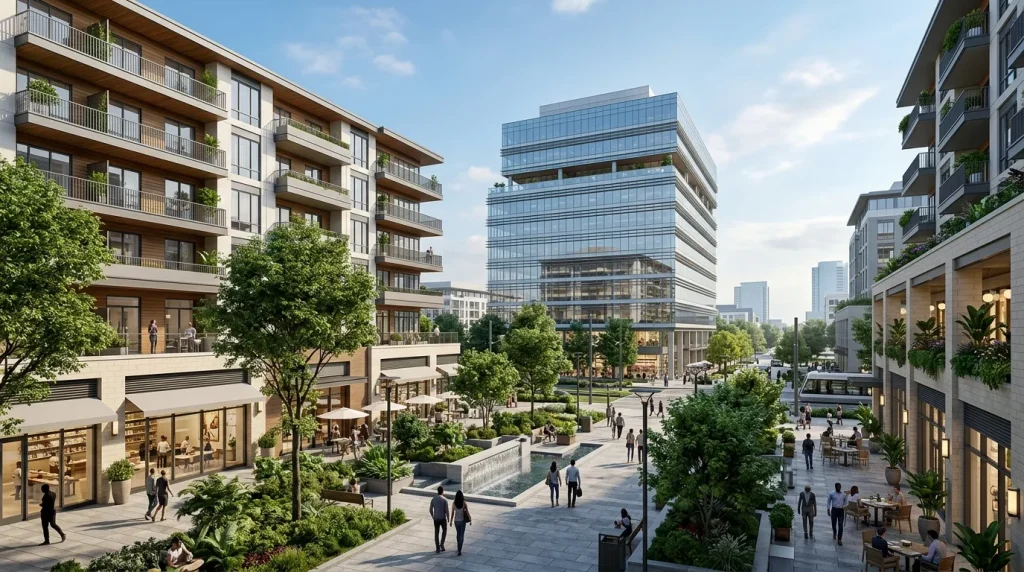
Many people think mixed-use simply means apartments over retail. That can be one version, but the concept is broader. A mixed-use project may combine housing, office, retail, restaurants, hotel, entertainment, civic space, open space, transit access or community-serving uses in one coordinated development.
The Urban Land Institute’s mixed-use guidance describes the concept as more than a single building with stores on the ground floor. ULI’s Mixed-Use Development Handbook characterizes mixed-use development as providing three or more significant revenue-producing uses, fostering integration and compatibility, and creating walkable pedestrian connections.
Key takeaways
- Mixed-use real estate combines multiple property uses in one coordinated project or district.
- Common uses include residential, retail, office, hotel, entertainment and civic space.
- Successful mixed-use projects need more than buildings; they need flow, programming and a sense of place.
- ULI’s 2026 mixed-use outlook says success increasingly depends on amenitized workplaces, hospitality experience and retail at grade.
- Mixed-use can work vertically in one building or horizontally across a district.
- The biggest risks are cost, complexity, financing, tenant mix and weak street-level activation.
What is mixed-use real estate?
Mixed-use real estate brings different property uses together so they support one another.
A simple mixed-use building might include retail on the first floor and apartments above. A larger mixed-use district might include apartments, office buildings, grocery, restaurants, hotels, entertainment, parks and public gathering space.
The goal is not just to stack uses. The goal is to create a place where residents, workers, visitors and shoppers generate activity at different times of day.
That is why a true mixed-use project is both a real estate strategy and a place-making strategy.
Vertical vs. horizontal mixed-use
Mixed-use can be vertical or horizontal.
Vertical mixed-use places different uses in the same building. A common example is ground-floor retail with residential or office above.
Horizontal mixed-use spreads different uses across a larger site or district. A development might place apartments on one parcel, grocery and restaurants on another, office nearby and public space in the center.
ULI’s 2026 mixed-use outlook noted that as mixed-use development expands into suburban markets, some developers are thinking more horizontally, using oversized parking lots or over-retailed sites to create mixed-use environments without necessarily copying dense urban towers.
Why developers like mixed-use projects
Developers like mixed-use projects because different uses can support one another.
Residents can support retail and restaurants. Office workers can drive daytime traffic. Hotel guests can add weekend and evening demand. Civic uses, entertainment and public space can make a project feel like a destination rather than a collection of buildings.
That combination can create stronger foot traffic, longer visit times and a more resilient income stream if one use softens. For example, a project with retail, apartments and hotel uses may be less dependent on a single tenant type than a standalone office building.
But mixed-use is not automatically safer. It is more complex.
Why mixed-use is harder than it looks
Mixed-use projects require coordination across different users, lenders, construction schedules and operating models.
A residential building, grocery store, restaurant row and office tenant all have different needs. Parking, deliveries, trash, noise, signage, security, access and public space must be planned carefully.
A common mistake is treating the uses as separate pieces instead of one connected place. ULI’s 2026 outlook emphasized that mixed-use success increasingly depends on pedestrian flow, hospitality-level service, public-space experience, ground-floor activation and subtle details that turn a development into a true destination.
The importance of street-level retail
Retail at grade can make or break a mixed-use project.
Ground-floor retail should not be an afterthought. It needs the right tenants, signage, outdoor seating, visibility, parking strategy and customer flow. A weak retail layer can make a mixed-use project feel empty even if the apartments above are occupied.
The best retail mix often includes daily-needs uses, food and beverage, fitness, personal services, entertainment or community-oriented tenants that draw repeat visits.
Financing and entitlement risk
Mixed-use projects can be harder to finance and approve than single-use projects.
Lenders may underwrite each component differently. Residential, office, hotel and retail uses have different risk profiles. Construction costs can be higher, and timelines may be longer. Public approvals can also be more complicated because mixed-use projects often involve zoning, traffic, parking, infrastructure and community concerns.
What this means
Mixed-use real estate can create more dynamic and resilient places, but only when the pieces work together.
For developers, the challenge is not simply adding apartments, retail and office to one site. The challenge is creating a project where the uses support each other economically and socially.
For investors, the key is underwriting each use separately and together. A mixed-use project should be evaluated by tenant demand, walkability, parking, public space, operating complexity, financing and local market depth.
FAQ
What is mixed-use real estate?
Mixed-use real estate combines multiple property uses, such as housing, retail, office, hotel, entertainment or civic space, in one coordinated building, site or district.
Is mixed-use the same as apartments over retail?
No. Apartments over retail are one form of mixed-use, but mixed-use can also be horizontal across a district and include many different property types.
Why do developers like mixed-use projects?
Mixed-use projects can create multiple demand drivers, support stronger foot traffic and make a development more resilient than a single-use property.
What makes mixed-use projects hard?
They require more complex financing, zoning, design, parking, tenant coordination, operations and public-space planning.
Sources with clickable URLs
- Urban Land Institute — Understanding Mixed Use and Multi Use
- Urban Land Magazine — Product Council Outlook for Mixed-Use Development
- Urban Land Magazine — Mixed Use and Multi-Use
- ULI/PwC — Emerging Trends in Real Estate 2026