Office conversions are one of the most talked-about ideas in commercial real estate, but they are not a universal solution for vacant office buildings.
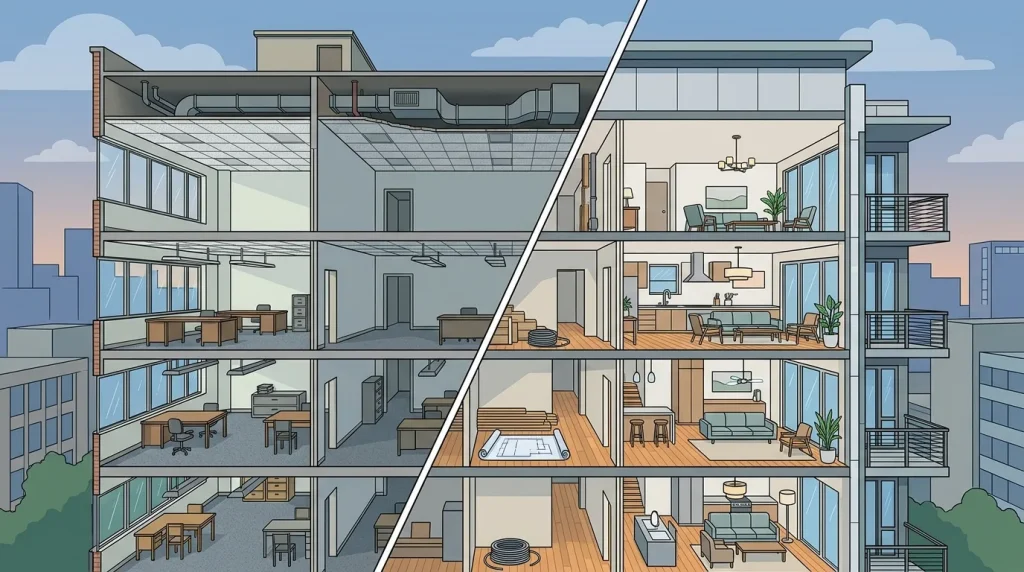
The basic concept is appealing: take underused office space and convert it into apartments, hotels, life sciences space, schools, self-storage or another use. In theory, conversions can reduce office vacancy, add housing supply and revive downtown districts. In practice, only certain buildings, markets and capital structures work.
CBRE reported that the U.S. office conversion pipeline reached 81 million square feet of planned and underway projects across 44 markets as of May 2025, equal to 1.9% of total U.S. office inventory.
Key takeaways
- Office conversions are increasing, but they remain a modest share of national office inventory.
- CBRE reported 81 million square feet of planned and underway office conversion projects as of May 2025.
- Office-to-multifamily conversions have delivered more than 28,500 housing units since 2018.
- CBRE said another 43,500 units could be delivered if planned projects proceed.
- Building layout, floor plate, window access, plumbing, cost and zoning determine feasibility.
- Conversions can help locally but will not solve the national housing shortage alone.
Why conversions are gaining attention
Office conversions have gained attention because the office market changed after the pandemic. Hybrid work reduced demand for some older or less competitive office properties, while housing shortages remained severe in many cities.
That mismatch created a policy and investment idea: convert office space that workers no longer need into housing people do need.
CBRE said conversions and demolitions have accelerated since the pandemic and that 2024 set an annual record with 94 office conversion projects totaling 13.1 million square feet completed. CBRE expected about 68 conversions totaling 12.8 million square feet in 2025.
Why most office buildings are hard to convert
A vacant office building is not automatically a future apartment building.
Residential buildings need natural light, unit layouts, kitchens, bathrooms, plumbing stacks, ventilation, code compliance and usable residential floor plans. Many office buildings have deep floor plates, large central cores or mechanical systems that make apartment layouts difficult.
JPMorgan notes that conversion feasibility can vary dramatically based on physical characteristics, especially floor-plate depth, and that sprawling footprints can make residential conversion harder. Gensler’s analysis of more than 1,300 buildings in 130 North American cities found that only 25% of the buildings analyzed were suitable candidates for office-to-residential conversion.
What makes a good conversion candidate?
A strong office-conversion candidate usually has several traits: outdated or weak office demand, discounted building value, manageable floor-plate depth, enough window line for residential units, feasible plumbing and mechanical upgrades, zoning that allows residential or mixed use, access to transit and amenities, local housing demand and a capital stack that can support high redevelopment costs.
Some older buildings work well because they were built with smaller floor plates and more windows. Some newer office towers are much harder to convert because they were designed for large open-plan office use.
Multifamily is the main conversion target
Most planned and active office conversions are aimed at multifamily housing.
CBRE reported that just over 70% of planned and active office conversion projects by square footage are to multifamily. Office-to-multifamily conversions have delivered more than 28,500 housing units since 2018, with another 43,500 expected if planned projects proceed.
Those numbers matter, but they also show the limits. Tens of thousands of units can help individual cities and neighborhoods, but they are modest compared with the national housing shortage.
What this means
Office conversions can be a smart strategy when the building is obsolete for office use, the physical layout works, the local residential market is strong and financing is available.
They do not work when the building is too expensive, too deep, too hard to reconfigure or located in a market where residential rents cannot support conversion costs.
For cities, conversions can reduce empty office space and add residents downtown. For investors, they can create value from stranded assets. For housing policy, they are one tool — not the whole solution.
The best question is not “Can offices become apartments?” It is “Which buildings can become apartments at a cost that actually works?”
FAQ
What is an office conversion?
An office conversion is the redevelopment of an office building into another use, such as apartments, hotel, school, self-storage or mixed-use space.
Are office-to-residential conversions increasing?
Yes. CBRE reported that the U.S. office conversion pipeline reached 81 million square feet of planned and underway projects across 44 markets as of May 2025.
Can office conversions solve the housing shortage?
No. They can help locally, but CBRE’s reported housing-unit totals remain modest compared with national housing needs.
What makes an office building good for residential conversion?
Good candidates often have manageable floor plates, strong window access, workable structure, feasible plumbing and mechanical upgrades, supportive zoning and strong residential demand.
Why are many office buildings hard to convert?
Many office buildings have deep floor plates, large cores, limited window access or systems that are expensive to adapt for housing.
Sources with clickable URLs
- CBRE — Conversions & Demolitions Reducing U.S. Office Supply
- CBRE — Q1 2026 U.S. Office Market Report
- JPMorgan — What to Know About Office-to-Residential Conversion
- Gensler — Office-to-Everything: A New Path for Revitalizing Downtowns
- White House Guidebook — Commercial to Residential Conversions
Related Articles
- Office Vacancy Explained: Why Some Buildings Recover and Others Do Not
- Mixed-Use Real Estate Explained: Why Developers Still Like Live-Work-Play Projects
- Commercial Real Estate Outlook 2026: Office Is Stabilizing, Industrial Is Rebounding, Retail Is Tight, and Multifamily Demand Is Healing
- More Commercial Real Estate news →