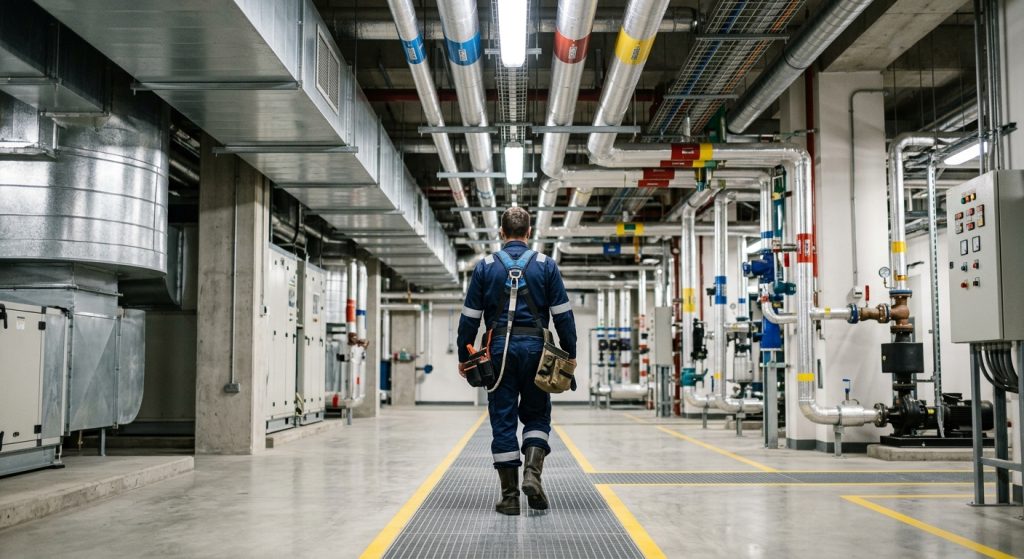
Running America’s commercial buildings — not building them, running them — generates $609.9 billion in annual economic output and supports 3.9 million jobs, according to a study the Building Owners and Managers Association International released Sept. 16.
The figure covers office, retail and industrial properties across the 79 U.S. markets BOMA’s local associations serve, which span 38 states. The association’s 2026 Market Study: The Economic Impact of U.S. Commercial Real Estate puts annual building operating expenditures at $274.9 billion, which it calculates contributes $344.4 billion to U.S. GDP and generates $219.4 billion in personal earnings. Every dollar spent on operations, the study says, produces $2.22 in total economic output once direct, indirect and induced activity are counted.
The study was conducted by the Business Research Division at the Leeds School of Business at the University of Colorado Boulder on behalf of BOMA — a commissioned analysis by a trade group whose members are the owners and managers being measured, and worth reading with that in mind.
Data centers have quietly taken over “office” construction
The most consequential finding for anyone reading construction data is a classification problem. Federal construction statistics count data centers as private office construction. That accounting choice has become distorting as the AI buildout accelerates.
In 2025, data centers accounted for roughly $41.2 billion, or nearly 46%, of the more than $90 billion in private office construction nationally, the study found. A decade earlier the share was less than 5%. Traditional office construction — the category most people mean when they say office — totaled approximately $48.4 billion in 2025.
The practical implication is that a headline showing office construction holding steady may be describing a market in which conventional office building has shrunk while server halls have filled the gap. Analysts and reporters who track the federal series without separating the two are measuring two very different businesses as one. RealtyWire has reported on the same distortion from the demand side, including data centers accounting for $77.4 billion of a $78 billion projected gain in commercial construction this year.
Industrial off its peak, retail steady
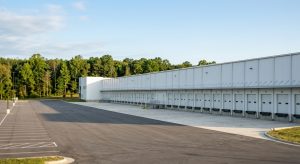
Warehouse and manufacturing construction totaled approximately $274.2 billion in 2025. That was down 7.9% from the prior year, but the study notes it remained more than twice the 2020 level and was the third-highest annual total on record — a cooling from an extraordinary peak rather than a retreat.
Retail construction came to roughly $47.1 billion in 2025, with activity increasing during the first three months of 2026. The study also describes the U.S. life sciences real estate market as normalizing after several years of rapid expansion, and includes a separate analysis of life sciences properties in the 17 markets where sufficient data were available.
Those figures sit alongside a broader construction picture that has been uneven this year. Census data showed total construction spending slipping to $2.16 trillion in July as single-family building dropped.
The argument BOMA is making
The study is, by design, an advocacy document, and its framing is about permanence. “The economic impact of commercial real estate is not a one-time event,” said Mary Lue Peck, president and chief operating officer of BOMA International. “Ongoing investments in the operation, maintenance and improvement of our buildings generate economic activity that supports businesses, jobs and wages across the country.”
Kjersten Jaeb, chair and chief elected officer of BOMA International, put it in terms of the labor behind the numbers. “Commercial buildings are economic engines, supporting businesses, jobs and communities across the country,” she said. “Every building relies on an extensive network of professionals to keep it running safely and efficiently.”
That emphasis on operations rather than development is the point of the exercise. Development spending is cyclical and concentrated in a handful of booming markets; janitorial contracts, HVAC service, security, engineering and property management are recurring and spread across all 38 states in the sample. It is the argument a building-owners’ group makes when the industry’s public image is dominated by vacant towers and by data center projects that local voters increasingly resist.
BOMA, founded in 1907, says the full study and accompanying state profiles are available through its website. More of our coverage of the sector is on the Commercial Real Estate page.