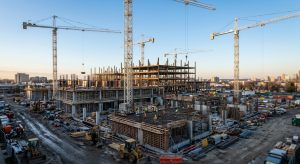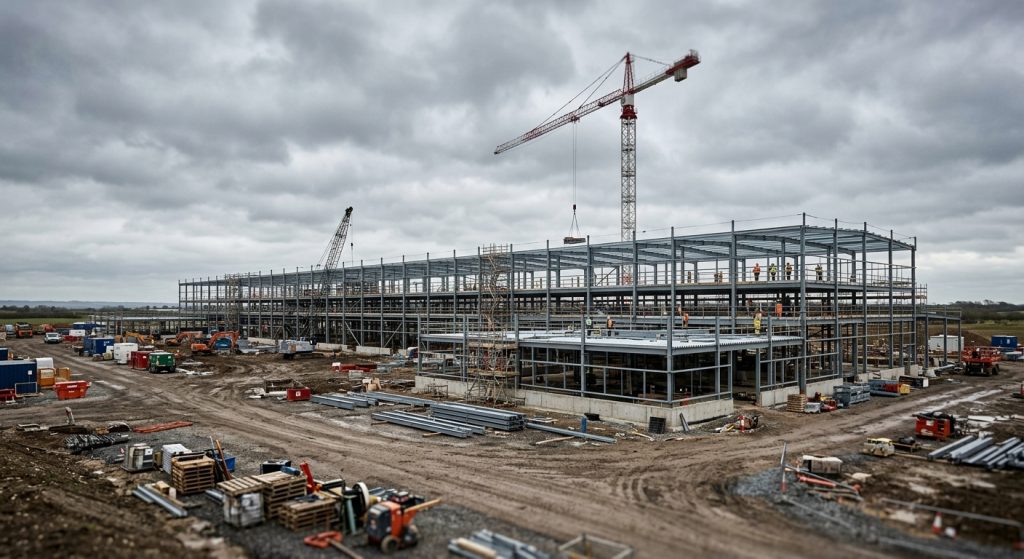
Data centers now account for essentially all of the growth in U.S. commercial construction, according to the autumn 2026 construction starts forecast ConstructConnect published Sept. 8 with Oxford Economics. Of an anticipated $78 billion increase in commercial construction this year, $77.4 billion is expected to come from data centers — meaning that without them, the category would show virtually no growth at all.
The forecast raises the outlook for nonresidential building to 8.7% growth in 2026, an upgrade of more than five percentage points from the firm’s previous projection. Total U.S. construction starts across all categories are forecast to rise 2.1%, with year-to-date starts through June already running 6.5% ahead of the same period in 2025.
One segment carrying the market
Private offices, the category that includes data centers in ConstructConnect’s classification, are projected to be the fastest-growing segment in the country, with new construction up 83.1% this year. That single number is doing most of the work in the nonresidential upgrade.
Almost every other nonresidential category is either flat or falling. Manufacturing construction is forecast to drop nearly 43%, which ConstructConnect attributes to tariff-related cuts in capital spending and fading federal support for the factory-building wave of recent years. Institutional construction is the exception, expected to rise 7.4% on gains in prisons, courthouses and military facilities.
On the civil side, construction spending is forecast to grow 3.6%, with power investment up 7.8% as capital shifts toward infrastructure priorities beyond green energy — much of it, in practice, feeding the same electricity demand that the data center buildout has created. RealtyWire reported in July that nonresidential starts hit a one-month record $100.3 billion in June, also led by data centers, and that July starts rebounded 25.6% on $29 billion of data center and chip megaprojects.
Housing keeps sliding
Residential construction is the clearest weak spot in the forecast. Starts are expected to fall 10.5% in 2026, with single-family starts down 5.9% and multifamily weaker still.
ConstructConnect cites high financing and materials costs, soft rent growth, an excess of multifamily supply and constrained buyer demand. New single-family permits totaled 462,000 in the first half of 2026, which the firm describes as a three-year low.
That is consistent with the government data RealtyWire has tracked through the summer, including a plunge in single-family housing starts in July even as permits climbed.
The rate assumption changed
One of the more consequential revisions in the forecast is not a construction number at all. ConstructConnect’s baseline now assumes the Federal Reserve’s next rate cut arrives in September 2027 — nearly a year later than the December 2026 cut assumed in its previous forecast.
The firm expects U.S. GDP to grow 2.3%, supported by a stable labor market, rapid AI investment and a turn in the inventory cycle, offsetting moderating consumer spending and persistent inflation. But it also expects monetary policy to stay restrictive for longer than previously assumed — a direct headwind for the rate-sensitive residential and speculative commercial projects that data center demand does not touch.
Risks flagged in the forecast include energy-price volatility tied to the Strait of Hormuz, unresolved tariff policy and a tighter construction labor supply resulting from reduced immigration.
What it means
The verified fact is a market with one engine. Data centers and the power infrastructure serving them are pulling nonresidential construction upward while manufacturing contracts sharply and housing declines by double digits.
ConstructConnect’s own reading, attributed to chief economist Michael Guckes, is that the outlook “rewards project selectivity and close attention to sector rotation,” with data centers and power infrastructure the clearest opportunities and everything else facing pressure from financing costs, excess capacity, tariffs and softer demand.
The RealtyWire analysis worth adding is about concentration risk rather than growth. A category that supplies 99% of an entire sector’s expansion is also the category whose slowdown would erase it. ConstructConnect expects exactly that moderation to begin: it projects data center expansion to slow from 2027 through the end of the decade, leaving what it calls a more mixed outlook across the remaining nonresidential segments. Contractors, lenders and developers who have rebuilt pipelines around one asset class over the past two years would feel that turn first.
The staffing pressure is already visible. RealtyWire covered a 36% jump in construction job openings as the data center boom pulled labor away from housing — a reallocation that becomes a problem in reverse if data center starts cool before residential demand recovers. More construction and development coverage is in RealtyWire’s Commercial Real Estate section.
What to watch this fall: whether the manufacturing decline stabilizes as tariff policy settles, whether single-family permits move off their three-year low, and whether the 2027 data center moderation ConstructConnect projects begins showing up in starts data before the year is out.