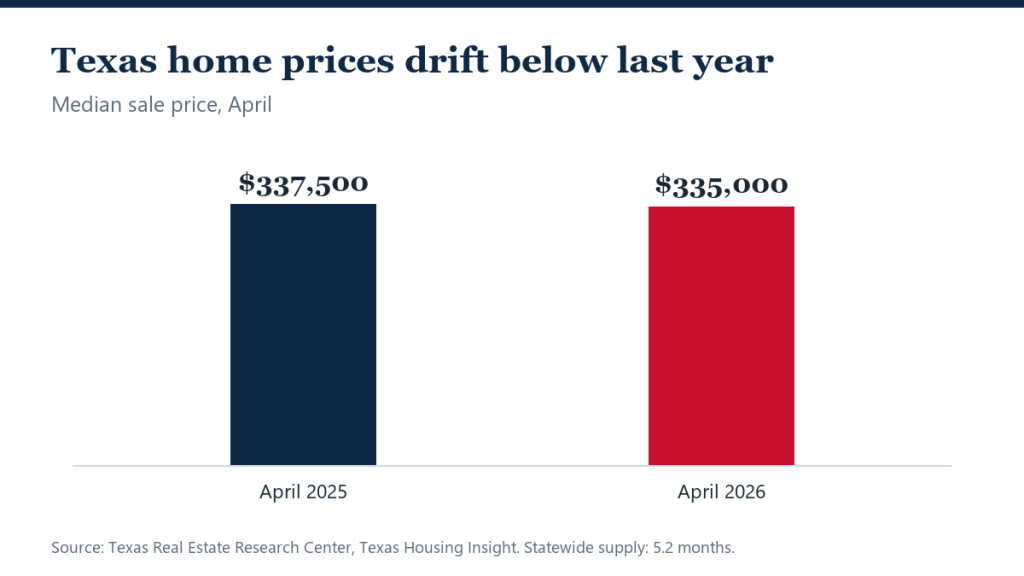
Texas keeps tilting toward buyers. The statewide median sale price came in at $335,000 in the Texas Real Estate Research Center’s latest Housing Insight — up from March but below the $337,500 recorded a year earlier — while unsold inventory sat at a 5.2-month supply, among the most buyer-friendly readings of any large state.
Demand has not folded: sales are running 2.3% ahead of last year’s pace year to date, led by Austin, and about one in four active listings drew a pending offer in April. But sellers are doing more of the work — the median price cut was $12,500, or 3.6% of list price — and homes still averaged 70 days on market, slower than either 2024 or 2025.
The Texas market in numbers
- Median sale price: $335,000 — below $337,500 a year earlier.
- Months of supply: 5.2, with unsold homes averaging 90 days on market.
- Sales: up 2.3% year to date versus 2025; Austin led regional growth while Dallas and Houston were flat and San Antonio slipped.
- Seller price cuts: median $12,500 (3.6% of list), down from 4.1% in March.
- New listings: up 3.3% from March but essentially flat with last year.
Why Texas softened first
Texas built more housing than almost anywhere through the boom, and that supply is doing what supply does. With inventory at roughly one and a half times 2019 levels, buyers can negotiate — the same math behind why rising inventory pressures prices without crashing them. Notably, the pipeline is now throttling: new-listing activity in Dallas–Fort Worth and Houston fell below last year, and weaker seller activity is the classic self-correcting mechanism of a soft market.
The comparison with the national picture is stark. Nationally, the median existing single-family home reached $421,900 in April, up from $418,000 a year earlier — records, as June’s national data confirmed. Texas is running the opposite direction, modestly and orderly.
What it means
For buyers, Texas offers what most of the country still lacks: selection, time and negotiability — plus sellers pre-conceding $12,500 at the median. For sellers, the state rewards day-one realism: price cuts are shrinking as list prices come down to meet the market, exactly the pattern showing up in national asking prices. For investors, a 5.2-month supply with positive sales growth reads as rebalancing, not retreat.
The momentum indicators lean healthier than the price line. Homes sold in April spent an average of 70 days on the market, down from 79 in March, and the inventory turnover ratio ran ahead of last year’s pace for the first time in 2026. Sellers who meet the market are transacting — the median price cut itself shrank from 4.1% of list in March to 3.6% in April.
Watch the supply side for the turn. New-listing activity in Dallas–Fort Worth and Houston has slipped below last year, and San Antonio is the only major metro adding sellers aggressively (+11.5%). Softer prices discouraging new listings is how Texas-style corrections historically end: supply throttles itself until demand catches up. If mortgage rates take another run below 6%, a 5.2-month cushion can absorb surprisingly fast.
The other Texas constant — property taxes and insurance — still shapes the affordability math more than the sticker price, a reminder that the full monthly cost decides what buyers can actually carry in Houston or Dallas.
FAQ
Are Texas home prices crashing?
No. The median is down roughly 0.7% from a year ago — a drift, not a collapse — while sales volume is growing. Elevated supply is absorbing demand rather than signaling distress.
Is 5.2 months of supply a buyer’s market?
It is close. Six months is the conventional balanced-market threshold; at 5.2, Texas buyers hold more leverage than in almost any recent year, though well-priced homes in Austin still move quickly.
Why are sales rising if prices are falling?
Because affordability improved. Lower prices plus more choice pull buyers off the sidelines — falling prices and rising volume is what a functioning correction looks like.