
Current real estate market data, news and analysis for the Tucson, AZ metropolitan area — 1.1M residents across Pima county.
Data as of May 2026. Sources: Redfin Data Center, U.S. Census Bureau.
Latest Tucson Real Estate News
Tucson Real Estate Market Overview
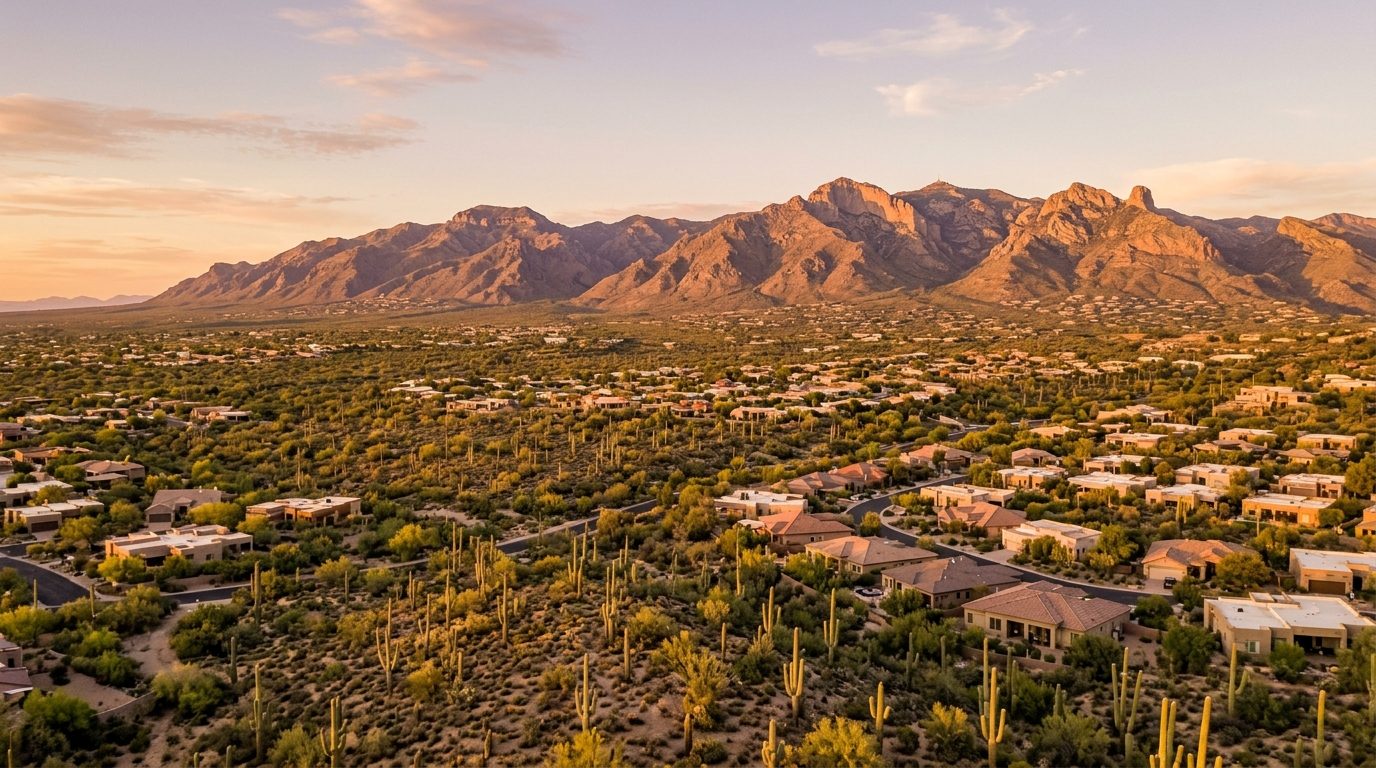
The Tucson metro fills a broad desert valley in southern Arizona, ringed by four distinct mountain ranges — the Santa Catalinas to the north, the Rincons to the east, the Santa Ritas to the south, and the Tucson Mountains to the west. The Sonoran Desert setting brings a two-season climate: long, intensely hot summers broken by a distinct late-summer monsoon period of dramatic afternoon storms, followed by mild, sunny winters. Housing stock ranges from a compact historic core near downtown and the University of Arizona, with adobe construction and early-twentieth-century bungalows, to a broad band of mid-century ranch homes, to large master-planned subdivisions that continue to expand along the metro’s northern and southern edges. Much of the metro’s population lives not in the City of Tucson itself but across a patchwork of separately incorporated towns and unincorporated Pima County, plus land belonging to the Tohono O’odham and Pascua Yaqui nations.
The area against the base of the Santa Catalina Mountains north of the city commands the metro’s strongest premium, prized for its mountain views, low density, and distance from downtown, with similar view-driven pockets carrying a comparable premium in the newer communities further north. Established master-planned suburbs to the north and northwest layer in newer construction and consistently strong schools. Toward the south and southeast, newer subdivisions along the interstate corridor and a large retirement-oriented community offer relatively more affordable, if often more distant, housing. Central Tucson’s older historic districts trade on walkability and architectural character but frequently carry smaller, older homes, while the far south and east of the metro generally see lower costs tied to newer, less expensive tract construction and longer commutes.
The University of Arizona is both the region’s largest employer and its academic anchor, and the metro has built a national reputation in optics and photonics, reflected in a dense cluster of aerospace and defense contractors, including a major missile-systems manufacturer with a large local presence. Davis-Monthan Air Force Base, home to a fighter wing and the well-known aircraft storage facility nicknamed "the Boneyard," adds a substantial military employment base. Two major hospital networks operate multiple campuses across the metro, and mining remains part of the regional economy, with a large copper-mining company maintaining a technical and exploration presence in the city. A large e-commerce fulfillment center and the Tohono O’odham Nation are also significant regional employers.
Water supply is a defining long-term consideration in a desert metro dependent on a mix of Colorado River water and groundwater, and the broader Southwest’s ongoing drought conditions are worth tracking for any long-term buyer. Summer monsoon storms can produce flash flooding in washes that crisscross the valley, so verifying a parcel’s proximity to a wash and its flood-zone status is worthwhile. Zoning and permitting authority is split among the City of Tucson, several incorporated towns, unincorporated Pima County, and tribal governments, each with its own rules, so it matters which jurisdiction a specific address falls under. Public transit is limited outside a short downtown streetcar loop and a bus network, leaving most of the metro car-dependent. Buyers should also check HOA rules on desert landscaping and water use, confirm well versus municipal water service in unincorporated areas, and consider noise exposure near Davis-Monthan’s flight paths.
Cities and Towns in the Tucson Metro Area
Notable Communities and Neighborhoods
Tucson Real Estate Market FAQ
How is the Tucson metro housing market organized?
Much of the metro’s population lives outside the City of Tucson itself, spread across separately incorporated towns, unincorporated Pima County, and tribal land, each with its own zoning and permitting rules. The market runs from a compact historic core near downtown outward through mid-century suburbs to large, newer master-planned communities at the edges.
Which parts of the Tucson area tend to be more expensive?
The foothill areas at the base of the Santa Catalina Mountains north of the city carry the strongest premium, prized for mountain views and low density, along with similar view-driven newer communities further north. More affordable, newer subdivisions tend to sit along the interstate corridor to the south and southeast.
What should buyers verify before purchasing in the Tucson metro?
Confirm which jurisdiction — the city, a separate town, unincorporated county, or tribal land — governs a specific address, since zoning and permitting rules differ. Check a property’s proximity to a desert wash and its flood-zone status, verify well versus municipal water service in unincorporated areas, and review any HOA rules on desert landscaping and water use.
What water-related factors should Tucson buyers keep in mind?
The region relies on a mix of Colorado River water and groundwater, and long-term Southwest drought conditions are an active regional issue worth tracking. It’s a reasonable question to ask about a specific property’s water source and any relevant municipal water-use rules before buying.
Nearby Markets