
Current real estate market data, news and analysis for the Flagstaff, AZ metropolitan area — 144,368 residents across Coconino county.
Data as of May 2026. Sources: Redfin Data Center, U.S. Census Bureau.
Latest Flagstaff Real Estate News
Coverage of this market is coming soon. Browse all housing market news.
Flagstaff Real Estate Market Overview
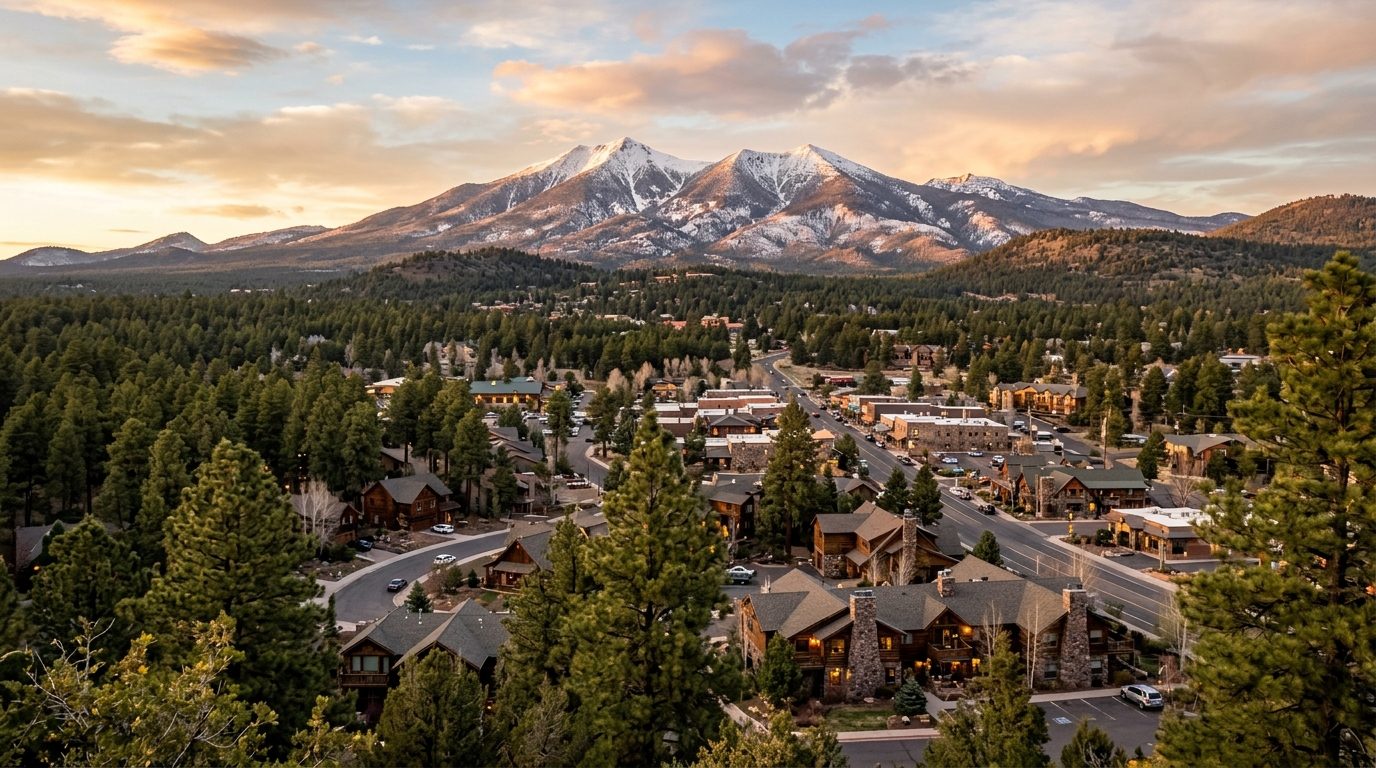
The Flagstaff metro sits high on the Colorado Plateau in Coconino County, wrapped in the largest contiguous stand of ponderosa pine forest in the country and anchored by the San Francisco Peaks just north of the city. Flagstaff itself is the metro’s population and commercial center, with a compact, walkable downtown built around a historic railroad corridor, ringed by forested residential subdivisions climbing toward the base of the peaks. The metro’s boundaries stretch far beyond the city, taking in the Grand Canyon gateway towns of Tusayan and Williams to the west and the Lake Powell community of Page to the north, along with the small town of Fredonia near the Utah border. Housing stock varies across this expanse, from early downtown-era brick and log homes to postwar ranch houses, mountain-style custom construction on forested acreage, and manufactured homes in more rural stretches.
Within Flagstaff, areas closest to downtown and Northern Arizona University tend to carry a premium tied to walkability, historic character, and steady rental demand from students and staff. Moving outward, forested subdivisions toward the base of the San Francisco Peaks and the Country Club and golf-course communities east of downtown draw buyers seeking wooded lots, mountain views, and recreational amenities, generally placing them in a higher tier. Newer subdivisions south and southeast of the city, near the interstate corridors, offer more recent construction with an emphasis on trail access. Rural, unincorporated areas northeast of the city trade smaller homes on larger acreage for greater distance from job centers. Outside Flagstaff proper, Page, Williams, and Tusayan operate as smaller, self-contained housing markets shaped by tourism demand and second-home ownership, while Fredonia remains the smallest and most remote town in the metro.
The metro’s economy centers on Northern Arizona University, one of the region’s largest employers and a steady source of jobs and rental demand. Northern Arizona Healthcare, which operates Flagstaff Medical Center, is another major employer, alongside W. L. Gore & Associates, a materials science manufacturer with a longstanding presence in the city. Government employment, including the City of Flagstaff, Coconino County, and federal land-management agencies tied to the national forest and Grand Canyon National Park, also plays a sizable role. The wider metro leans heavily on tourism: Williams serves as a rail gateway to the Grand Canyon’s South Rim, Tusayan exists largely to serve park visitors, and Page’s economy centers on recreation at Lake Powell alongside regional power generation.
Buyers in this metro should weigh conditions distinctive to a forested, high-elevation region. Wildfire is a recognized risk across the Flagstaff area, and local jurisdictions have adopted wildland-urban interface building and vegetation standards affecting construction materials, defensible-space landscaping, and insurance availability in forested subdivisions. Winters bring substantial snowfall and freezing conditions atypical of most of Arizona, affecting road access, roofing, and seasonal maintenance costs. Because much of the metro is bordered or surrounded by national forest and other public land, development is geographically constrained, shaping where new construction can occur near the forest edge. Page’s proximity to Lake Powell means its local economy can be sensitive to lake levels, while Tusayan’s market is tied almost entirely to Grand Canyon visitation. Buyers should verify wildfire and defensible-space requirements, water source details in outlying areas, road maintenance responsibility on unincorporated parcels, and any homeowners’ association or historic-district rules before purchasing.
Cities and Towns in the Flagstaff Metro Area
Notable Communities and Neighborhoods
Flagstaff Real Estate Market FAQ
How is the Flagstaff metro area organized for real estate purposes?
The metro spans Coconino County and includes the city of Flagstaff along with the smaller towns of Page, Williams, Tusayan, and Fredonia. Flagstaff functions as the primary housing and job market, while the other towns operate as smaller, more isolated markets tied closely to tourism and their distance from the Grand Canyon or Lake Powell.
Which areas of the metro tend to be priced higher, and why?
Neighborhoods close to downtown Flagstaff and Northern Arizona University tend to command a premium for walkability and rental demand, while forested subdivisions with mountain views near the base of the San Francisco Peaks and golf-course communities draw buyers seeking larger wooded lots and recreational amenities. More rural or remote areas, and the smaller tourism towns farther from Flagstaff’s job base, tend to sit in a lower tier.
What should buyers verify locally before purchasing in this metro?
Buyers should confirm wildfire and defensible-space requirements for any property near forested land, check whether a parcel relies on a private well versus municipal water, verify road maintenance responsibility in unincorporated areas, and review any homeowners’ association or historic-district rules that may apply to older neighborhoods near downtown Flagstaff.
What is the primary environmental risk to understand in this area?
Wildfire is the most significant risk given the metro’s location within extensive ponderosa pine forest, and it has shaped local building codes, vegetation-clearance rules, and insurance considerations. High elevation also brings heavy winter snowfall that can affect road access and property maintenance in ways uncommon elsewhere in Arizona.
Nearby Markets