
Current real estate market data, news and analysis for the Springfield, MA metropolitan area — 464,338 residents across Hampden county.
Data as of May 2026. Sources: Redfin Data Center, U.S. Census Bureau.
Latest Springfield Real Estate News
Springfield Real Estate Market Overview
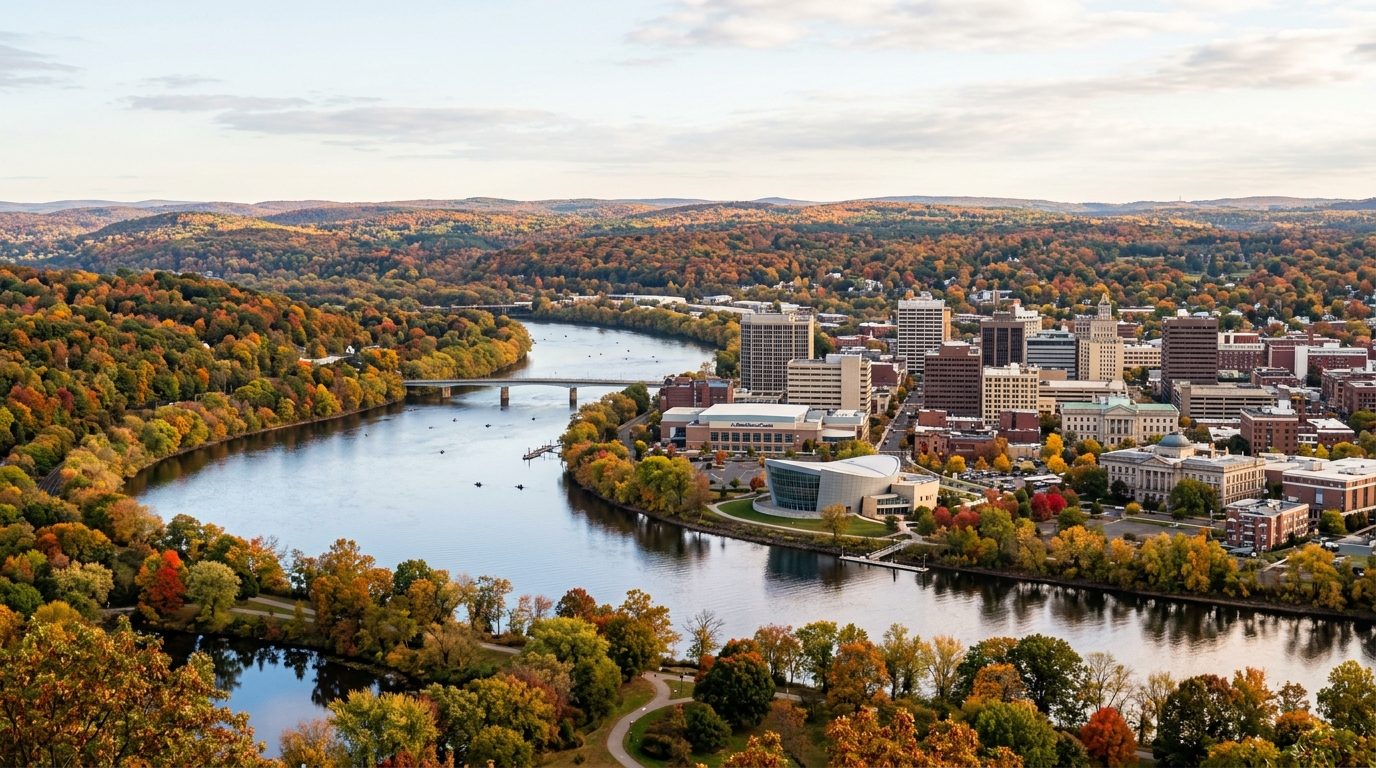
Springfield sits along the Connecticut River in the Pioneer Valley of western Massachusetts, the historic urban hub of Hampden County where the river valley narrows between the Berkshire foothills to the west and the central Massachusetts uplands to the east. The city itself grew as a nineteenth and early twentieth century industrial and armory center, and its core neighborhoods still carry that legacy: dense grids of wood-frame triple-deckers, worker’s cottages, and brick multi-family buildings built for a manufacturing workforce. Moving outward, the surrounding towns split into two distinct landscapes: flatter, more suburban communities close to the river and along the Interstate 91 corridor, and hillier, more rural towns rising toward the Berkshire foothills to the west, where farmhouses, capes, and ranch homes sit on larger, wooded lots.
Within the metro, price tiers generally track distance from the urban core and the age and density of housing. Longmeadow and East Longmeadow, immediately south of Springfield, carry the metro’s higher-tier reputation, built out largely in the mid-twentieth century with colonial and Tudor-style homes on generous lots, tree-lined streets, and school districts that operate independently from Springfield’s. Wilbraham and Southwick offer similar suburban character with somewhat later construction and a more rural edge. Springfield’s own core neighborhoods, with older multi-family stock, smaller lots, and the Springfield Public Schools district, sit at the lower end of the range. The hill towns to the west, including Blandford, Chester, Granville, Montgomery, Russell, and Tolland, vary widely by lot size, age, and condition rather than any consistent tier.
The regional economy centers on healthcare, insurance, and a residual manufacturing base. Baystate Health, anchored by Baystate Medical Center in Springfield, is the dominant healthcare employer and hosts a regional campus tied to the state’s public medical school. Massachusetts Mutual Life Insurance Company, founded in Springfield in 1851, keeps a major corporate campus in the city as part of a long-running regional insurance industry legacy. Big Y Foods, a regional supermarket chain, is headquartered in Springfield with a large distribution operation. Smith & Wesson still operates a significant firearms manufacturing plant in the city, even after relocating its corporate headquarters to Tennessee. Higher education adds further employment, with Springfield College, American International College, Western New England University, and Springfield Technical Community College all based in the city, alongside downtown casino and entertainment development.
Buyers should account for a full New England winter climate and the region’s occasional exposure to severe convective weather; an EF3 tornado crossed Springfield, Westfield, Monson, and Brimfield in June 2011, and homes along its former path were extensively rebuilt in the years after. Some low-lying areas near the Connecticut River and its tributaries carry flood exposure worth checking against current flood maps. Much of the housing stock predates 1978, so lead paint, older wiring such as knob-and-tube, aging heating systems, and asbestos are common inspection findings that buyers should budget to address. Property tax rates and municipal services vary independently by town, since each community sets its own rate, and commute patterns rely heavily on Interstate 91, Interstate 90, and limited regional and Amtrak rail service through Springfield’s Union Station.
Cities and Towns in the Springfield Metro Area
Notable Communities and Neighborhoods
Springfield Real Estate Market FAQ
How is the Springfield, MA metro area organized?
The metro centers on the city of Springfield in Hampden County, an older mill-city core along the Connecticut River, surrounded by a ring of towns that fall into two groups: closer-in suburban communities such as Longmeadow, East Longmeadow, Wilbraham, Ludlow, and Southwick, and more rural hill towns to the west including Blandford, Chester, Granville, Montgomery, Russell, and Tolland, plus smaller towns like Hampden, Monson, Brimfield, Holland, and Wales to the south and east.
Which parts of the Springfield metro tend to be pricier, and why?
Longmeadow and East Longmeadow are generally the higher-priced suburbs, reflecting larger mid-twentieth-century lots, independent school districts, and a more consistently maintained housing stock. Wilbraham and Southwick follow a similar pattern. Springfield’s own urban neighborhoods, built earlier and at higher density for a mill-era workforce, tend to sit at the more affordable end, while pricing in the outlying hill towns depends heavily on the individual property’s age and condition rather than location alone.
What should buyers verify locally before purchasing in the Springfield area?
Because Hampden County towns set their own tax rates and school budgets independently, buyers should confirm the specific town’s property tax rate, school district assignment, and any local zoning or septic requirements, since several outlying towns rely on private wells and septic systems rather than municipal water and sewer. Flood zone status near the Connecticut River and its tributaries and the condition of older utility infrastructure are also worth confirming directly with the town and a licensed inspector.
What regional risk factors are specific to the Springfield, MA market?
Much of the area’s housing predates 1978, so lead paint, knob-and-tube wiring, and aging heating and plumbing systems are common inspection issues in older homes, particularly in Springfield’s core neighborhoods. The region also has a documented history of severe convective weather, including a destructive tornado that crossed Springfield and several nearby towns in June 2011, which is worth factoring into any conversation about insurance coverage and building-code-era construction.
Nearby Markets