
Current real estate market data, news and analysis for the Amherst Town-Northampton, MA metropolitan area — 164,065 residents across Hampshire county.
Sources: U.S. Census Bureau.
Latest Amherst Town Real Estate News
Coverage of this market is coming soon. Browse all housing market news.
Amherst Town Real Estate Market Overview
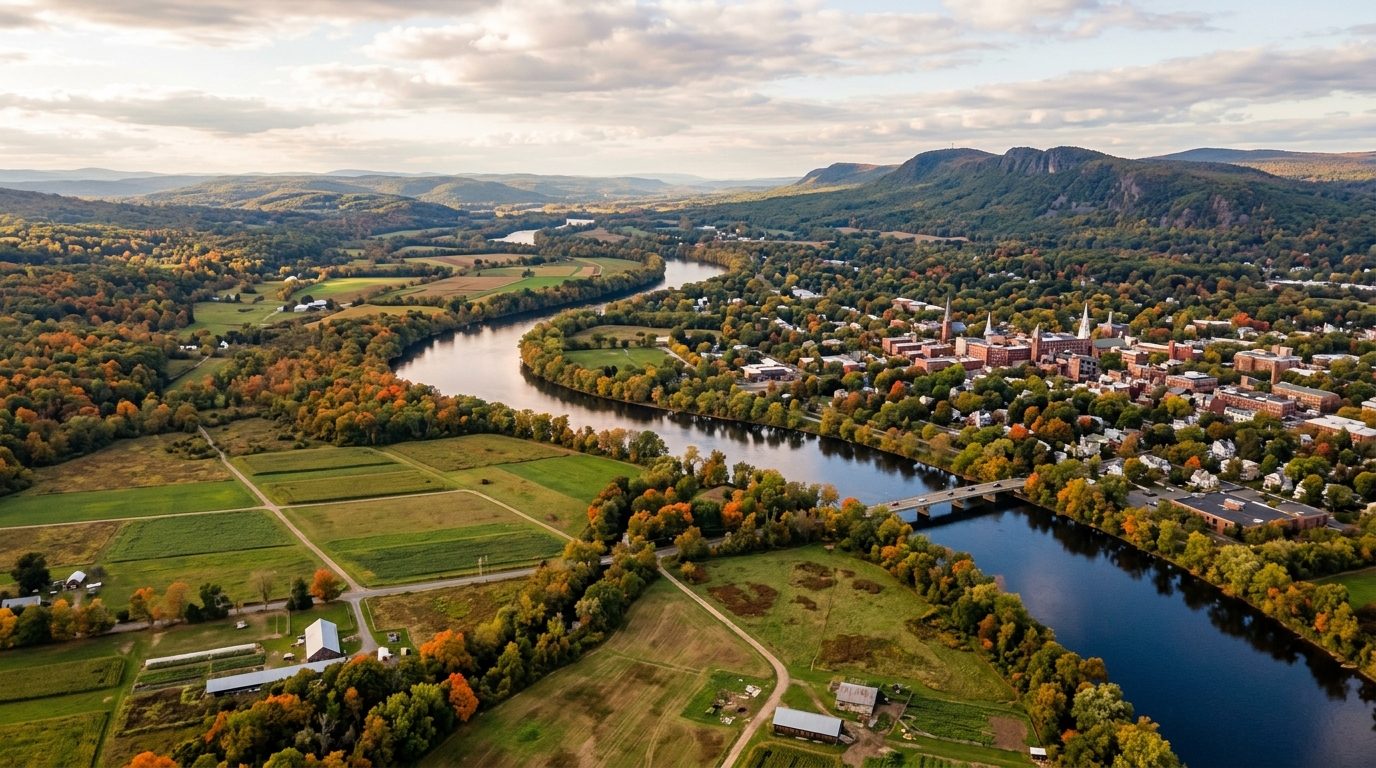
The Amherst-Northampton area sits in the Pioneer Valley, where the Connecticut River runs north-south through Hampshire County toward Connecticut. East of the river, the Holyoke Range separates the valley towns from lower ground around Belchertown, Granby, and Ware; west of the river, land rises into the Berkshire foothills, home to hill towns such as Chesterfield, Cummington, Goshen, Huntington, Middlefield, Pelham, Plainfield, Southampton, Westhampton, Williamsburg, and Worthington. Valley towns such as Hadley and Hatfield sit on fertile alluvial soil farmed since the colonial period, while the hill towns are forested and rural. Housing mirrors this geography: village centers retain antique capes, colonials, and farmhouses; former mill villages such as downtown Ware and South Hadley Falls carry brick multi-family housing from the textile era; and the hill towns favor widely spaced single-family homes on large parcels, often on private wells and septic rather than municipal utilities.
Homes closest to the historic downtowns of Amherst and Northampton and to the Five College campuses tend toward the upper end of the local market, reflecting demand from faculty, staff, and families wanting walkable access to campus, shops, and cultural activity. Village centers with similar character, including Florence and Leeds in Northampton, the South Hadley center near Mount Holyoke College, and Williamsburg’s village core, follow the same pattern. Outlying hill towns and former mill communities generally sit lower, due to distance from campus and hospital jobs, longer rural commutes, and the cost of a well and septic system in place of public water and sewer. Ware and parts of Belchertown, built around nineteenth-century mill and institutional operations now closed, show a similar effect, with downtowns still adjusting to a service and commuter economy.
The area’s economy is anchored by higher education. Amherst is home to the University of Massachusetts Amherst, flagship of the state university system and one of the region’s largest employers, along with Amherst College and Hampshire College; Smith College is based in Northampton and Mount Holyoke College in South Hadley, and the five form the Five College Consortium. Cooley Dickinson Hospital in Northampton, affiliated with Massachusetts General Hospital, is another major employer. Agriculture remains active in the valley towns, particularly Hadley and Hatfield, where family farms grow produce in river-bottom soil, some kept out of development under the state’s Agricultural Preservation Restriction program. Belchertown is converting its former state school campus into Carriage Grove, a mixed-use development of housing, business space, and public land.
The climate follows a four-season New England pattern, with cold, snowy winters harder in the hill towns than the valley, and warm, humid valley summers. Property taxes are set independently by each town; services vary between valley towns, with fuller municipal water, sewer, and school infrastructure, and hill towns, which rely on regional school districts and leaner budgets. The Pioneer Valley Transit Authority connects Amherst, Northampton, and the Five College campuses by bus, free with a college ID; Amtrak’s Valley Flyer serves Northampton but no longer stops in Amherst. Amherst’s rental market is shaped by its student population: zoning limits unrelated occupants per unit, and landlords must register rental properties annually, rules investment buyers should confirm before closing. Buyers in valley towns should check floodplain maps and confirm whether a parcel carries an agricultural preservation restriction; hill-town buyers should verify well water, septic condition, and road maintenance.
Cities and Towns in the Amherst Town Metro Area
Notable Communities and Neighborhoods
Amherst Town Real Estate Market FAQ
How is the Amherst-Northampton real estate market organized geographically?
The market splits along the Connecticut River. East-of-river valley towns like Hadley, Hatfield, Belchertown, Granby, and Ware sit on flatter farmland and former mill sites, while west-of-river hill towns, including Chesterfield, Cummington, Goshen, Huntington, Middlefield, Pelham, Plainfield, Southampton, Westhampton, Williamsburg, and Worthington, are rural and forested in the Berkshire foothills. Amherst, Northampton, and South Hadley, home to the Five College campuses, form the market’s core, with village centers such as Florence, Leeds, and North Amherst functioning as distinct sub-markets within those towns.
Which areas are priciest, and why?
Areas within walking distance of downtown Amherst, downtown Northampton, and the Five College campuses tend to carry the strongest demand, driven by faculty, staff, and families who want walkable access to campus jobs, shops, and year-round cultural programming. Similar village centers with historic, walkable cores, such as Florence and Leeds in Northampton or the South Hadley center near Mount Holyoke College, follow the same pattern. Outlying hill towns and former mill communities such as Ware trend lower, largely due to distance from campus and hospital employment, longer commutes, and reliance on private wells and septic systems rather than municipal utilities.
What should buyers know about the student-rental market in Amherst?
Amherst has a large off-campus rental market tied to UMass Amherst, Amherst College, and Hampshire College. The town enforces zoning limits on the number of unrelated occupants allowed per dwelling unit and requires annual registration of residential rental properties. Buyers considering an investment property in Amherst should verify a property’s occupancy classification and rental registration status with the town before purchasing, since these rules directly affect how a unit can legally be rented.
What region-specific risks should buyers verify before purchasing here?
In the valley towns, buyers should check floodplain maps along the Connecticut River and its tributaries, since low-lying farmland and riverside parcels can carry flood exposure, and should confirm whether a parcel is subject to an Agricultural Preservation Restriction limiting future development. In the hill towns, buyers should verify well water quality, septic system condition and age, and whether local roads receive year-round town maintenance, since rural infrastructure and service levels vary considerably from town to town across Hampshire County.
Nearby Markets