
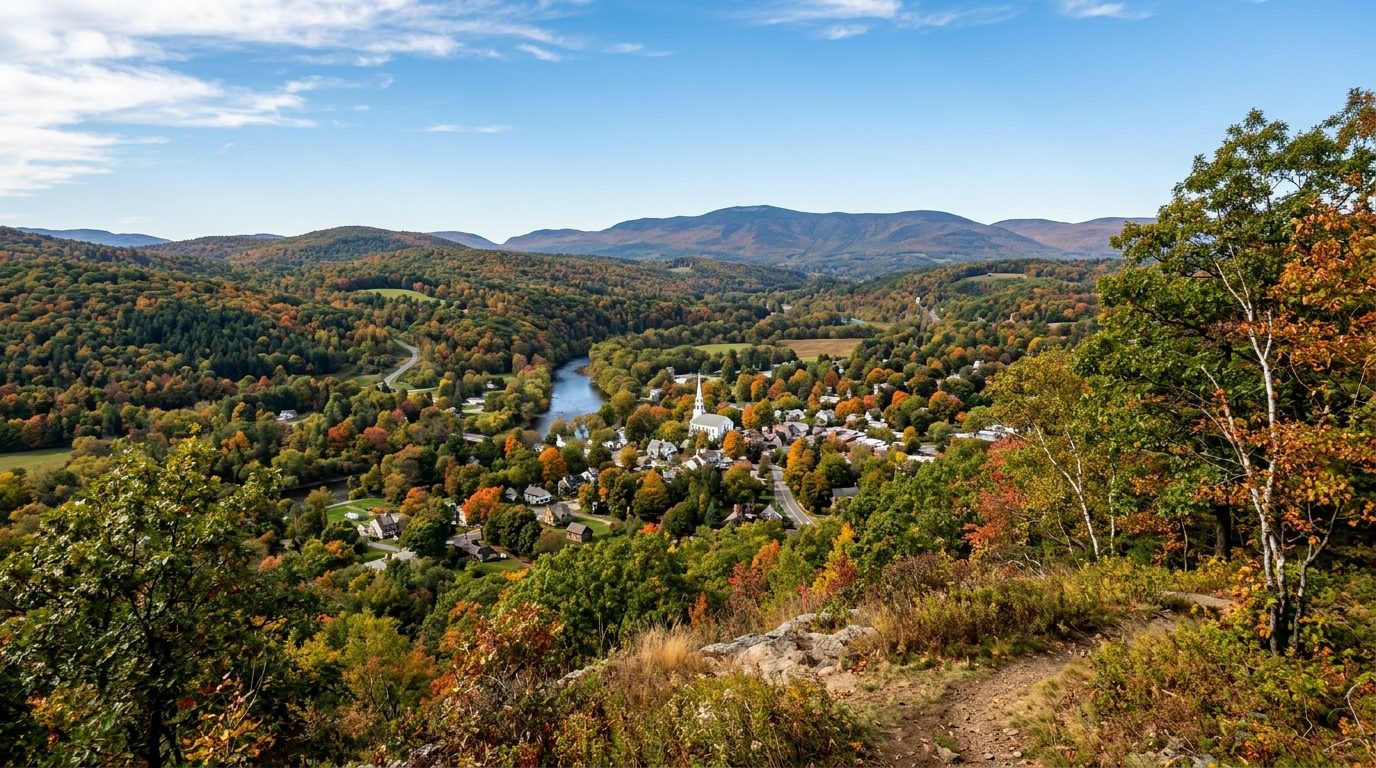
Current real estate market data, news and analysis for the Pittsfield, MA metropolitan area — 128,224 residents across Berkshire county.
Data as of May 2026. Sources: Redfin Data Center, U.S. Census Bureau.
Latest Pittsfield Real Estate News
Coverage of this market is coming soon. Browse all housing market news.
Pittsfield Real Estate Market Overview
Berkshire County occupies the far western edge of Massachusetts, bordered by New York and Connecticut, and split by two mountain ranges: the Taconic range along the western edge and the Berkshire Hills, part of the Appalachian chain, through the eastern half. Between them run north-south river valleys, chiefly the Housatonic in the south and the Hoosic in the north, with Mount Greylock rising as the state’s highest point near the Vermont line. The elevation and inland location bring a colder, snowier climate than coastal Massachusetts, shaping where and how people built. Housing stock reflects two eras: dense village and mill-town construction from the industrial period in Pittsfield, Dalton, and Adams, and large estate and cottage building from the resort era in the southern county, when wealthy families built country houses to escape summer heat elsewhere. Hill towns retain scattered farmhouses and camps, and lake and mountain properties were developed later as vacation retreats.
Price tiers track this history. Southern Berkshire towns such as Lenox, Stockbridge, West Stockbridge, and Great Barrington sit at the upper end of the market, supported by cultural institutions, walkable village centers, proximity to New York and Connecticut, and well-preserved historic estates. Pittsfield, the county seat and largest population center, contains a wide range of housing, from neighborhoods built for mill and factory workers to postwar subdivisions, and generally trades below the southern county. Former manufacturing towns such as Adams and Cheshire carry older, denser housing tied to their mill-town origins. Rural hill towns, including Peru, Savoy, Windsor, Florida, Washington, and Hancock, have thin, uneven housing markets shaped by distance from services, seasonal roads, and reliance on well water and septic systems.
The economy has shifted from a single dominant manufacturer toward a varied base. General Electric was once the largest employer in Pittsfield; its former operations were sold and now operate as General Dynamics Mission Systems, continuing defense and submarine-systems manufacturing in the city. Crane Currency, based in Dalton, has manufactured currency paper for the federal government since the nineteenth century and remains one of the county’s oldest employers. Berkshire Health Systems, anchored by Berkshire Medical Center in Pittsfield, is a major regional healthcare employer. Higher education adds to the base, led by Williams College in Williamstown and Berkshire Community College in Pittsfield. Tourism and the arts form another pillar, drawn by Tanglewood, summer home of the Boston Symphony Orchestra, in Lenox, Jacob’s Pillow Dance Festival in Becket, the Norman Rockwell Museum in Stockbridge, and Kripalu Center in Stockbridge.
Buyers should weigh the region’s winter climate and rural infrastructure. Many homes outside village centers rely on private wells and septic systems rather than municipal water and sewer, so capacity, yield, and water quality are worth confirming with the town board of health. Older housing stock, common countywide, can carry deferred maintenance and aging heating systems that warrant inspection. Land-use authority is fragmented among small town governments rather than centralized countywide, so zoning and permitting differ town to town. Southern Berkshire towns have a notable second-home and vacation-rental presence tied to seasonal cultural programming, affecting year-round supply and listing turnover around peak season. Properties near the Housatonic or Hoosic rivers or in low-lying valleys should be checked against flood zone maps, and homes on mountain roads should be checked for private road maintenance agreements and winter access.
Cities and Towns in the Pittsfield Metro Area
Notable Communities and Neighborhoods
Pittsfield Real Estate Market FAQ
How is the Pittsfield, MA metro area organized geographically?
The metro is coterminous with Berkshire County, running the full width of Massachusetts between the New York and Connecticut borders. It is generally described in three sub-regions: northern Berkshire around Williamstown and Adams, central Berkshire around Pittsfield and Dalton, and southern Berkshire around Lenox, Stockbridge, and Great Barrington. Each sub-region has its own village centers, and most zoning, permitting, and school decisions are handled at the individual town level rather than countywide.
Which areas of the Berkshires tend to be pricier, and why?
Southern Berkshire towns, particularly Lenox, Stockbridge, West Stockbridge, and Great Barrington, tend to command higher prices. This reflects a concentration of cultural institutions, walkable historic village centers, well-preserved estate-era homes, and closer driving proximity to the New York and Connecticut population centers. Pittsfield and the more rural hill towns generally offer a broader range of price points, with mill-town neighborhoods and remote hill properties at the lower end.
What should buyers verify locally before purchasing in the Berkshires?
Because zoning, building codes, and permitting are administered separately by each town rather than by the county, requirements can vary meaningfully even between adjacent towns, so buyers should check directly with the relevant town hall. Outside village centers, private wells and septic systems are common rather than municipal water and sewer, so well yield, water quality, and septic system condition and capacity are worth confirming with the local board of health. Road status also matters, since some mountain and rural roads are private and maintained by the abutting property owners rather than the town.
What is the seasonal or second-home dynamic like in this market?
Southern Berkshire in particular has a long-standing second-home and vacation-rental presence tied to summer cultural programming such as symphony and dance performances, which draws seasonal residents and visitors from the greater New York and Boston areas. This seasonal pattern can affect how much year-round housing is available, when properties come to market, and how a given town regulates short-term rentals, so buyers should ask about occupancy patterns and any local short-term rental rules for a specific property.
Nearby Markets