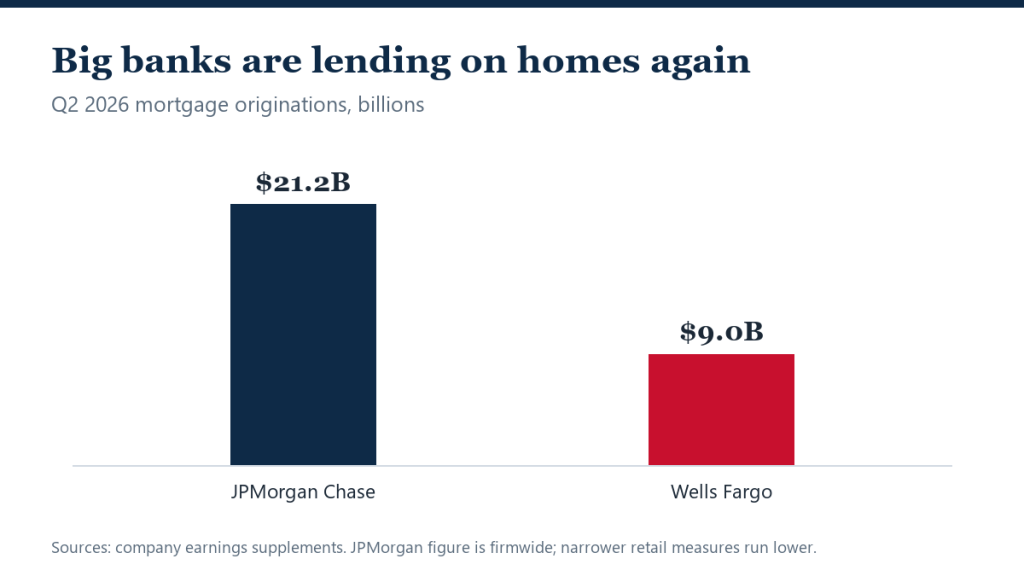
The nation’s largest banks are lending on homes again. Second-quarter earnings supplements showed a sharp mortgage rebound at the money-center banks, with average quarter-over-quarter origination growth of roughly 32% across JPMorgan Chase, Wells Fargo and Bank of America.
The absolute numbers require care with definitions — a caution this story earns honestly: JPMorgan’s own supplement lists $21.2 billion in firmwide mortgage originations, while narrower retail-channel measures cited in trade coverage run around $17.2 billion. Wells Fargo reported $9.0 billion. Different lines, same direction: up, meaningfully.
What the quarter showed
- The trend: roughly 32% average quarter-over-quarter origination growth across the three largest bank lenders, based on the banks’ quarterly disclosures.
- JPMorgan: $21.2 billion firmwide per its Q2 supplement (narrower channel measures run lower — definitions matter).
- Wells Fargo: $9.0 billion in the quarter.
- Context: banks are growing from a diminished base after years of ceding share to nonbank lenders.
Expansion or reconquest?
The question that matters for borrowers is whether depositories are growing the mortgage pie or taking share back from the nonbanks that dominated the post-2020 market. The evidence leans toward both: overall origination forecasts are rising — Fannie Mae projects $2.3 trillion for 2026 — while banks’ funding-cost advantages grow more valuable in a higher-rate world, and jumbo lending, a bank stronghold, is the one credit segment loosening.
Bank re-entry changes competitive texture: depositories cross-sell mortgages against deposits and wealth relationships rather than living on gain-on-sale margins, which lets them price aggressively for preferred customers — particularly jumbo borrowers — when they choose to compete.
What it means
For borrowers, more aggressive bank competition is unambiguously good: quote at least one large bank alongside nonbank lenders and brokers, especially for jumbo loans or where existing-customer pricing applies. For the industry, watch whether banks sustain appetite into any refinance wave — their balance-sheet capacity is the sleeping variable in every refi-boom scenario.
Bank of America rounds out the trio in the group, and the three banks’ collective ~32% quarter-over-quarter jump landed while overall market volume grew far less — the clearest evidence that this is share reconquest, not just a rising tide. The channels tell the story: correspondent purchases (buying closed loans from smaller lenders) can scale bank volume quickly, and jumbo portfolios — loans banks keep on balance sheet — are where their deposit-funding advantage is decisive.
The strategic backdrop is deposit economics. Banks flush with low-cost deposits can hold mortgages profitably at rates that force gain-on-sale nonbanks to choose between margin and volume. That advantage grows with every quarter rates stay elevated — and it positions banks to pounce on any refinance wave with pricing nonbanks struggle to match, particularly for their existing wealth-management clients.
For the mortgage industry’s workforce and vendors, bank re-entry also reshapes where hiring happens: correspondent and private-bank channels staff differently than retail branch networks, and the nonbanks that dominated 2020–2021 hiring are the ones facing renewed margin pressure.
FAQ
Why do JPMorgan’s numbers differ across reports?
Definitions: firmwide originations ($21.2B in its supplement) include correspondent and private-bank channels that narrower retail measures exclude. Both are accurate for what they measure.
Are banks better than nonbank lenders for a mortgage?
Neither is categorically better. Banks can price relationship discounts and hold loans; nonbanks often move faster and serve a wider credit box. Compete them against each other.
Why did banks retreat from mortgages before?
Post-2008 capital rules, servicing costs and litigation made mortgages less attractive for banks, opening the field to nonbanks. Higher rates have shifted the economics back toward balance-sheet lenders.