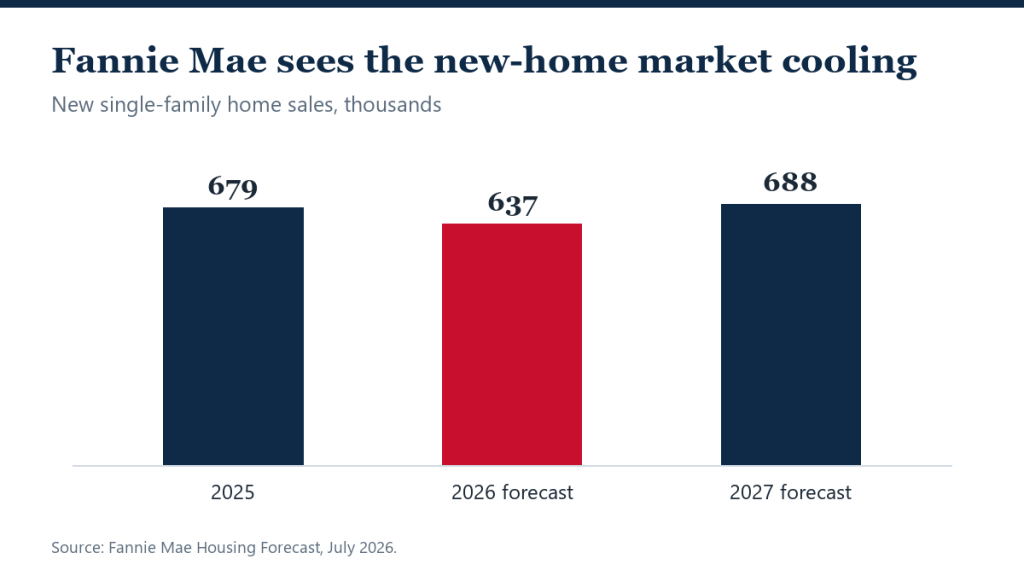
Fannie Mae expects 2026 to end almost exactly where it started. The mortgage giant’s July forecast puts total home sales at 4.763 million for the year — up just 0.2% from 2025 — with modest growth in existing-home sales offset by a 6.1% pullback in new single-family sales.
Beneath the flat headline, the forecast describes a market slowly rebalancing: existing-home sales edging up 1.2% to 4.125 million as more owners accept prevailing rates, new-home sales retreating to 637,000 as builders work off inventory, and the average 30-year mortgage rate easing to 6.3% for the year.
The forecast at a glance
- Total 2026 home sales: 4.763 million, up 0.2% from 2025.
- Existing-home sales: 4.125 million, up 1.2%.
- New single-family sales: 637,000, down 6.1% from 679,000 in 2025.
- Average 30-year rate: 6.3% for 2026, down from 6.6% in 2025.
- Home-price growth: 2.3% for 2026 on Fannie Mae’s index, slowing to about 1.0% in 2027.
- Originations: $2.30 trillion forecast for 2026, up from $1.96 trillion, with the refinance share rising to 37%.
Why new homes are the soft spot
The new-home pullback reflects a builder market still digesting its own success. Through the inventory-starved years, builders won share by being the only game in town and by buying down mortgage rates; with resale supply recovering and builder confidence slipping as incentives spread, that advantage is fading. Fannie Mae’s forecast has single-family housing starts falling 4.2% in 2026 before recovering in 2027.
For buyers, the practical takeaway is leverage: builders defending a shrinking sales pace tend to sweeten deals rather than cut list prices, extending the rate buydowns and closing credits that already define new-construction shopping in 2026.
A refinance market quietly rebuilding
The forecast’s most striking internal number is originations: $2.30 trillion in 2026, up nearly 17% from 2025, with refinance volume growing from $573 billion to $852 billion. A 37% refinance share — up from 29% — implies a meaningful cohort of 2023–2024 borrowers with rates above 7% finding it worthwhile to refinance into the low 6s, a dynamic covered in RealtyWire’s refinance break-even guide.
What it means
Fannie Mae’s outlook argues against waiting for a dramatically different market. Sales roughly flat, prices growing 2.3% and rates averaging 6.3% describe 2026 as a year of grinding normalization, not a breakout in either direction — with the more meaningful improvement (6.8% sales growth, sub-2% price growth) penciled in for 2027.
The construction side of the forecast tells the same story from another angle. Total housing starts are projected to slip about 1.0% to 1.34 million in 2026, with single-family starts down 4.2% before recovering in 2027 — builders throttling supply to protect margins rather than chasing volume into a soft patch.
Fannie Mae’s price outlook reads as deceleration, not decline: 2.3% home-price growth in 2026 easing to roughly 1.0% in 2027 on its index. Pair that with incomes growing near 4% and the forecast quietly describes affordability healing the slow way — wages catching up to prices over years rather than prices correcting over months.
The 2027 line is the optimistic kicker: total sales jumping 6.8% to 5.09 million with rates still averaging 6.3%. That is an implicit bet that pent-up demand — millions of postponed moves — rather than cheaper money powers the next leg of recovery.
FAQ
Does Fannie Mae expect mortgage rates to fall?
Modestly. The forecast averages 6.3% for the 30-year fixed in 2026 — down from 6.6% in 2025 — and holds 6.3% through 2027. It does not project a return to pandemic-era rates.
Why would existing-home sales rise while new-home sales fall?
Supply is normalizing. As more homeowners list, resale competition improves and buyers depend less on builders. New-home sales fall not because demand collapses but because resale alternatives return.
How reliable are these forecasts?
They are informed estimates, updated monthly, and Fannie Mae notes rate forecasts are based on end-June market conditions. Treat the direction as more meaningful than any single decimal.