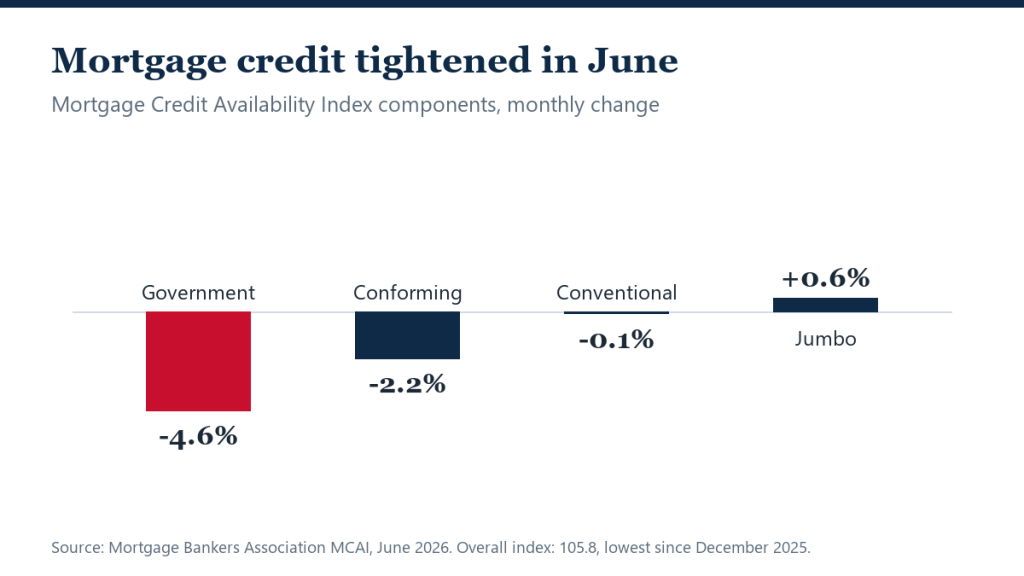
Mortgage credit got harder to obtain in June. The Mortgage Bankers Association’s Mortgage Credit Availability Index fell 2.0% to 105.8 — its lowest reading since December 2025 — with nearly all of the tightening concentrated in government-backed lending.
The Government MCAI, covering FHA, VA and USDA programs, dropped 4.6% as lenders pulled back streamline-refinance offerings for borrowers with high loan-to-value ratios or lower credit scores. Jumbo credit actually loosened, rising 0.6% on new non-QM programs — a reminder that the credit squeeze is landing on the borrowers least able to route around it.
June’s index in detail
- Overall MCAI: 105.8, down 2.0% — lowest since December 2025 (benchmark: 100 = March 2012).
- Government index: down 4.6%, driving most of the decline.
- Conventional index: down 0.1%; within it, conforming fell 2.2% while jumbo rose 0.6%.
“A contraction in government loan programs accounted for a significant share of the June decrease, as lenders pulled back on FHA and VA streamline refinance loan programs, particularly those for high LTV and low credit score borrowers,” said Joel Kan, the MBA’s vice president and deputy chief economist. “The jumbo index increased slightly, supported by new non-QM programs.”
Who feels this first
Streamline refinances exist precisely for stretched borrowers — FHA and VA homeowners who need a lower payment without a full requalification. Trimming those programs for high-LTV, lower-score applicants narrows the exit for exactly the households most exposed to payment stress, a squeeze that compounds the eligibility math covered in RealtyWire’s FHA-versus-VA comparison.
The split with jumbo lending is the tell: banks and investors remain comfortable extending credit to wealthy borrowers while tightening standards at the entry level — mirroring the two-speed pattern running through 2026’s broader affordability data.
What borrowers should do
Credit availability is cyclical, and a 2% monthly move is meaningful but not a lockout. Borrowers with thin credit or small down payments should expect more documentation and stricter overlays, shop more than one lender — overlays differ significantly — and mind their debt-to-income ratio, the metric most likely to decide a marginal file in a tightening month.
The jumbo uptick has its own subplot. The new programs supporting it are largely non-QM — loans outside the qualified-mortgage box that serve self-employed borrowers, investors and others with complex income. Kan noted the increase is consistent with market data showing non-QM taking a larger share of originations, meaning the private market is expanding credit at exactly the moment government programs retreat.
Context tempers the alarm: the index is benchmarked to 100 in March 2012, the bottom of the post-crisis credit freeze. At 105.8, overall mortgage credit is only marginally looser than that trough — 2026’s entire lending regime is conservative by historical standards, and June’s move tightens within it. This is nothing like the loose-credit era that preceded 2008; if anything, the risk runs the other way, with creditworthy marginal borrowers priced out of programs designed for them.
FAQ
What does the MCAI actually measure?
It condenses underwriting criteria — credit scores, loan types, LTV limits — from more than 95 lenders and investors into one index. Falling numbers mean fewer loan programs and stricter standards; the index is benchmarked to 100 in March 2012.
Does tighter credit mean higher mortgage rates?
No — they measure different things. Rates price the loan; availability determines who qualifies at all. June tightened availability even as rate expectations eased.
Are FHA and VA loans harder to get now?
At the margins, yes — June’s pullback centered on streamline refinance programs for higher-LTV, lower-score borrowers. Standard FHA and VA purchase lending remains widely available.