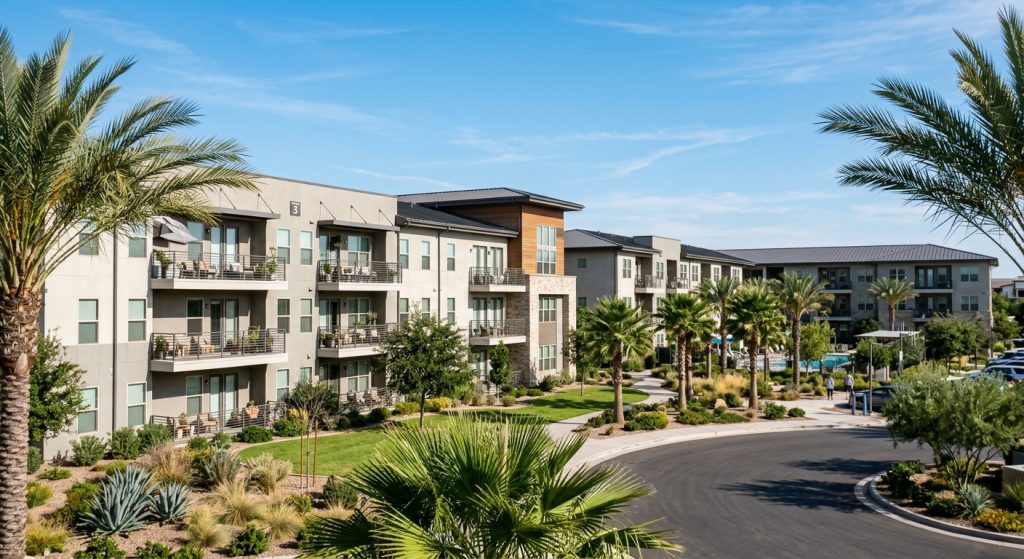
KBRA has assigned a preliminary rating to a $1.036 billion commercial mortgage-backed securities (CMBS) loan collateralized by a 6,041-unit portfolio of 15 apartment complexes spread across seven states, the rating agency said in an Aug. 3 release. The single-borrower securitization, dubbed BX 2026-LBTY, is one of the larger multifamily CMBS deals to reach the market this year and offers a rare public look at how rating agencies are valuing large apartment portfolios even as lenders keep financing them.
The deal is structured around a floating-rate, interest-only mortgage with an initial two-year term and three one-year extension options, according to KBRA. Borrowers only make interest payments during that window, a common structure for large institutional multifamily loans that gives sponsors flexibility to refinance or sell once rates move or leases roll.
A seven-state, 6,000-unit collateral pool
The loan is secured by the borrower’s fee-simple interest in 15 properties, ranging in size from 150 units to 1,675 units, built between 2001 and 2019 and averaging roughly 15 years old. As of July 2026, the portfolio was 94.1% leased, according to the KBRA release.
Geographically, the collateral leans heavily toward the Sun Belt. Florida accounts for the largest share at 25.8% of the portfolio, followed by Texas at 24.6%, Georgia at 21.0%, Arizona at 14.9% and Tennessee at 6.6%, with the remainder spread across two additional states. KBRA’s release did not name the borrower or the individual properties; those details are contained in a pre-sale report that requires a KBRA account to access.
KBRA’s analysis leaned on its North American CMBS Property Evaluation Methodology and its North American CMBS Single Borrower & Large Loan Rating Methodology, along with its Global Structured Finance Counterparty Methodology for assessing counterparty risk. The review incorporated third-party engineering, environmental and appraisal reports as well as KBRA’s own site inspections, the agency said.
KBRA’s numbers run well below the deal’s own appraisal
The gap between KBRA’s underwriting and the deal’s own appraisal is the most notable figure in the release. KBRA calculated net cash flow for the portfolio at approximately $68.6 million, which it said is 5.6% below the issuer’s own net cash flow estimate. More striking, KBRA’s valuation of the portfolio came in at $899.1 million — 37.3% below the appraiser’s aggregate as-is value.
That discount pushes KBRA’s own loan-to-value calculation, which it calls the in-trust KBRA Loan to Value (KLTV), to 115.2%. In practical terms, KBRA’s conservative valuation puts the $1.036 billion loan above the value it assigns to the underlying real estate — a signal of just how cautiously rating agencies are now marking large multifamily collateral pools, even for a portfolio that is more than 94% leased.
The rating action was led by KBRA analyst Justin Audette, with Kieran Hall, a director, and Nitin Bhasin, KBRA’s senior managing director and global head of CMBS, chairing the rating committee. KBRA is registered with the U.S. Securities and Exchange Commission as a nationally recognized statistical rating organization and is one of the more active raters of CMBS conduit and single-borrower deals.
What it means
The facts here are limited to what KBRA disclosed: loan terms, portfolio composition and KBRA’s own valuation metrics. The identity of the borrower and the specific properties were not included in the public release. That KBRA’s valuation runs more than a third below the deal’s appraisal is KBRA’s own analytical judgment, not a market consensus, and reflects the wide gap that has opened between appraised values and rating-agency valuations across CMBS deals as agencies apply more conservative cap-rate and cash-flow assumptions than they did earlier in the cycle.
The deal itself is evidence that large, single-borrower multifamily securitizations are still getting done despite that caution — a data point that sits alongside broader signs of stress in the CMBS market. RealtyWire reported last week that CMBS distress hit a 2026 high of 10.91% in July, though that increase was concentrated in office loans rather than multifamily. Large securitizations tied to other asset classes have also continued moving through the pipeline this year, including a $1.18 billion securitization Aligned Data Centers closed to finance its data center portfolio.
What to watch: KBRA’s rating on BX 2026-LBTY is preliminary. A final rating, along with the size of each bond class and pricing on the securitization, typically follows once the deal is marketed to bond investors. Any move by KBRA to widen or narrow the gap between its valuation and the deal’s appraisal in the final report would be a signal of how the agency’s view of Sun Belt multifamily fundamentals is shifting heading into the back half of 2026.