Maryland Gov. Wes Moore signed two executive orders in Annapolis on Oct. 1, 2026 aimed at the supply side of the state’s housing shortage: one to push modular construction into the mainstream, the other to create a standing team charged with clearing the permitting, licensing and certification backlogs that hold development up.
The orders — EO 01.01.2026.17, “Housing Innovation,” and EO 01.01.2026.18, establishing the Governor’s Permitting and Licensing Acceleration Team — are posted on the governor’s executive orders page and were announced in a statement from the governor’s office.
“Maryland’s housing crisis demands that we move swiftly, think creatively, and deliver solutions that will ease housing cost burdens for our people,” Moore said in the statement, describing the orders as “breaking the barriers to construction and implementing necessary reform to our permitting, licensing and certification process.”
A state bet on modular housing
The Housing Innovation order creates a Maryland Housing Innovation Incubator inside the Department of Housing and Community Development, charged with developing housing policy through research and pilot programs, and a Housing Innovation Advisory Council to steer it — identifying funding sources, setting research priorities and recommending legislative, regulatory and budgetary changes.
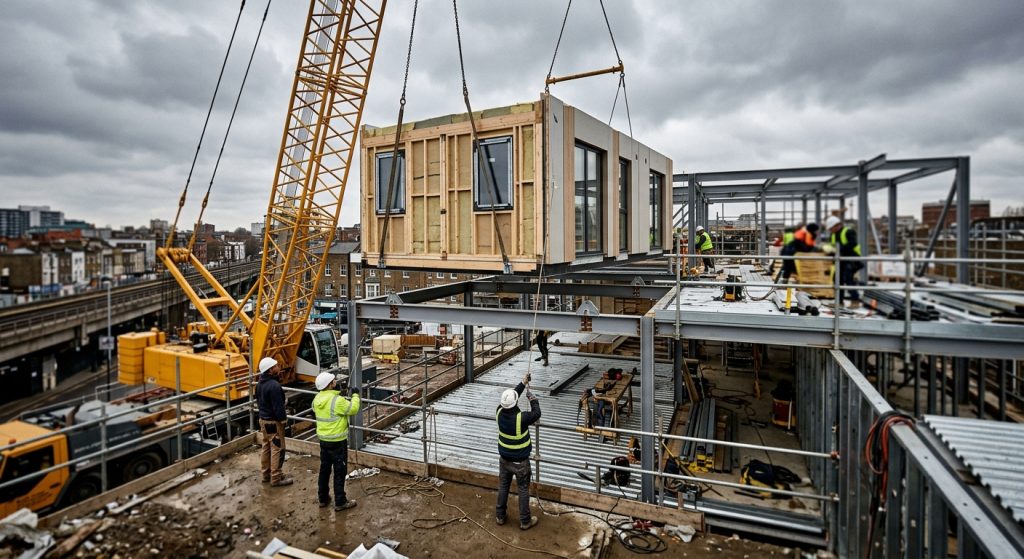
The operational core of the order is a Governor’s Initiative to Accelerate Modular Housing Construction. It directs the state to modernize regulations governing modular building, develop statewide pre-approved building plans and provide technical assistance to local governments. On our reading, the pre-approved plans are the piece most likely to move costs: they shift design review from a project-by-project negotiation toward a standard menu, and repeated plan review is where modular construction’s factory savings tend to get spent back.
A companion state Modular Workforce Partnership is tasked with building training curricula and outreach for modular work, creating on-the-job construction training for Maryland Corps and Service Year cohorts and high school-level registered apprentices, and expanding the mandate of the Baltimore Vacants Reinvestment Council to support local workforce development.
“More housing at all sizes and price points creates more opportunities for Marylanders — from the young adult looking to put down roots to the senior hoping to downsize,” said Jake Day, secretary of the Maryland Department of Housing and Community Development.
A permitting team with a dashboard
The second order establishes the Permitting and Licensing Acceleration Team, known as PLAT, to run statewide reform of permitting, licensing and certification. It carries forward the findings of the Maryland Coordinated Permitting Review Council, created under a 2024 Moore executive order on the state’s business climate.
PLAT’s assignment is to map existing processes, identify administrative, regulatory, statutory, operational and technology barriers, help agencies implement improvements and recommend policy changes — with the stated qualifier that Maryland’s health, safety, professional and environmental standards are maintained. Its initial focus is multifamily housing and other priority development projects.
The accountability mechanics are specified: process maps, standardized timelines and performance measures, applicant resources, a priority-project dashboard, and what the order calls concierge-style coordination for selected priority projects. The order also provides for voluntary partnerships with local jurisdictions, which is where most building permits actually get issued.
What the last order produced
The more useful read on whether this approach works is the record of its predecessor. Moore’s “Housing Starts Here” order, signed in September 2025, directed DHCD to work with the state transportation, environment and general services departments on state land, permitting timelines and project delivery. The governor’s office published its results to date:
Surplus state parcels totaling more than 300 acres have been identified and are under review by the Department of General Services and DHCD for housing suitability. DHCD’s reviews of multifamily housing project applications are running 26% faster. The Maryland Department of the Environment has cut average permit processing times by 25%, and the State Highway Administration’s on-time processing rate for permit applications has risen from 87% to 95%. Both agencies have created pathways for third-party permitting. And Maryland’s first State Housing Ombudsman, a position created seven months ago, has supported 50 individual housing development projects.
Those are process gains rather than unit counts, and the state did not publish a figure for homes delivered as a result. But a 25% reduction in environmental permit turnaround and a 26% faster multifamily review are the kind of numbers developers can underwrite, and they are considerably more concrete than the usual output of a housing executive order.
What the orders do not do
Neither order comes with new money attached, at least none described in the announcement. Both create bodies and assign directives, and the Housing Innovation Advisory Council’s charge explicitly includes “identifying potential sources of funding,” which is a fair signal that financing for the modular push has not been settled. Maryland’s separate affordable-housing spending runs on its own track; the administration announced a $17.6 million investment to create or preserve 555 units on Sept. 30.
The state has been working the demand side too, cutting mortgage rates by half a percentage point for teachers and first responders in September. Supply-side campaigns have meanwhile gained national backing, with major listing portals and homebuilders joining a joint housing supply campaign.
More development and commercial real estate coverage is collected on RealtyWire’s commercial page.