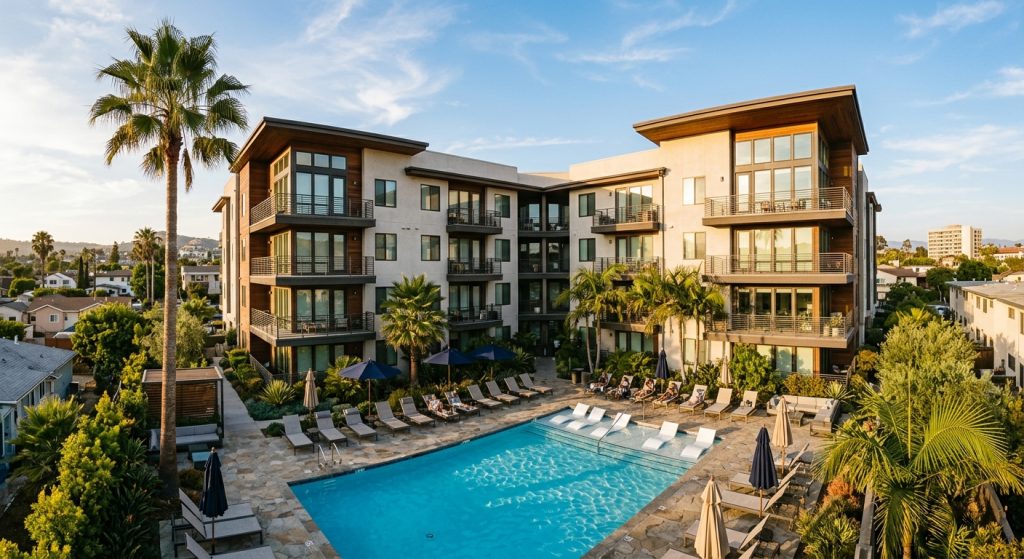
Camden Property Trust (NYSE: CPT) has closed the sale of its entire California apartment portfolio for approximately $1.625 billion, exiting the state as part of a broader push to shift capital toward faster-growing Sunbelt markets. The Houston-based multifamily REIT disclosed the closing alongside its second-quarter 2026 earnings, calling it a “significant strategic milestone” in its long-running effort to reduce coastal exposure.
According to Camden’s second-quarter operating results filed with the Securities and Exchange Commission, the company sold 11 operating communities totaling 3,620 apartment homes on July 29, 2026, for an aggregate sales price of about $1.625 billion. The portfolio had been classified as held for sale as of June 30 and was excluded from Camden’s same-property results for the quarter. The properties were concentrated in Southern California, split primarily between the Los Angeles-Orange County area and the San Diego-Inland Empire region. Camden did not name the buyer in its public filings, and no counterparty had been disclosed as of publication.
The transaction produced a trailing 12-month FFO yield of 5.6% and an AFFO yield of 5.2%, according to a recap of Camden’s second-quarter earnings call published by Yahoo Finance. Camden Chief Executive Officer Alex Jessett confirmed on the call that the $1.625 billion figure was stated before roughly $15 million in transaction costs, more than half of which stemmed from a management tax imposed by the City of Los Angeles on one of the transactions — a cost he cited as illustrative of the added expense of operating in that market.
Camden said approximately $0.9 billion of the sale proceeds will be used to retire outstanding balances on the company’s unsecured revolving credit facility and commercial paper program. The remainder has already been redeployed: Camden repurchased $694 million of its own common shares at an average price of $105.17, a move representing a 6.4% FFO yield, and closed on $645 million of Sunbelt acquisitions with an average property age of five years, plus two additional acquisitions and a land site awarded for $195 million. CFO Ben Fraker said on the earnings call that buying back Camden stock “remains the best investment” given the gap between the company’s share price and consensus net asset value, while Jessett went further, calling the shares a “screaming buy.”
What it means
Verified: Camden closed the $1.625 billion sale of its 11-community, 3,620-unit California portfolio on July 29, 2026, and disclosed the transaction in SEC filings tied to its second-quarter earnings. The FFO and AFFO yields, the $0.9 billion debt paydown, the $694 million buyback, and the $645 million in Sunbelt acquisitions are figures Camden itself reported.
Company framing: Camden’s executives describe the exit as a deliberate rebalancing toward higher-growth Sunbelt markets and as an efficient use of capital given the discount between Camden’s stock price and its NAV — characterizations from Jessett and Fraker on the earnings call rather than independently audited outcomes.
RealtyWire analysis: Camden is one of several large apartment REITs that have trimmed or discussed trimming California and other high-regulation coastal exposure in favor of Sunbelt growth markets in recent years. Whether this specific sale marks an acceleration of that industry-wide trend, rather than a company-specific portfolio decision, is not established by Camden’s disclosures alone and should be treated as an open question rather than a confirmed pattern. Notably, not every major California-exposed multifamily REIT is moving in the same direction — Essex Property Trust recently raised its guidance citing strong San Francisco rent growth, underscoring that Camden’s exit reflects its own portfolio strategy rather than a uniform retreat from the state.
The sale also came with a workforce cost: Camden said the transaction resulted in the departure of approximately 100 long-tenured employees who had worked at the California communities. The company’s pro forma net debt to EBITDA now stands at 4.5 times following the deal, and Camden maintains roughly 59,000 apartment homes across 15 major U.S. markets after the exit.
The disposal caps months of speculation about Camden’s California holdings. The portfolio had been marketed for sale since earlier in 2026, with early estimates putting its value near $1.5 billion before the final price came in higher. Camden’s move follows a period in which California apartment vacancy has fallen to multi-decade lows in some metros even as regulatory costs and tenant-protection rules have weighed on owner returns elsewhere in the state — a tension that helps explain why REITs can reach different conclusions about the market at the same time. Portfolio-level apartment trades of this size remain relatively rare; for comparison, Weidner’s recent 387-unit sale in Lynnwood, Washington closed for $112 million, a fraction of the scale of Camden’s transaction.
For apartment investors and REIT-watchers, the deal is a concrete data point on institutional appetite for large West Coast multifamily portfolios and on how public apartment REITs are using capital recycling — pairing asset sales with share buybacks and out-of-state acquisitions — to manage the gap between public market valuations and private market pricing. More coverage of multifamily transactions and REIT strategy is available on RealtyWire’s commercial real estate section.