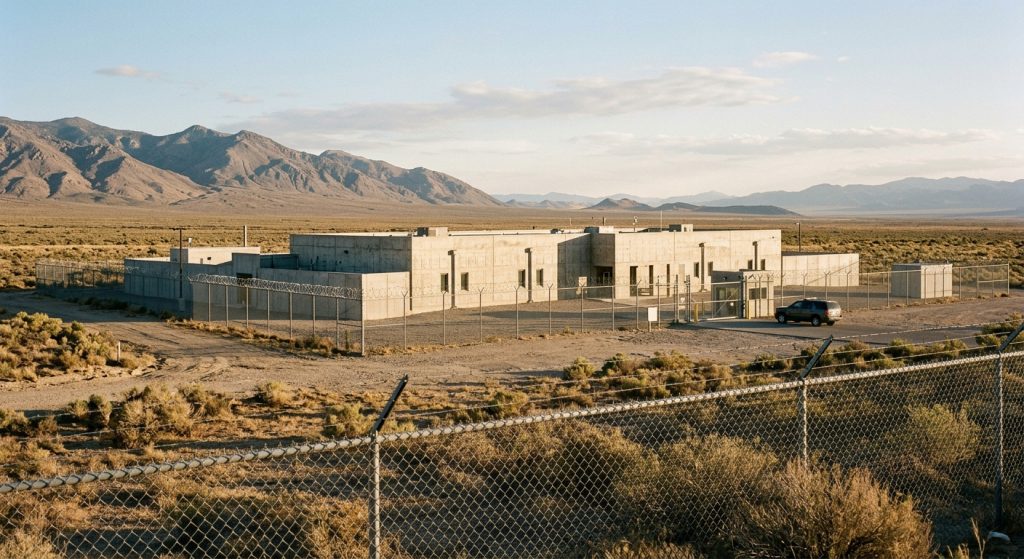
The GEO Group has sold a three-facility immigration detention complex in Adelanto, Calif., to the federal government for $950 million, a transaction that hands the Department of Homeland Security ownership of 2,644 beds while leaving the company that built them in place to run them.
GEO, a Boca Raton, Fla.-based government services contractor, said on Oct. 5, 2026 that it had completed the sales of the 1,280-bed Adelanto West ICE Processing Center, the 660-bed Adelanto East ICE Processing Center and the 704-bed Desert View Annex. The buyer, as the company describes it in the release filed with the Securities and Exchange Commission, is “the United States of America and its assigns, by and through the Department of Homeland Security.”
The $950 million is a gross figure. After federal and state taxes and transaction fees and expenses, GEO said it expects to receive roughly $705 million in net proceeds — meaning about a quarter of the headline price goes to tax and closing costs rather than to the seller. Spread across the 2,644 beds, the gross price works out to about $359,000 per bed.
GEO keeps the contract it has had for decades
What makes the deal unusual is what did not change. GEO said it expects to continue providing support services at all three facilities under its existing contract with U.S. Immigration and Customs Enforcement, a contract whose full term runs through Dec. 19, 2034 — the current term ends Dec. 19, 2029, followed by a five-year option period. Ownership of the real estate moved; the operator did not.
“We are pleased with the completion of these important asset sales to the U.S. federal government, and we look forward to continuing to provide high-quality secure support services under our existing long-term contracts with ICE,” said George C. Zoley, GEO’s chairman, chief executive officer and founder. “We are proud of our 40-year public-private partnership with ICE, and we stand ready to continue to assist the federal government in meeting its immigration enforcement priorities.”
Proceeds go to debt and a bigger buyback
GEO said it will use the net proceeds together with cash flow from operations to reduce debt, repurchase stock and for general corporate purposes. Alongside the closing, the board increased the company’s share repurchase authorization by $750 million, to $1.25 billion, effective through Dec. 31, 2029. The company noted the authorization does not obligate it to buy any particular amount of stock, and that repurchases will depend on market conditions, regulatory requirements and its credit agreement, among other factors.
The Adelanto closing may not be the last of its kind. GEO said it “remains engaged in an active process” for the sale of multiple other company-owned facilities to ICE, structured the same way: the government buys the asset, GEO keeps managing it under long-term support services contracts. The company was explicit about the limits of that disclosure, saying there is no definitive agreement in place, no precise timeline for any closing, and no assurance that further transactions will occur.
A federal buyer instead of a federal tenant
For real estate investors, the structure is the interesting part. The federal government is more familiar in this market as a tenant than as a buyer, and the usual way it occupies purpose-built property is under a lease — the model behind landlords such as Easterly Government Properties, which owns buildings leased to federal agencies and is valued on the durability of those leases. The Adelanto deal runs the other way. Rather than signing a longer lease or a new development contract, the government bought the buildings outright and retained the seller as the service provider.
On our reading, that is closer to an inverted sale-leaseback than to a standard disposition: the party that keeps using the asset is the one paying cash for it, and the party exiting ownership is the one that stays operationally attached. It also converts what had been a capital-intensive, owned-asset business line for GEO into a fee-for-services line, a shift investors in net-lease and sale-leaseback strategies will recognize as a change in both the risk and the return profile.
GEO’s remaining footprint is still substantial. The company said its worldwide operations include the ownership and/or delivery of support services for 97 facilities totaling approximately 76,000 beds — a figure that includes idle facilities and projects under development — with a workforce of up to roughly 20,000 employees across the United States, Australia, South Africa and the United Kingdom.
Whether the Adelanto template is repeated is now the open question, and GEO’s own language is the most reliable guide to it: an active process, no agreement, no date. More commercial real estate coverage follows the next closings as they are filed.