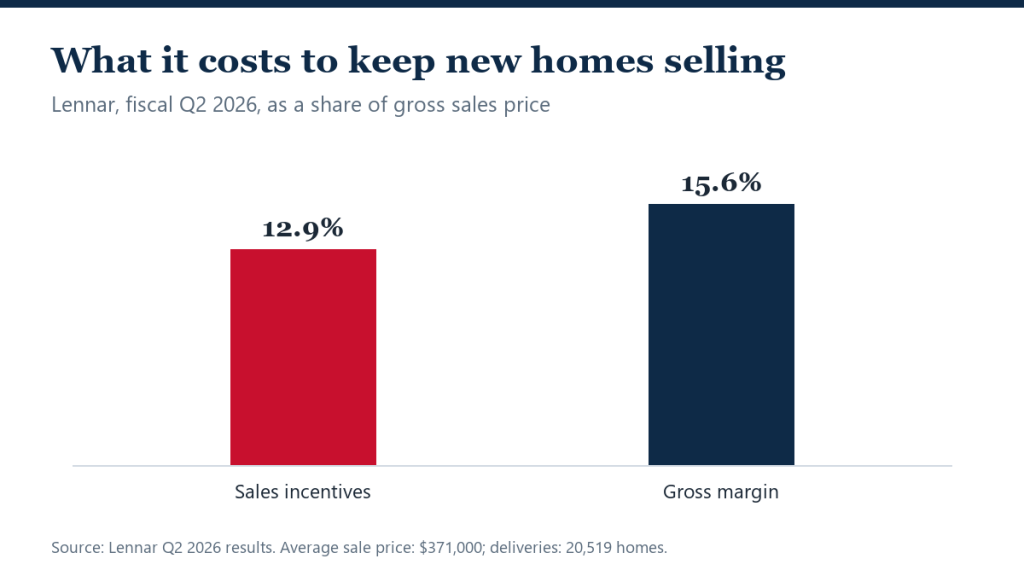
Lennar moved 20,519 homes last quarter — and paid visibly for the privilege. Sales incentives ran 12.9% of gross sales price, roughly $48,000 on the builder’s $371,000 average sale, as rate buydowns and concessions did the work list-price cuts used to do. Gross margin, at 15.6%, sat barely three points above the giveaway line.
The nation’s second-largest homebuilder is executing well inside a hard market: new orders of 21,749 exceeded deliveries, construction costs fell 2% sequentially, and cycle time hit a record-low 121 days. But management also trimmed full-year delivery guidance to 82,000–83,000 homes, citing rate pressure and geopolitical uncertainty — growth deferred in favor of margin defense.
Lennar’s quarter in numbers
- Deliveries: 20,519 homes; new orders: 21,749.
- Average sale price: $371,000 — reflecting approximately 12.9% in incentives.
- Gross margin: 15.6%, improved sequentially; guidance points to ~16% next quarter.
- Cycle time: a record-low 121 days, down from 132 a year ago.
- Full-year outlook: moderated to 82,000–83,000 deliveries.
Why builders pay incentives instead of cutting prices
A 12.9% incentive load and a headline price cut of the same size are very different tools. Buydowns attack the buyer’s actual constraint — the monthly payment — while protecting appraisals in every open community and the equity of every prior buyer. It is the same logic that governs the buydown-versus-price-cut decision for individual sellers, deployed at industrial scale.
Lennar’s guidance embeds a bet that the worst is passing: margin improving to ~16% “as incentive levels continue to moderate.” That matches Fannie Mae’s forecast of a 6.1% new-home sales pullback in 2026 before a 2027 recovery — builders trading volume now to avoid buying demand at any price.
What it means for buyers
New construction remains where the deals are explicit. A buyer comparing a resale listing to a new build should count the full incentive stack — buydown, closing costs, upgrades — against the builder’s price, per RealtyWire’s new-versus-existing comparison. Lennar’s own numbers say the average new-home buyer is capturing roughly $48,000 of help; buyers who do not ask for it are leaving the market rate on the table.
The operational quarter under the incentives was genuinely strong. Earnings ran $1.31 per share excluding mark-to-market losses; construction costs fell another 2% sequentially and are down 13% over several years; and finished-inventory discipline improved sharply, with unsold homes per community cut from 3.0 to 2.1 in a single quarter. Lennar is shrinking the inventory it must discount even as it discounts to move what remains.
The balance sheet tells the strategy: less than 5% of Lennar’s land sits on its books, total homebuilding inventory fell from $11.4 billion to $10.9 billion year over year, and the company ended the quarter with $1.8 billion in cash while buying back 5 million shares for $447 million. This is the asset-light model working as designed — volume flexes down, capital returns continue, and the land risk lives elsewhere.
Guidance embeds the sequence buyers should expect: average sale prices of $375,000–$380,000 next quarter with margins near 16% “as incentive levels continue to moderate.” Translation — the $48,000 help is not permanent policy. Buyers timing a new-construction purchase are negotiating against that clock.
FAQ
Is Lennar in trouble?
No — the quarter shows a profitable builder managing a demand problem: positive orders, improving margins and record build times, alongside honest guidance cuts. Watch incentive levels as the market’s fever chart.
Are incentives really worth $48,000?
That figure is simply 12.9% of the $371,000 average price — Lennar discloses the percentage, not a per-home dollar amount, and the mix varies by community and buyer.
Do incentives mean new homes are overpriced?
They mean the effective price is below the sticker. Appraisals are based on closed prices; a buydown-heavy market can leave list prices looking sturdier than net prices actually are.