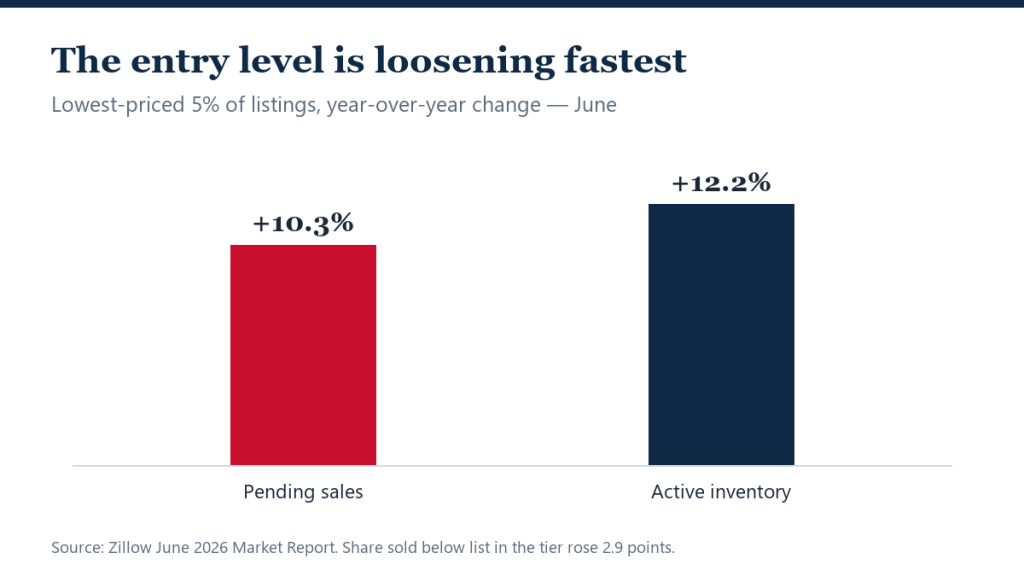
The hardest corner of the housing market is finally loosening. Newly pending sales in the lowest-priced 5% of listings rose 10.3% year over year in June while active inventory in that tier grew 12.2%, Zillow’s June market report shows — rare simultaneous gains in both choice and activity at the entry level.
Sellers in the tier are meeting buyers, too: the share of these homes selling below list price rose 2.9 percentage points from a year ago. For the first-time buyers who spent 2021–2024 outbid, out-cashed and out-waited, the affordable end is behaving like an actual market again.
June’s entry-level numbers
- Newly pending sales in the lowest 5% price tier: +10.3% year over year — outpacing the broader market.
- Active inventory in the tier: +12.2% — also faster than the market overall.
- Share selling below list: up 2.9 percentage points from a year ago.
Why the cheapest tier turned first
Three forces converged. Builders chasing affordability added smaller product; investors — historically the entry level’s toughest competition — pulled back to their lowest purchase volumes since 2020; and years of price appreciation pushed marginal listings down into the tier. The result is more supply exactly where demand is most rate-sensitive.
The improvement is relative, not absolute: entry-level affordability remains historically stretched, and every dollar of monthly cost still matters at this price point — which is why down payments and preparation decide who converts the new selection into a closing.
What it means for first-time buyers
The practical shift is negotiating room. A tier where homes increasingly sell below list rewards buyers who make disciplined offers backed by preapproval, ask for seller-paid rate buydowns, and stack down-payment assistance — nearly three-quarters of listings in some states now qualify for such programs. The window is genuine; entry-level windows historically close fastest when rates dip.
The tier’s outperformance stands out against a broader market that merely stabilized. Zillow’s same June report counted 381,125 sales nationally — up 9.2% from May and 5.9% from a year ago — while total active inventory of 1.39 million grew just 0.9% annually, the weakest gain in more than two years. The overall market is tightening at the edges even as its cheapest slice loosens; the two facts coexist because different buyers shop different tiers.
That contrast carries a warning for the window’s durability. With national inventory growth nearly stalled and new listings soft, the entry level’s 12.2% supply gain is the exception, not the rule — fed by builder product and investor retreat rather than by a broad seller return. Either force can reverse: builders throttle production when incentives bite, and investors return the moment rates or prices dip.
First-time buyers should also mind the quality distribution: the tier’s added inventory skews toward homes needing work, making a rigorous inspection and realistic repair budgeting the difference between a bargain and a money pit.
FAQ
What counts as entry-level in this data?
Zillow’s lowest-priced 5% of listings in each market — the tier below starter-home medians, which varies enormously by metro.
Is this happening everywhere?
No — like everything in 2026, it is regional. Supply-heavy Sun Belt and Texas metros show the clearest entry-level loosening; tight Northeastern markets much less.
Should first-time buyers wait for more improvement?
Waiting is a rate bet, not a price bet. Inventory is improving, but a meaningful rate decline would refill the tier with competition quickly — the entry level is always the first place bidding wars return.