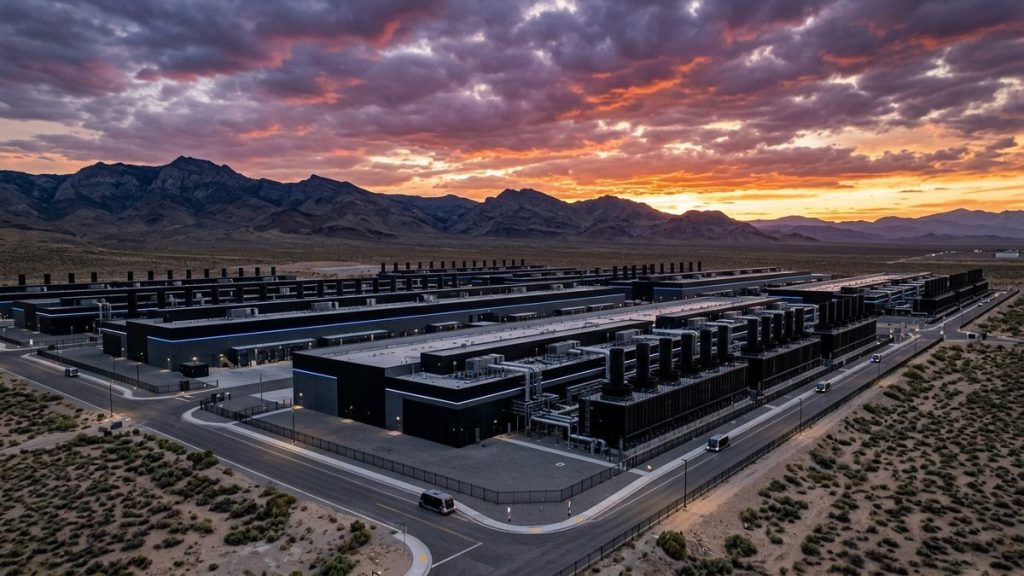
Switch, the Las Vegas-based data center operator taken private in 2022, has engaged banks for a potential initial public offering that could value the company at as much as $80 billion, Reuters reported, citing unnamed sources. Neither timing nor terms are confirmed — but even as a trial balloon, the number would test just how much the public markets will pay for AI-era digital infrastructure.
An $80 billion mark would represent a several-fold gain over the roughly $11 billion take-private just four years ago — a repricing driven almost entirely by what happened in between: the AI infrastructure boom that transformed data centers from niche real estate into the market’s scarcest growth asset.
What’s reported — and what isn’t
- Reported: Switch has engaged banks to explore an IPO; a potential valuation of up to $80 billion, per Reuters’ sources.
- Unconfirmed: timing, offering size, structure and whether the IPO proceeds at all.
- The backdrop: Switch operates large campuses in Nevada and beyond, serving enterprise and hyperscale tenants amid the AI capacity race.
The valuation test the whole sector is watching
Private capital has spent four years accumulating data center platforms; the exit math depends on what public investors will ultimately pay. A successful offering near the reported range would validate marks across the industry — from the $27-million-per-megawatt benchmark set in Northern Virginia to the development pipelines behind hyperscale projects of unprecedented scale. A postponement or repricing would say the public market’s AI-infrastructure appetite has limits private valuations haven’t acknowledged.
The offering would also hand public-market investors something scarce: direct exposure to AI’s physical layer. The existing public data center vehicles trade at premiums precisely because so much of the sector went private in 2021–2022; supply of investable platforms, like supply of powered land, hasn’t kept up with demand — the constraint documented across RealtyWire’s data center coverage.
What it means
Treat the report as reconnaissance, not a deal: sourced to unnamed people, with every parameter subject to change. But watch what it triggers — banker engagement at this scale usually precedes either an offering or a strategic sale, and either outcome prints the sector’s next big valuation mark. For real estate investors, the signal to date is consistent: capital keeps concluding that AI’s binding constraint is physical infrastructure, and pricing it accordingly.
The arithmetic of the round trip explains the attention: Switch left public markets in a roughly $11 billion take-private in 2022 — pre-ChatGPT, when data centers were solid infrastructure rather than the axis of the technology economy. A return at anything near $80 billion would rank among the great private-equity timing trades, and its owners’ willingness to test the number says how thoroughly AI has repriced the asset class beneath them.
Public investors’ appetite has a scarcity component: the 2021–2022 privatization wave (CyrusOne, CoreSite, QTS, Switch itself) stripped the public markets of pure-play data center vehicles just before demand exploded, leaving a handful of large names to absorb all the sector’s public capital. A major new listing would be the first real expansion of that investable universe in the AI era — one reason bankers see room for an aggressive valuation.
Procedurally, engaging banks starts a process, not a countdown: confidential filings, market soundings and dual-track sale explorations all follow this step, and each can end quietly. The tell to watch is a formal filing — until then, the $80 billion figure is best read as the owners’ opening ambition.
FAQ
Who is Switch?
A U.S. data center operator known for very large campuses — most famously in Las Vegas and Reno — serving enterprise and cloud tenants; it went private in 2022 in a roughly $11 billion transaction.
Is $80 billion realistic?
It is the top of a reported range from unnamed sources — aspiration as much as valuation. The market’s verdict would come only through an actual offering process.
Why IPO now?
AI demand has repriced the sector, public comparables trade richly, and private owners eventually need exits. Whether this window stays open is exactly what the process would test.