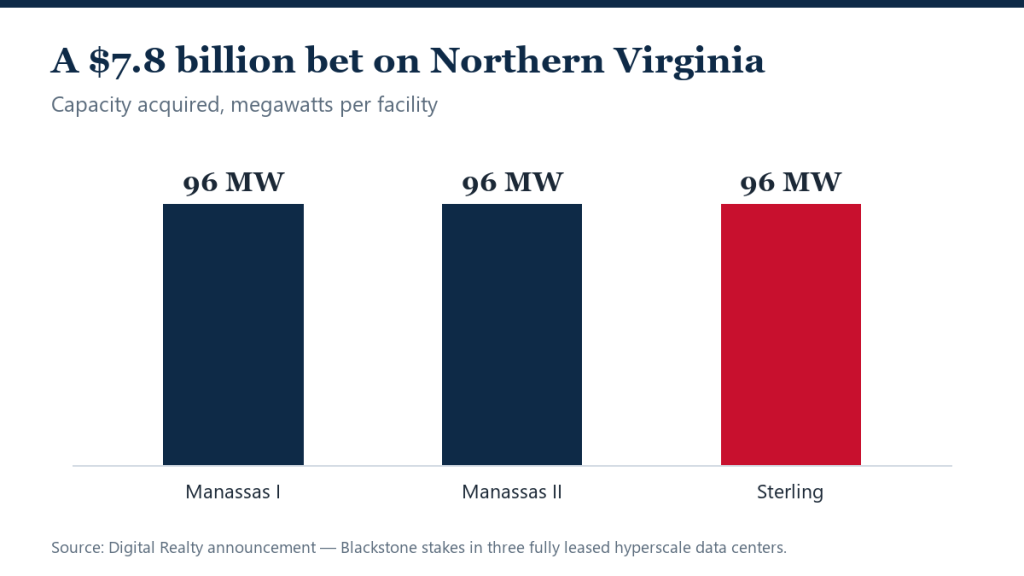
Digital Realty has agreed to buy Blackstone’s interests in three Northern Virginia data centers for a gross value of $7.8 billion — 288 megawatts of fully leased hyperscale capacity across two facilities in Manassas and one in Sterling, with 15-year leases carrying 3.6% annual escalators.
At roughly $27 million per megawatt for stabilized, long-leased capacity, the June 29 agreement plants one of the clearest valuation benchmarks yet for AI-era data center real estate — in the market that remains the industry’s global capital.
The transaction
- Assets: three hyperscale facilities — two 96 MW campuses in Manassas, one 96 MW in Sterling, Virginia.
- Gross value: $7.8 billion for 288 megawatts, fully leased.
- Lease profile: 15-year terms with 3.6% annual escalators — bond-like income with growth.
- Status: announced as an agreement to purchase; completion subject to closing.
What $27 million a megawatt says
Pricing stabilized capacity at this level tells the market two things. First, that the scarcest asset in digital infrastructure is not buildings but powered, connected, already-leased capacity in supply-constrained Northern Virginia — where new power delivery, not demand, is the binding constraint, per the dynamics in RealtyWire’s power-demand analysis. Second, that hyperscale tenants signing 15-year paper have made data centers investable on terms core real estate rarely offers: decade-plus income, contractual growth and tenants with trillion-dollar balance sheets.
For Blackstone, the sale crystallizes gains on assets it helped assemble; for Digital Realty, it concentrates ownership in its home market at scale pricing. Both sides of the trade — private capital harvesting, public platform consolidating — echo across a commercial market where data centers now anchor the growth thesis, and where hyperscalers simultaneously build their own capacity at unprecedented scale.
What it means
For investors, the benchmark reprices every stabilized megawatt in the sector — and widens the valuation gap over facilities lacking power, cooling headroom or credit tenancy. For Northern Virginia, the deal reaffirms its premium even as new supply chases cheaper power elsewhere: proximity, fiber density and operating history still command the top of the market. Verify closing before treating the transaction as final; announcements at this scale occasionally re-trade.
The lease mathematics explain the premium. A 15-year term with 3.6% annual escalators compounds to roughly 70% rent growth over the lease’s life — contracted, not hoped for — from tenants whose credit quality exceeds most sovereigns. Value stabilized capacity that way and the $7.8 billion is less a real estate price than the purchase of an investment-grade bond portfolio that happens to hum.
The deal also marks where private capital sits in the data center cycle: Blackstone was early into the asset class at scale, and harvesting stabilized assets to a public strategic buyer while retaining development exposure elsewhere is textbook cycle management. Expect the pattern to repeat — build-and-stabilize capital selling to yield-driven owners — as the sector’s development pipeline matures into income.
Northern Virginia’s constraint story is the quiet third party to the transaction. With utility power delivery timelines stretching years and local development scrutiny rising, existing energized capacity in Loudoun and Prince William counties functions like waterfront land: they are not making more of it on any timeline that matters to an AI roadmap.
FAQ
Why is Northern Virginia so dominant?
Decades of fiber infrastructure, proximity to federal and enterprise demand, and the industry’s deepest operating ecosystem. Its constraint is power delivery — which is exactly why existing powered capacity trades at a premium.
What does ‘fully leased with escalators’ mean for value?
Income certainty: tenants committed for 15 years with rent growing 3.6% annually. Buyers pay more per megawatt for cash flows that behave like investment-grade bonds with an inflation kicker.
Is $7.8 billion a record?
It ranks among the largest U.S. data center transactions to date; on a per-megawatt basis for stabilized assets, it sets a reference point the industry will quote for years.