Nuveen has raised more than $1 billion in new commitments for the fourth vintage of its C-PACE lending fund series, a sign that insurance companies are treating a once-niche corner of commercial real estate finance as a standing allocation rather than an experiment.
The firm announced the first close of Nuveen CPACE Lending Fund IV in a statement issued Tuesday from New York. The raise brings total commitments across the series to $3 billion since it began in 2023.
What C-PACE money actually does
Commercial Property Assessed Clean Energy financing is a public-private program administered at the state level. It supplies building owners and developers with long-term private capital for energy efficiency, water efficiency and climate resilience work, repaid through an assessment attached to the property. Nuveen said the programs are now active in 39 states plus Washington, D.C.
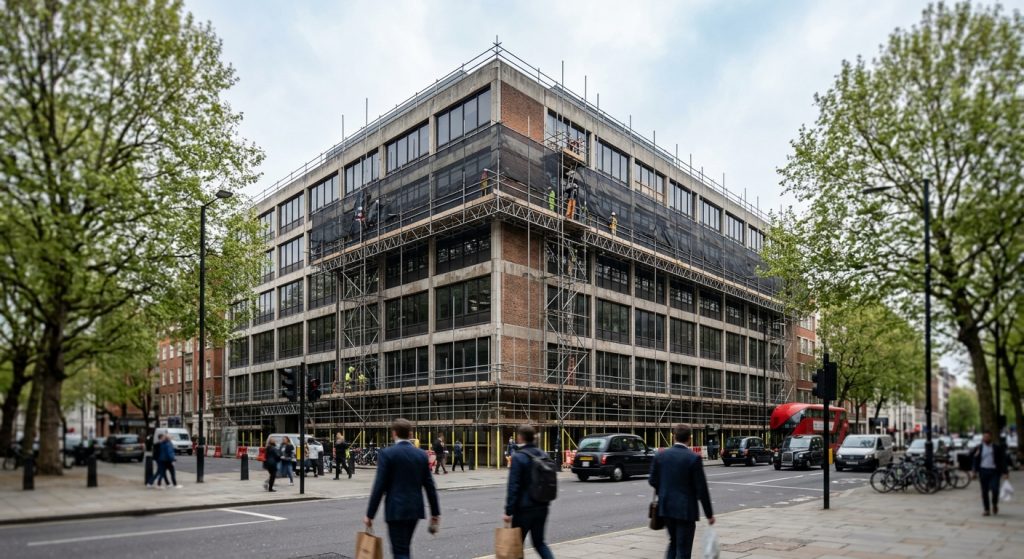
In practice, developers increasingly use it as a layer of the capital stack on heavy renovation projects — the kind of gut jobs where the building’s systems are being replaced anyway.
Nuveen Green Capital, the Nuveen subsidiary that originates the loans, has closed roughly $6 billion in C-PACE originations since it was founded in 2015 and now manages more than $6 billion in assets. The firm said its origination volume grew 73% year over year.
Insurers are the buyers
The capital behind these funds comes largely from insurance balance sheets, which are drawn to long-dated, investment-grade paper with predictable cash flows — a reasonable match for long-tail liabilities.
Nuveen pointed to its own survey work: 46% of North American insurers said they plan to increase allocations to private fixed income, and 53% of that group identified private asset-backed securities such as C-PACE as a key target.
“Investors have committed to this strategy across four vintages because fundamentals remain steady throughout variable market cycles,” said Alexandra Cooley, chief executive and chief investment officer of Nuveen Green Capital.
Joseph Pursley, Nuveen’s head of insurance for the Americas, framed the repeat commitments as a maturity signal. “The continued growth in commitments from across four funds tells us that insurers aren’t just testing this asset class,” he said.
The deal that showed the ceiling
The clearest demonstration of how large these transactions have become is The Geneva, a Washington, D.C. office-to-residential conversion that Nuveen Green Capital financed with $465 million in C-PACE proceeds — what the firm calls the largest C-PACE financing on record, well past the prior high of $290 million for the Pendry Hotel & Residences in Tampa, Fla.
According to Nuveen Green Capital’s account of the transaction, The Geneva sits at 1825–1875 Connecticut Ave. NW, where two nine-story towers totaling 604,000 square feet of office space are being rebuilt into a 15-story residential building. The plan calls for 429 market-rate apartments, 42 extended-stay rentals, 61 affordable units and 57,000 square feet of commercial space. A $110 million senior loan from Mavik brought total project financing to $575 million.
That mix — a very large conversion carrying a very large efficiency-financing layer — explains why C-PACE has grown alongside the office conversion pipeline. RealtyWire has covered the economics of these projects, from a $162 million conversion on Chicago’s Magnificent Mile to the regulatory friction that can stall them, as when New York halted work at 222 Broadway.
What it means
Verified: the fund’s first close exceeds $1 billion, series commitments total $3 billion since 2023, and C-PACE programs operate in 39 states and the District of Columbia. Those figures come from Nuveen’s announcement.
Company claim: the 73% origination growth, the “largest in history” label on The Geneva, and the insurer survey percentages are Nuveen’s own numbers and framing, not independently audited figures.
RealtyWire analysis: the notable shift is on the liability side, not the asset side. C-PACE spent a decade as a specialty product sold deal by deal; a fourth consecutive fund raised chiefly from insurers means the capital is now committed in advance and waiting for deals. For developers, that changes the practical question from whether C-PACE capital is available to how much of a stack it can carry — which matters most in conversion and deep-retrofit projects, where conventional lenders have been cautious. Broader commercial lending has been recovering unevenly; multifamily lending rose 32% to $381.8 billion in 2025.
What to watch: whether Fund IV reaches a larger final close, whether other managers launch competing insurer-funded vehicles, and whether state legislatures in the 11 states without active programs move to authorize them. More in RealtyWire’s commercial real estate coverage.