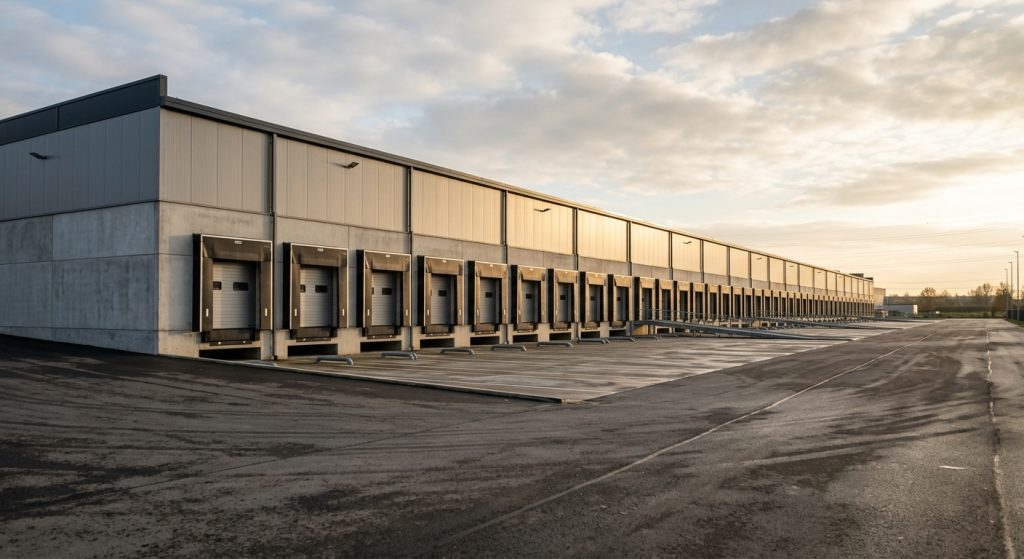
EQT Real Estate has sold a 46-building, roughly 10.5 million-square-foot logistics portfolio spread across 10 Southeast markets to an affiliate of California-based LBA Realty, in one of the largest single industrial trades of the year. The Swedish investment firm announced the completed sale Thursday from its U.S. headquarters in Radnor, Pa. Financial terms were not disclosed.
The deal is a clean read on where institutional capital thinks warehouse demand is going. It moves a portfolio the size of roughly 180 football fields of enclosed space from one large owner to another at a moment when national industrial fundamentals have just turned in landlords’ favor for the first time in four years.
What is in the Southeast logistics portfolio
The buildings sold out of EQT Real Estate Industrial Value Fund V and sit in Charlotte, Greensboro and Greenville-Spartanburg in the Carolinas; Atlanta and Savannah in Georgia; Tampa, Orlando and Jacksonville in Florida; and Birmingham and Huntsville in Alabama.
They average about 230,000 square feet apiece, which places them in the mid-size range rather than the million-square-foot bulk category. EQT describes the buildings as Class A and says tenant operations across the portfolio run from last-touch fulfillment and regional distribution to bulk distribution and advanced manufacturing — a mix that spreads exposure across several different demand drivers instead of concentrating it in e-commerce.
EQT tied the portfolio’s location strategy to freight infrastructure: the Port of Savannah, JAXPORT in Jacksonville and Inland Port Greer in South Carolina, plus the I-85, I-95, I-75, I-20 and I-4 corridors. JLL advised EQT Real Estate on the sale, with John Huguenard, Trent Agnew and Will McCormack leading the engagement.
“People and industry continue moving to the Southeast, and logistics demand has followed both,” said Matthew Brodnik, global chief investment officer at EQT Real Estate, who also credited local teams with adding value through hands-on management.
A sale, not a retreat
The transaction should not be read as EQT stepping away from Southeast warehouses. On June 10, the firm acquired a 2.4 million-square-foot logistics portfolio in Savannah, Jacksonville and Lakeland, Fla., through a different vehicle, Industrial Value Fund VI. Brodnik said at the time that the Southeast “continues to stand out as one of the most important logistics corridors in the U.S., driven by population growth, expanding port activity, and the ongoing modernization of supply chains.”
Selling from Fund V while buying into Fund VI is the ordinary mechanics of closed-end fund life cycles: an older vehicle harvests assets it has finished repositioning, and a newer one deploys fresh capital into the same thesis.
EQT has been unusually active on both sides of the industrial market this year. In August the firm sold a 20-property, 4.4 million-square-foot Midwest portfolio to SparrowHawk for just under $400 million, and it agreed to buy a roughly $1.2 billion infill Southern California portfolio from Rexford Industrial, a deal expected to close by the end of the third quarter.
The market backdrop
The sale lands just after industrial fundamentals inflected. JLL’s second-quarter U.S. industrial report put national vacancy at 6.8%, a 60-basis-point contraction and the first meaningful decline since mid-2023, on net absorption of 99.1 million square feet and leasing activity of 175.7 million square feet, up 49.4% year over year.
CBRE’s Q2 2026 industrial and logistics report measured the market slightly differently but reached the same conclusion: vacancy down 20 basis points to 6.5%, the first quarterly decline since the second quarter of 2022, with 85.1 million square feet of net absorption — the first quarter in four years in which demand outpaced new completions.
The common thread in both is a sharp slowdown in construction starts meeting demand that did not slow as much as owners feared.
What it means
The verified facts are the portfolio’s size, composition and markets, and the identity of buyer, seller and adviser. EQT’s characterizations of building quality and tenant mix are the seller’s own description of assets it just sold and should be read that way.
RealtyWire’s analysis: the absence of a disclosed price is the notable omission, and it limits how far anyone can read the deal as a pricing signal. For scale, the closest recent comparable in this region is the 53-building, 5.4 million-square-foot Southeast shallow-bay portfolio that TPG AG Real Estate and Redfearn Capital bought for $628 million in August, or about $116 per square foot — though that portfolio was roughly 87% occupied and built to a different specification, so it is a reference point rather than a valuation.
What the trade does confirm is buyer depth. A 46-building portfolio requires a purchaser able to underwrite ten markets at once and finance the whole thing in a single close. That there was such a buyer, in a quarter when vacancy finally started falling, says more about industrial capital markets than any single occupancy statistic. More coverage is on the RealtyWire commercial real estate page.
What to watch
Whether LBA discloses the price in any subsequent financing, whether EQT keeps recycling Fund V assets at this pace, and whether the third-quarter vacancy readings confirm that the second-quarter turn was a trend rather than a one-quarter bounce.