
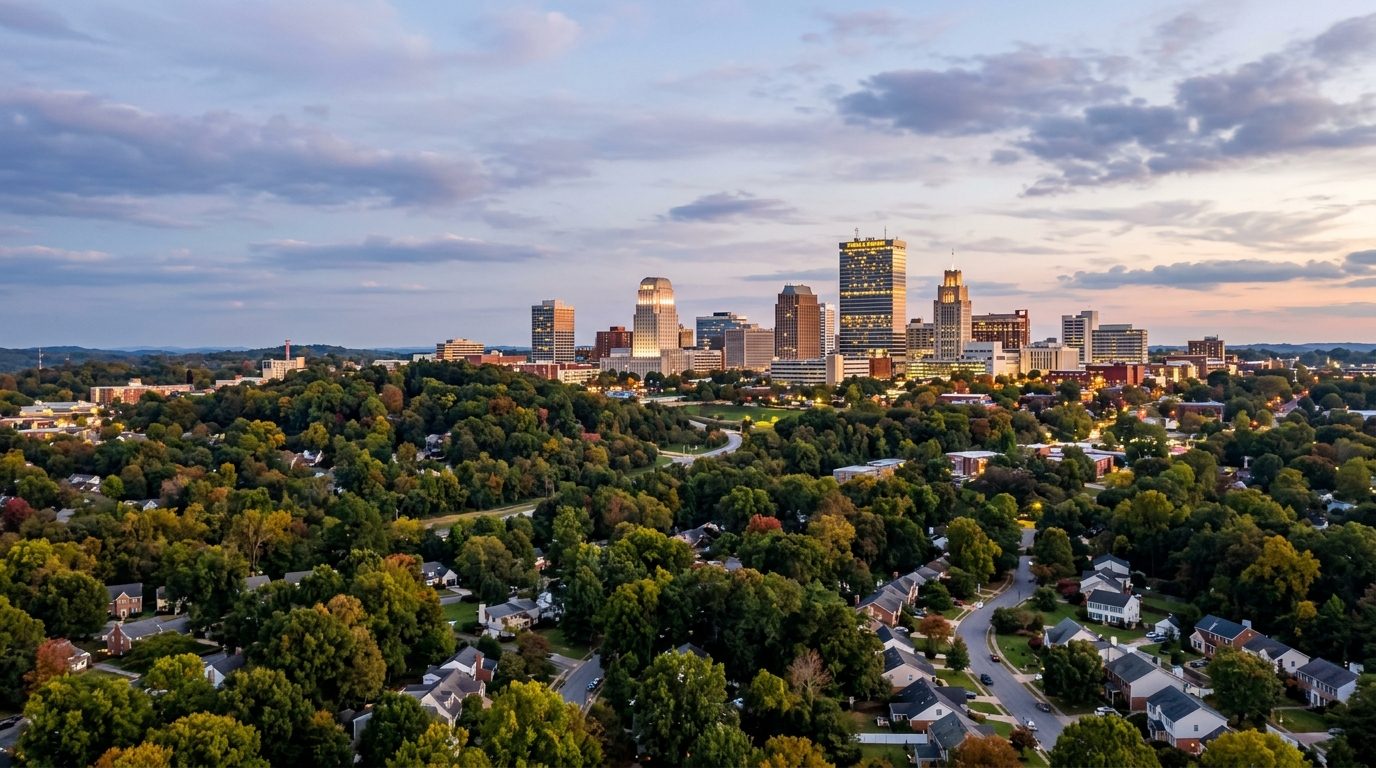
Current real estate market data, news and analysis for the Winston-Salem, NC metropolitan area — 712,206 residents across 5 counties in North Carolina.
Sources: U.S. Census Bureau.
Latest Winston Real Estate News
Winston Real Estate Market Overview
Winston-Salem sits in the north-central Piedmont of North Carolina, a landscape of rolling hills between the low Sauratown Mountains in Stokes County to the north and the Yadkin River valley to the west. The metro spans five counties: Forsyth, the urbanized core anchored by Winston-Salem itself, plus Davidson and Davie to the south, Stokes to the north, and Yadkin to the west. Close to downtown are brick and frame streetcar-suburb houses built from the late 1800s through the 1930s in Craftsman, Colonial Revival, and Queen Anne styles. Ringing those are mid-century ranch neighborhoods, and beyond them newer subdivisions in Kernersville, Clemmons, and Lewisville. The smaller towns of the outer counties, including Lexington, Thomasville, King, Mocksville, and Yadkinville, carry their own older town-center housing plus more recent rural subdivisions.
Price tiers track architectural character, proximity to downtown and Wake Forest University, and school assignment rather than any single factor. Historic in-town districts such as Old Salem, West End, Buena Vista, Reynolda, and Washington Park command premiums for walkability, mature tree canopy, and preserved architecture, and several carry historic-district design review. Newer master-planned and golf-oriented communities in Clemmons and Davie County, including Salem Glen and Bermuda Run, draw buyers seeking larger newer homes, often tied to specific school attendance zones considered desirable. More affordable housing tends to sit farther from the urban core, in older sections of eastern Winston-Salem and in the furniture- and textile-manufacturing towns of Davidson County, where housing stock is older and job growth has historically been slower.
The economy grew up around tobacco, textiles, and banking, and has since diversified into healthcare, biotechnology, and higher education. R.J. Reynolds Tobacco Company, now part of Reynolds American, remains headquartered in Winston-Salem, and Hanesbrands, an apparel company rooted in the city’s textile past, is also based there. Winston-Salem was a founding home of both Wachovia and BB&T; those banks have since merged into Wells Fargo and Truist respectively, but both retain a significant local presence. Healthcare is now the largest employment sector, led by Atrium Health Wake Forest Baptist and Novant Health, alongside Wake Forest University and its School of Medicine. Downtown, former R.J. Reynolds tobacco warehouses have been redeveloped into Innovation Quarter, a research and biotech district anchored by Wake Forest School of Medicine and Winston-Salem State University programs. Davidson County towns such as Lexington and Thomasville retain a furniture-manufacturing legacy, though the industry is far smaller than at its mid-twentieth-century peak.
The Piedmont climate brings hot, humid summers and mild winters, with occasional ice storms and a spring severe-weather season that can produce damaging thunderstorm winds, hail, and tornadoes; buyers should check flood and wind exposure for a specific address rather than assume metro-wide risk is uniform. North Carolina applies a flat state income tax, but property tax bills combine county, municipal, and often fire-district rates, so the effective rate depends on whether a property sits inside Winston-Salem, a smaller town, or an unincorporated county area. Development favors highway-corridor growth along I-40, US-421, and NC-150, with denser development inside Forsyth County and more dispersed, larger-lot patterns in Davie, Yadkin, and Stokes counties. Buyers should verify whether a property relies on municipal water and sewer or on well and septic, confirm school attendance zones with the county school system, and check homeowners association covenants attached to master-planned communities before purchase.
Cities and Towns in the Winston Metro Area
Notable Communities and Neighborhoods
Winston Real Estate Market FAQ
How is the Winston-Salem metro organized geographically?
The metro is built around Forsyth County, whose urban core is Winston-Salem, surrounded by four more rural and suburban counties: Davidson and Davie to the south and southwest, Stokes to the north, and Yadkin to the west. Each outer county has its own town centers, such as Kernersville, Clemmons, and Lewisville near the Forsyth County line, and Lexington, Thomasville, King, Mocksville, and Yadkinville farther out, each with a distinct housing stock and pace of development.
Which parts of the metro tend to be pricier, and why?
Historic in-town neighborhoods near downtown and Wake Forest University, such as Old Salem, West End, Buena Vista, Reynolda, and Washington Park, carry premiums for architecture, walkability, and historic-district status. Newer master-planned and golf communities in Clemmons and Davie County, including Salem Glen and Bermuda Run, are also priced higher, often reflecting larger, newer homes and specific school attendance zones that buyers seek out.
What should buyers verify locally before purchasing?
Confirm whether a property is inside a municipality or an unincorporated county area, since this affects the combined property tax rate and which services apply. Verify current school attendance zones directly with the county school system, check whether the home uses municipal water and sewer or well and septic, especially in Davie, Yadkin, and Stokes counties, and review any homeowners association rules for master-planned communities.
What region-specific weather risk should buyers be aware of?
The Piedmont Triad sits in a zone of the Southeast that experiences a spring severe-weather season, with the potential for damaging thunderstorm winds, hail, and occasional tornadoes. Winters are generally mild but can bring ice storms. Buyers should check flood zone maps and insurance requirements for a specific address rather than assume risk is uniform across the metro.
Nearby Markets