
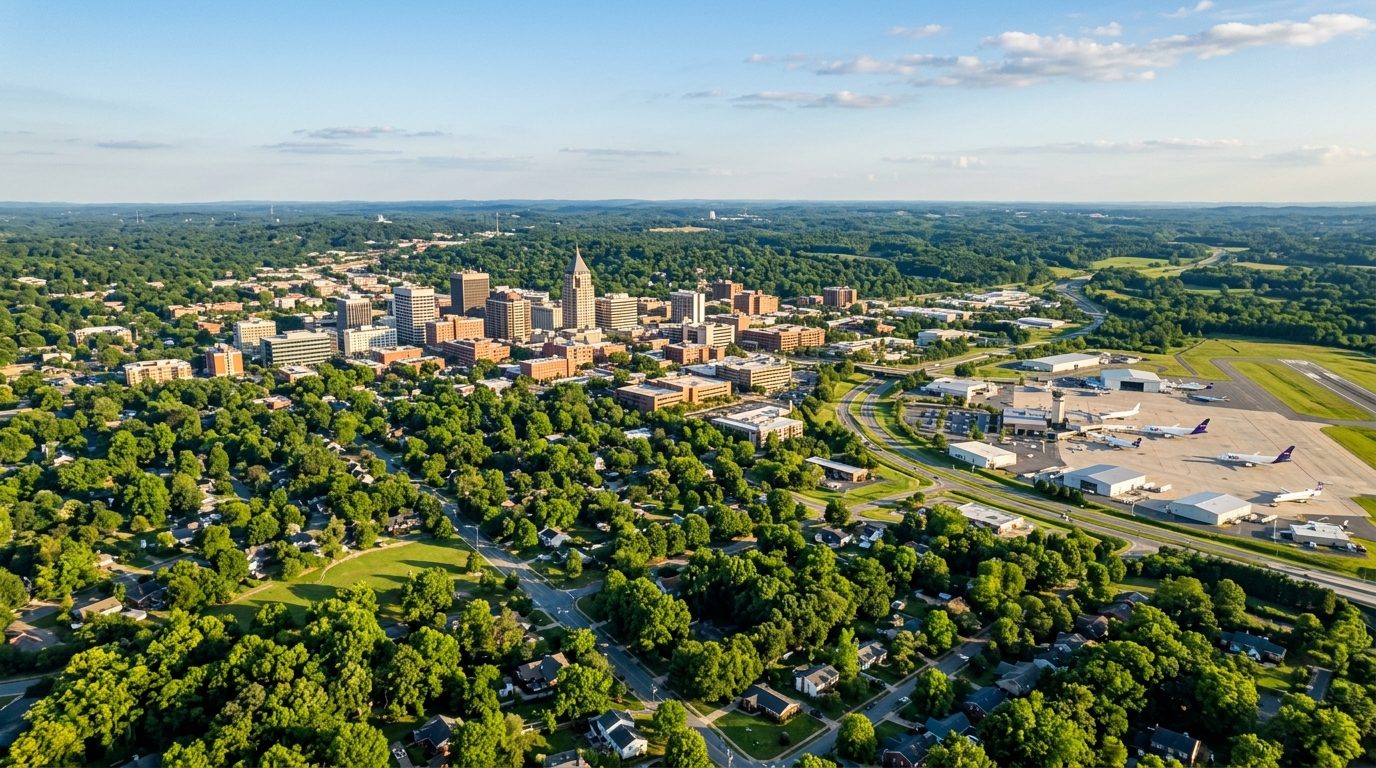
Current real estate market data, news and analysis for the Greensboro-High Point, NC metropolitan area — 805,945 residents across Guilford, Randolph and Rockingham counties.
Data as of May 2026. Sources: Redfin Data Center, U.S. Census Bureau.
Latest Greensboro Real Estate News
Greensboro Real Estate Market Overview
Greensboro-High Point sits in the north-central Piedmont of North Carolina, spanning Guilford, Randolph, and Rockingham counties on the rolling plateau between the mountains and the coastal plain. Greensboro and High Point form the urban core, a short drive apart, surrounded by Guilford County suburbs such as Jamestown, Oak Ridge, Summerfield, and Stokesdale. Randolph County, anchored by Asheboro, extends the metro south into rural country, while Rockingham County, anchored by Reidsville and Eden, extends it north toward Virginia. Housing stock mirrors this growth: brick ranch homes and old mill-village cottages sit near prewar bungalows and Colonial Revival houses in older urban neighborhoods, newer traditional and craftsman-style subdivisions ring the suburbs, and farmhouses and manufactured housing appear farther out. Both downtowns have added infill condos and loft conversions of former furniture and textile buildings, though detached homes remain dominant.
The priciest pockets cluster in Greensboro’s mature in-town neighborhoods, where tree canopy, distinctive early-twentieth-century architecture, and walkable access to downtown jobs and culture carry a premium, and in newer northern Guilford County communities where larger lots, newer construction, and well-regarded schools draw move-up buyers. High Point’s historic district south of downtown carries a similar premium for similar reasons. Values soften moving into Randolph and Rockingham counties, where commutes lengthen and land use is more rural, and in former mill-village neighborhoods near the urban cores built to house textile and furniture workers, though some are seeing reinvestment. As an inland metro with little lake or river frontage, school reputation, commute distance, and neighborhood character drive price differences more than waterfront access.
The regional economy grew up around furniture and textile manufacturing. High Point remains internationally known as a hub of the home furnishings industry, home to a seasonal wholesale furniture market that draws buyers and designers to its showroom district, and firms tied to furniture design and distribution remain significant employers, with textile and yarn manufacturing heritage persisting. That base has diversified toward logistics, aviation, and advanced manufacturing, anchored by Piedmont Triad International Airport, home to a FedEx Express air-cargo hub, the headquarters and plant of Honda Aircraft Company, and newer aerospace investment. Volvo’s North American truck operations are headquartered in Greensboro, and Randolph County has become a center of large-scale manufacturing following a major automaker’s electric-vehicle battery plant near Liberty. Healthcare and higher education round out the base, led by a large hospital system and schools including UNC Greensboro, North Carolina A&T State University, and High Point University.
Buyers should weigh several local factors. The metro is inland and does not face direct hurricane landfall, though it can see tropical remnants, severe thunderstorms, tornadoes, and winter ice storms, so wind, hail, and backup-power coverage are worth discussing with an insurer; flooding is localized near creeks, and specific parcels should be checked against flood maps. Property tax rates differ by county and municipality, with Guilford County generally running higher than Randolph or Rockingham, so buyers should confirm the combined rate for a given address. Public transit is limited to city bus systems plus a regional connector; the metro is largely car-dependent. Development leans toward low-density suburban subdivisions on the fringe alongside downtown infill and reuse of former industrial buildings. Because zoning, annexation, school assignment, and water and sewer service are handled separately across three counties and many towns, buyers should verify these locally.
Cities and Towns in the Greensboro Metro Area
Notable Communities and Neighborhoods
Greensboro Real Estate Market FAQ
How is the Greensboro-High Point real estate market organized geographically?
The metro covers Guilford, Randolph, and Rockingham counties. Greensboro and High Point, both in Guilford County, form the urban core and the bulk of the metro’s population and employment. Guilford County suburbs such as Jamestown, Oak Ridge, Summerfield, Stokesdale, Gibsonville, and Whitsett fill out the closer-in residential ring. Randolph County, to the south and anchored by Asheboro, and Rockingham County, to the north and anchored by Reidsville and Eden, are more rural and small-town in character, with longer commutes back into the Greensboro-High Point job centers.
Which parts of the metro tend to be more expensive, and why?
Greensboro’s mature in-town neighborhoods near downtown, along with High Point’s historic residential district south of its downtown, tend to carry premiums because of established tree canopy, architecturally distinctive early-twentieth-century housing, and walkable proximity to employment and cultural amenities. Newer subdivisions in northern Guilford County towns also draw a premium for larger lots, newer construction, and well-regarded schools. Prices generally moderate moving into Randolph and Rockingham counties, where commutes lengthen and land use is more rural, and in older neighborhoods near former mill and factory sites closer to the urban cores.
What should buyers verify locally before purchasing in this metro?
Because the metro spans three counties and many incorporated towns, buyers should confirm which county and municipality a property sits in, since zoning, school district assignment, annexation status, and property tax rates all vary by jurisdiction and are not uniform across the metro. Buyers should also confirm whether a property uses municipal water and sewer or well and septic, check flood zone status for the specific parcel rather than assuming metro-wide risk, and verify road maintenance responsibility in unincorporated areas.
What is the main region-specific risk buyers should be aware of?
This is an inland Piedmont metro, so it does not face direct hurricane landfall, but it is exposed to severe thunderstorms, tornadoes, remnants of tropical systems moving inland, and occasional winter ice storms that can down trees and interrupt power. Localized flooding can occur near creeks and floodplains rather than across the whole metro, so buyers should check flood maps for a specific address and discuss wind, hail, and backup-power coverage with a local insurance agent.
Nearby Markets