
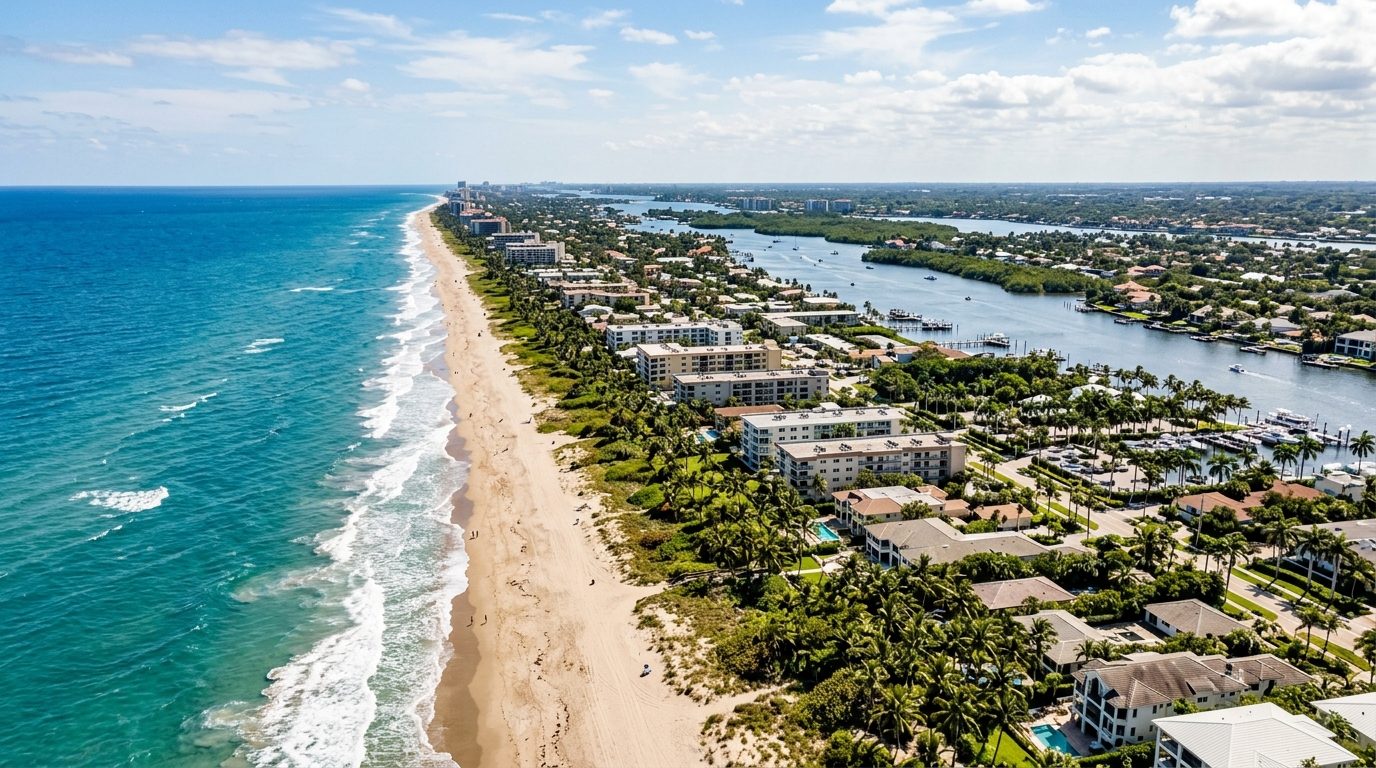
Current real estate market data, news and analysis for the Deltona-Daytona Beach-Ormond Beach, FL metropolitan area — 746,933 residents across Flagler and Volusia counties.
Data as of May 2026. Sources: Redfin Data Center, U.S. Census Bureau.
Latest Deltona Real Estate News
Deltona Real Estate Market Overview
The Deltona-Daytona Beach-Ormond Beach metro area covers Volusia and Flagler counties on Florida’s east-central Atlantic coast. A barrier island strip, including Daytona Beach Shores, Ormond-by-the-Sea, Flagler Beach, and the beachside of New Smyrna Beach, is separated from the mainland by the Halifax River and Indian River lagoon system. West of the lagoon, mainland cities such as Daytona Beach, Holly Hill, South Daytona, Port Orange, and Ormond Beach sit on flat coastal terrain, while the interior of Volusia County rises gently toward the St. Johns River, where DeLand, DeBary, Orange City, and Deltona are built around its floodplain, lakes, and springs. Housing stock reflects this geography: the barrier island mixes older beach cottages and converted motel-era condos with newer high-rise towers, mainland Daytona-area cities have postwar bungalows and ranch homes, DeLand retains a historic downtown of early-20th-century houses, and Deltona is a large grid of ranch homes on lots platted in the 1960s by an early Florida land-development company. Palm Coast, in Flagler County, is itself a planned community begun in the 1970s with an extensive canal network, still filling in with new subdivisions.
Within the metro, direct oceanfront and intracoastal property on the barrier island commands the highest prices because buildable land there is fixed and water access is limited. Newer gated and golf-oriented subdivisions in Ormond Beach, Palm Coast, and Port Orange, built from the 1990s onward, also sit toward the upper end due to their age and amenities. Inland areas such as Deltona, Orange City, and older sections of Daytona Beach and DeLand tend to be more moderately priced, reflecting smaller and older homes, greater distance from the coast, and, in Deltona’s case, a housing stock built quickly and uniformly in a single development era rather than shaped by long-term organic growth.
Tourism anchors much of the coastal economy, centered on Daytona Beach’s drivable sand beaches, the Daytona International Speedway, and events such as Bike Week and Speedweeks. Embry-Riddle Aeronautical University, headquartered in Daytona Beach, adds an aviation and aerospace-education presence, and the workforce has ties to Kennedy Space Center in neighboring Brevard County. Healthcare is a major employer through the AdventHealth and Halifax Health hospital systems. Stetson University in DeLand and Daytona State College add to the education sector, while Publix, Walmart, and Amazon are large retail and logistics employers, and Brown & Brown, an insurance brokerage headquartered in Daytona Beach, is a notable corporate presence alongside manufacturers such as Brunswick Corporation’s Boston Whaler boat operations.
The coast is subject to Atlantic hurricane and tropical storm activity, and barrier-island and lagoon-adjacent properties fall within FEMA-mapped flood zones that typically require flood insurance in addition to standard homeowners coverage. Florida has no state income tax, and Volusia and Flagler counties apply the standard homestead exemption and Save Our Homes assessment cap for owner-occupied primary residences. Much of Deltona and Palm Coast was platted decades before infrastructure and buildings caught up, so lot sizes, road access, and utility availability can vary block to block. Buyers should confirm a parcel’s FEMA flood zone and elevation, obtain separate wind and flood insurance quotes before making an offer, and check whether a community carries a homeowners association or lies within a community development district with its own assessments, since these vary widely between older platted subdivisions and newer planned communities.
Cities and Towns in the Deltona Metro Area
Notable Communities and Neighborhoods
Deltona Real Estate Market FAQ
How is the Deltona-Daytona Beach-Ormond Beach metro area organized geographically?
It spans Volusia and Flagler counties and has two distinct corridors: a narrow Atlantic barrier island and adjoining mainland coastal cities (Daytona Beach, Ormond Beach, Port Orange, New Smyrna Beach, Flagler Beach, Palm Coast) separated by the Halifax River/Indian River lagoon, and an inland corridor along the St. Johns River and its lakes (DeLand, DeBary, Orange City, Deltona) further west.
Which areas tend to be pricier, and why?
Direct oceanfront and intracoastal property on the barrier island commands the highest prices because buildable coastal land is limited, while newer gated, golf, and canal-front subdivisions in places like Ormond Beach and Palm Coast also sit toward the upper end due to their age and amenities. Inland areas such as Deltona and Orange City are generally more moderate, reflecting older, smaller homes built further from the coast.
What should buyers verify locally before purchasing?
Buyers should confirm a property’s FEMA flood zone and elevation certificate, get separate quotes for wind and flood insurance, check whether the home is served by public sewer or septic (common in older platted subdivisions), and determine if the property is subject to a homeowners association or a community development district with its own fees and assessments.
What is the biggest region-specific risk to be aware of?
Hurricane and tropical storm exposure is significant given the Atlantic coastline, and much of the metro’s coastal and river-adjacent land lies within mapped flood zones. Standard homeowners insurance does not cover flood damage, so separate flood coverage and, in many cases, windstorm coverage are typically required and should be priced out before buying.
Nearby Markets