
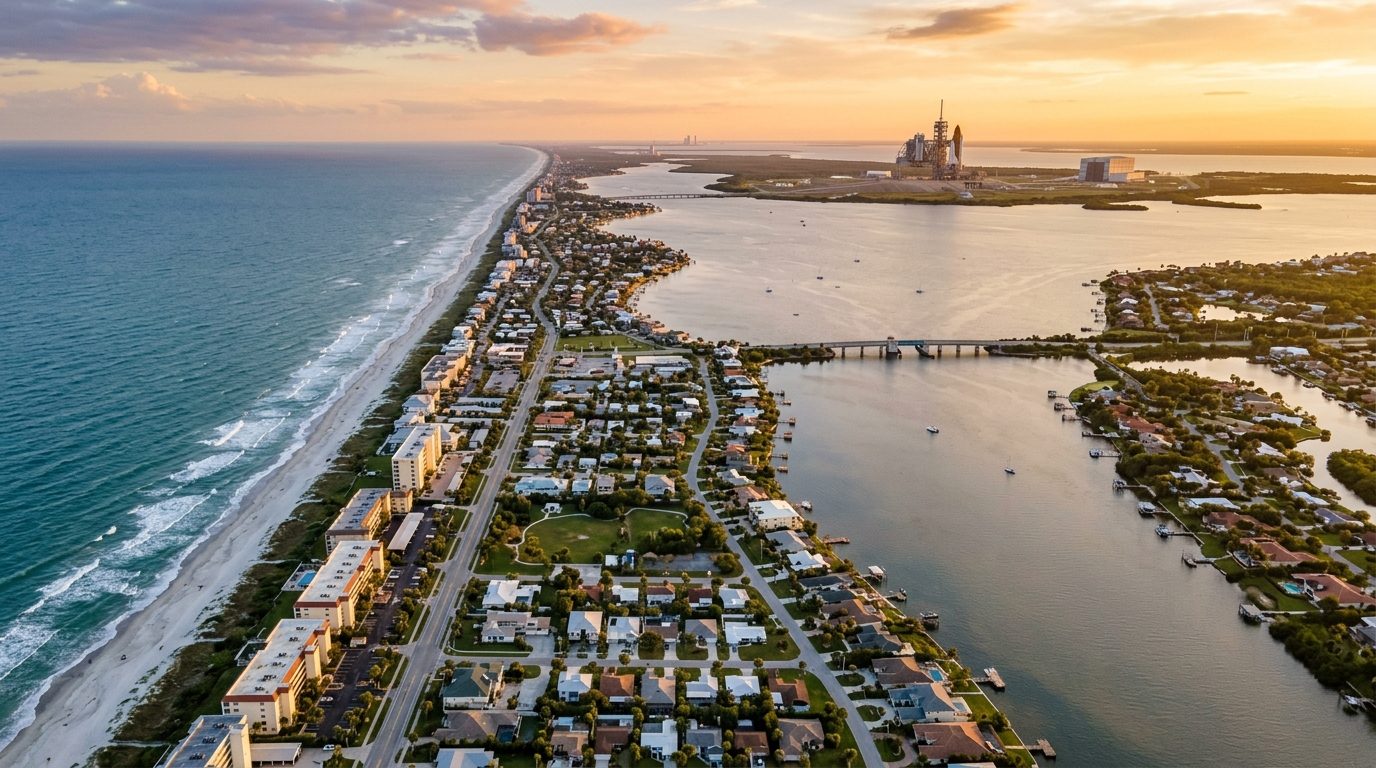
Current real estate market data, news and analysis for the Palm Bay-Melbourne-Titusville, FL metropolitan area — 663,982 residents across Brevard county.
Data as of May 2026. Sources: Redfin Data Center, U.S. Census Bureau.
Latest Palm Bay Real Estate News
Palm Bay Real Estate Market Overview
The Palm Bay-Melbourne-Titusville metro area covers Brevard County along Florida’s central Atlantic coast, a stretch locals call the Space Coast. The county’s geography splits into two strips of land: a narrow barrier island running from Cape Canaveral and Cocoa Beach south through Satellite Beach, Indian Harbour Beach, Indialantic, and Melbourne Beach, and a larger mainland shoreline anchored by Titusville, Cocoa, Rockledge, Merritt Island, Melbourne, and Palm Bay. The Indian River Lagoon and its northern arm, the Banana River, separate the barrier island from the mainland and are crossed by causeways and bridges. Housing on the barrier island leans toward low-rise condominiums, duplexes, and older beach cottages on small lots, with newer construction filling in over time. Mainland housing stock is dominated by single-family ranch and split-level homes built from the 1960s through the 1980s, many originating in large platted subdivisions, alongside newer subdivisions built from the 1990s onward.
Price tiers generally track distance from the water and the age of the surrounding development. Direct oceanfront and lagoon-front properties on the barrier island, in Cocoa Beach, Satellite Beach, Indian Harbour Beach, Indialantic, and Melbourne Beach, sit at the higher end because buildable land is limited and beach access is finite. Newer, amenity-rich master-planned areas on the mainland, such as Viera and Suntree near Melbourne, also command more than older neighborhoods because of their newer infrastructure and planned commercial centers. Older mainland subdivisions platted decades ago in Titusville, Cocoa, and large sections of Palm Bay tend to sit at the lower end, reflecting smaller and older housing stock, longer commutes to the coast, and, in some cases, lots platted well ahead of infrastructure.
The metro’s economy centers on aerospace, defense, and government space operations. NASA’s Kennedy Space Center occupies Merritt Island, and Cape Canaveral Space Force Station and Patrick Space Force Base sit on the barrier island to the south, anchoring launch and range operations used by NASA, the Space Force, and commercial operators including SpaceX and Blue Origin, which has built a rocket manufacturing campus near Cape Canaveral. Melbourne hosts the corporate headquarters of L3Harris Technologies and a large Northrop Grumman engineering and manufacturing campus, both major defense employers, along with other aerospace contractors. Health First operates the county’s hospital network, including Holmes Regional Medical Center in Melbourne and additional hospitals in Palm Bay, Viera, and Cape Canaveral. Florida Institute of Technology, a private research university in Melbourne, is closely tied to the area’s engineering workforce.
Hurricane exposure and flood risk are defining factors for property in this metro, particularly on the barrier island, where storm surge, wind damage, and beach erosion are recurring concerns and where wind and flood insurance costs and underwriting run higher than on the mainland. Florida has no state income tax, but property insurance costs, and on older homes wind-mitigation and roof-age requirements, affect ownership costs. Public transit is limited to a countywide bus system, and daily life is largely car-dependent, with US 1, State Road A1A, and Interstate 95 forming the main travel corridors between coastal and mainland communities. Land use ranges from decades-old platted subdivisions with minimal deed restrictions to newer communities governed by homeowners associations or community development districts. Buyers should independently verify flood zone designation, elevation certificate, insurance costs, and, in older platted areas, whether a lot has public sewer or septic.
Cities and Towns in the Palm Bay Metro Area
Notable Communities and Neighborhoods
Palm Bay Real Estate Market FAQ
How is the Palm Bay-Melbourne-Titusville metro organized geographically?
The metro is coextensive with Brevard County and is split into two parallel strips of land separated by the Indian River Lagoon and its Banana River arm. A narrow barrier island holds the beach towns, including Cape Canaveral, Cocoa Beach, Satellite Beach, Indian Harbour Beach, Indialantic, and Melbourne Beach. The larger mainland side holds Titusville, Cocoa, Rockledge, Merritt Island, Melbourne, West Melbourne, and Palm Bay, with causeways and bridges connecting the two sides.
Which areas tend to be pricier, and why?
Barrier island locations with direct ocean or lagoon frontage, such as Cocoa Beach, Satellite Beach, Indian Harbour Beach, Indialantic, and Melbourne Beach, tend to sit at the higher end because beachfront and waterfront land is limited. Newer master-planned mainland communities such as Viera and Suntree also trend higher due to newer infrastructure and planned amenities, while older platted mainland subdivisions in Titusville, Cocoa, and parts of Palm Bay tend to be less expensive.
What should buyers verify locally before purchasing?
Buyers should confirm a property’s flood zone designation and elevation certificate, obtain an actual wind and flood insurance quote rather than assuming a prior owner’s rate carries over, check the age and condition of the roof against wind-mitigation requirements, and, in older platted subdivisions, confirm whether the lot is served by public water and sewer or by well and septic.
What is the biggest region-specific risk to understand?
Hurricane exposure is the defining risk, particularly for barrier island property, where storm surge, high wind, and beach erosion are recurring hazards. This exposure translates into higher wind and flood insurance costs and stricter underwriting on the barrier island compared with mainland locations, and insurance availability and pricing can change after major storms.
Nearby Markets