
Current real estate market data, news and analysis for the Chattanooga, TN-GA metropolitan area — 594,530 residents across 6 counties in Tennessee and Georgia.
Sources: U.S. Census Bureau.
Latest Chattanooga Real Estate News
Chattanooga Real Estate Market Overview
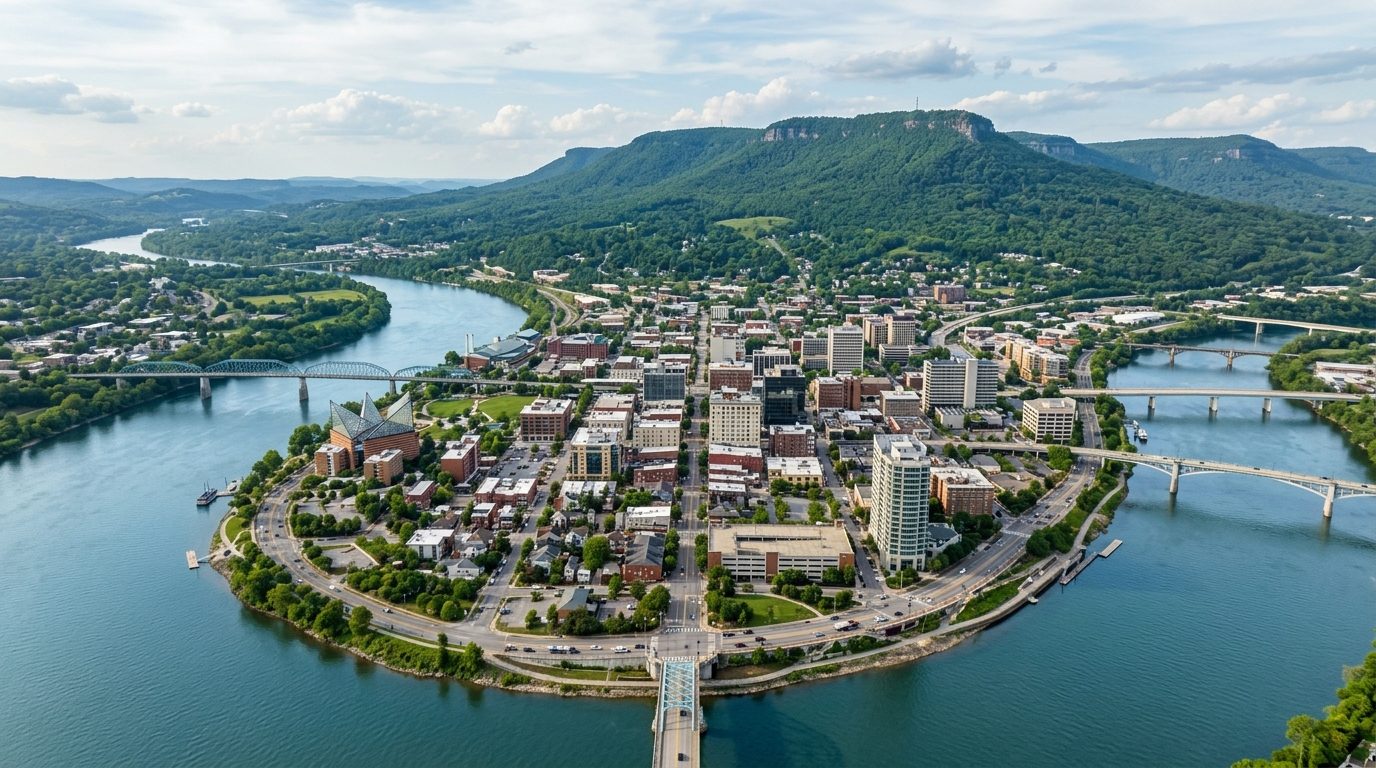
Chattanooga sits along a bend in the Tennessee River, where the Appalachian ridge-and-valley country meets the Cumberland Plateau. Lookout Mountain rises to the southwest and Signal Mountain and Walden’s Ridge climb to the north, so terrain shifts quickly from flat valley floor to steep mountainside within a few miles. The metro spans both Tennessee and Georgia, with a compact urban core along the river and outlying towns spread across valley floor, ridges, and plateau. Housing stock reflects this range: older sections near downtown retain Victorian and Craftsman-era homes, while most of the surrounding metro was built out in postwar and later decades with ranch and contemporary suburban construction. The climate is humid subtropical, with warm, muggy summers and mild winters occasionally interrupted by ice or snow, especially at higher elevations.
Neighborhoods close to downtown and the river, along with the mountaintop communities, generally sit at the higher end of the local price range. The North Shore and St. Elmo benefit from walkable commercial districts and proximity to downtown employers, while Lookout Mountain and Signal Mountain carry a premium tied to elevation, established tree canopy, and long-regarded schools. Suburban areas farther from the core, including parts of East Ridge, Red Bank, and sections of Hixson, tend toward more moderate pricing linked to older housing stock and longer commutes. Newer-growth areas such as East Brainerd and Ooltewah have drawn buyers seeking recently built homes and expanding retail, placing them in a middle-to-upper tier depending on subdivision and school zone. Smaller towns on the Georgia side and in more rural stretches of the metro generally trade lower, reflecting distance from the urban core.
The regional economy has diversified beyond its industrial roots, though manufacturing remains significant. Volkswagen operates a large assembly plant in Chattanooga, one of its North American manufacturing anchors, supporting a network of area suppliers. Healthcare is a major pillar, led by Erlanger Health System and CHI Memorial. Insurance and financial services are represented by BlueCross BlueShield of Tennessee and Unum, both headquartered in the city, while logistics and trucking firms such as Covenant Logistics and U.S. Xpress reflect the metro’s position along interstate freight corridors. Food production is anchored by McKee Foods, maker of Little Debbie snack products, and the Tennessee Valley Authority maintains a substantial regional presence. Higher education is anchored by the University of Tennessee at Chattanooga and Chattanooga State Community College.
Buyers should weigh a few local factors. Areas near the Tennessee River and its tributary creeks carry flood risk, so flood-zone status is worth confirming for property near low-lying water frontage. Winter ice storms can be more disruptive on mountain roads than in the valley, and homes on Lookout Mountain, Signal Mountain, or other elevated terrain may involve added considerations around access, retaining walls, or slope stability. Because the metro straddles the Tennessee-Georgia line, property tax rates, assessment practices, and school district boundaries differ depending on which side a home sits, so confirming county and municipality is important. Public transit is limited and concentrated in the urban core, leaving most of the metro car-dependent. Zoning ranges from historic districts with design review to unincorporated areas with fewer restrictions, so verifying local zoning, HOA rules, and sewer versus septic service is worthwhile before buying.
Cities and Towns in the Chattanooga Metro Area
Notable Communities and Neighborhoods
Chattanooga Real Estate Market FAQ
How is the Chattanooga metro organized geographically?
The metro is centered on the city of Chattanooga along the Tennessee River and extends across three Tennessee counties (Hamilton, Marion, Sequatchie) and three Georgia counties (Catoosa, Dade, Walker). Terrain ranges from the river valley in the urban core to plateau and mountain communities such as Signal Mountain and Lookout Mountain, with towns spread across ridges and valley floor on both sides of the state line.
Which areas of the metro tend to be pricier, and why?
Neighborhoods close to downtown along the river, such as the North Shore and St. Elmo, and mountaintop communities like Lookout Mountain and Signal Mountain tend to sit at the higher end of the local price range. This generally reflects walkability, river or mountain views, established tree canopy, and long-regarded schools rather than any single factor. Outlying and more rural towns farther from the urban core tend to trade at lower price points.
What should buyers verify locally before purchasing in this metro?
Buyers should confirm flood-zone status for any property near the Tennessee River or its tributary creeks, check whether a home relies on public sewer or private septic, review local zoning and any HOA requirements for planned or mountain communities, and verify which county, municipality, and school district a property falls under, since these can differ across the Tennessee-Georgia line.
What region-specific risk factors should buyers consider?
Because the metro spans two states, property tax rates and assessment practices differ between the Tennessee counties and the Georgia counties, so a comparable home can carry a different tax burden depending on which side of the line it sits. Winter ice storms and localized flooding along the Tennessee River and its tributaries are also worth factoring into a purchase decision, particularly for property on mountain roads or near low-lying water frontage.
Nearby Markets