
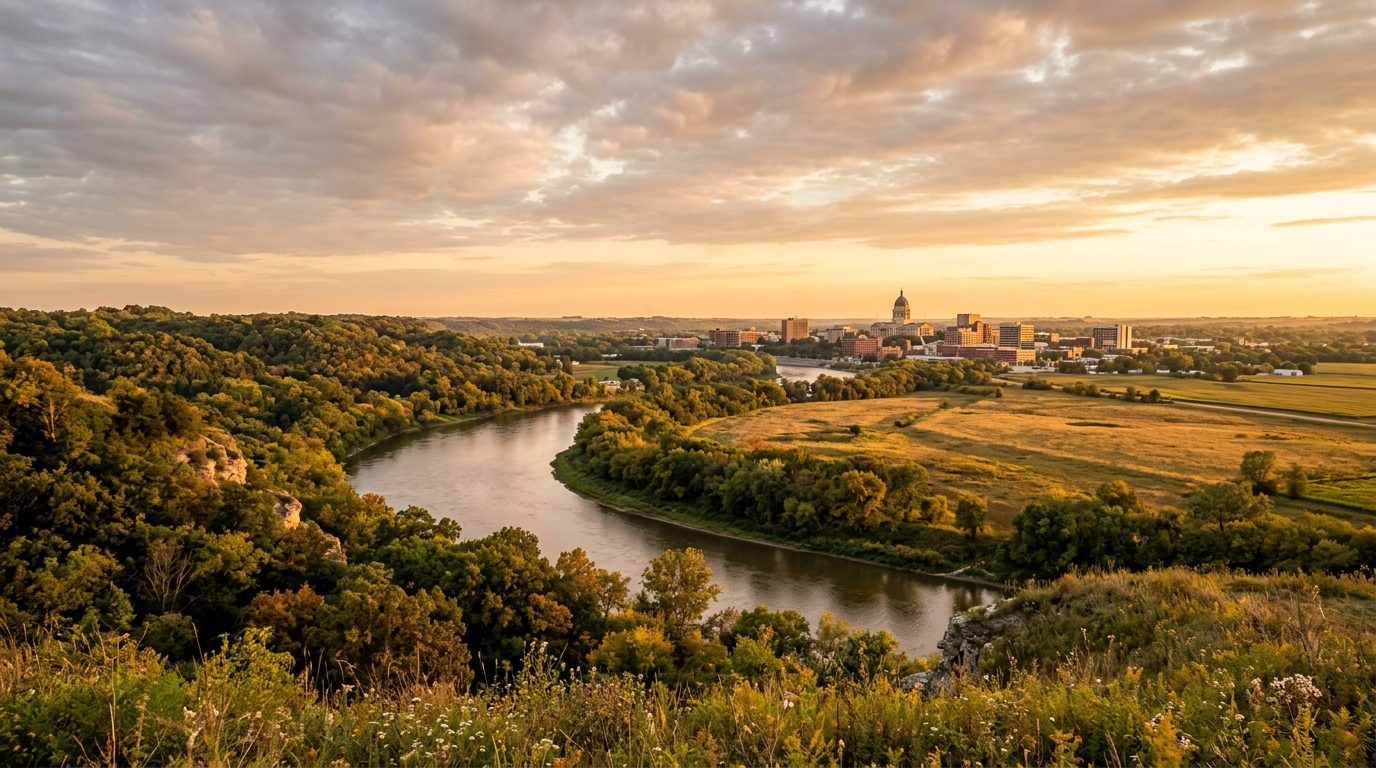
Current real estate market data, news and analysis for the Bismarck, ND metropolitan area — 139,750 residents across Burleigh, Morton and Oliver counties.
Data as of May 2026. Sources: Redfin Data Center, U.S. Census Bureau.
Latest Bismarck Real Estate News
Coverage of this market is coming soon. Browse all housing market news.
Bismarck Real Estate Market Overview
Bismarck and Mandan sit on opposite banks of the Missouri River in central North Dakota, joined by bridges along Interstate 94 and Memorial Highway. Bismarck, the state capital, occupies the east bank on higher ground above the river valley, while Mandan spreads across the west bank in Morton County. The surrounding landscape is rolling prairie broken by river bluffs, coulees, and wooded bottomland along the Missouri itself. Housing stock reflects growth in waves: bungalows and postwar ramblers near the historic cores, split-levels and ranch homes from the mid-twentieth century in the established residential rings, and newer construction with attached garages spreading outward along the edges of both cities. Smaller outlying towns such as Lincoln, New Salem, Hebron, Glen Ullin, Center, Flasher, Wing, Regan, and Almont round out the metro with farmhouses, acreages, and small-town housing stock.
Within Bismarck, the neighborhoods on and around the hill north of downtown, including the Cathedral area, carry a premium tied to mature tree canopy, larger lots, architectural variety, and elevation above the floodplain with views toward the river valley. Highland Acres, a mid-century subdivision in west Bismarck, occupies a similar tier for its established character and park-oriented layout. New construction commands its own premium in subdivisions expanding to the north, northeast, and south of Bismarck. The original downtown core and older sections of both cities generally sit at the more affordable end, reflecting the age of the housing stock and smaller original lot sizes. Mandan, across the river in Morton County, tends to offer relatively lower price points than comparable Bismarck homes, tied to land costs and age of stock, though newer Mandan subdivisions on its south and east sides are narrowing that gap.
The Bismarck-Mandan economy centers on government, healthcare, and regional trade. As the seat of North Dakota’s state government, Bismarck hosts state agency offices around the Capitol grounds, making state government the area’s largest employer base. Healthcare is anchored by two hospital systems, Sanford Health and CHI St. Alexius Health, both with major Bismarck campuses serving as regional referral centers for central and western North Dakota. Manufacturing has a foothold through Doosan Bobcat, and the utility sector is represented by MDU Resources Group and Basin Electric Power Cooperative, both headquartered locally. Agriculture remains foundational to the surrounding counties, with grain and livestock production supported by rail service that also connects to the state’s energy-producing Bakken region to the west.
Winters here are long and cold, with sustained subzero temperatures, wind, and snow that affect construction schedules, heating costs, and home maintenance such as roof and pipe insulation. The Missouri River has flooded the area historically, and levee systems now protect low-lying stretches of both riverbanks; buyers considering property near the river, including islands and bottomland areas, should check current flood zone maps before purchasing. North Dakota offers a Primary Residence Credit that reduces the property tax burden for owner-occupants, applied for annually through the state tax commissioner’s office. Public transit is limited to a small local bus system, so most residents rely on personal vehicles, and development has generally followed a low-density, auto-oriented pattern outward from both cores. Buyers outside city limits in Burleigh, Morton, or Oliver counties should confirm well and septic permitting, since rural properties are not connected to municipal water and sewer.
Cities and Towns in the Bismarck Metro Area
Notable Communities and Neighborhoods
Bismarck Real Estate Market FAQ
How is the Bismarck-Mandan metro organized?
The metro centers on two cities facing each other across the Missouri River: Bismarck, the larger city and state capital, on the east bank in Burleigh County, and Mandan on the west bank in Morton County. The two are connected by bridges carrying Interstate 94 and other river crossings, and many residents commute between the two sides for work. Beyond the twin cities, the metro includes smaller communities such as Lincoln just south of Bismarck, and more distant towns along or near I-94 and secondary highways, including New Salem, Glen Ullin, Hebron, Center, Flasher, Wing, Regan, and Almont, which function as smaller residential and agricultural communities within commuting range.
Which areas of the metro tend to be pricier, and why?
Established neighborhoods on the hill north of downtown Bismarck, including the Cathedral area, and mid-century areas like Highland Acres tend to command a premium tied to mature landscaping, larger lots, architectural character, and elevated positions above the river valley. New-construction subdivisions on the growing edges of Bismarck, particularly to the north, northeast, and south, carry a premium for modern floor plans and updated systems. The original downtown core, older sections of both cities, and much of Mandan tend to sit at more moderate price points, largely reflecting the age of the housing stock and smaller historic lot sizes rather than location quality alone.
What should buyers verify before purchasing in this metro?
Buyers should confirm a property’s flood zone status, particularly for homes near the Missouri River, low-lying islands, or bottomland areas that have flooded historically. For property outside Bismarck or Mandan city limits in Burleigh, Morton, or Oliver counties, buyers should verify well water and septic system permitting and inspection records through the relevant county building and health departments, since these rural properties are not tied into municipal water and sewer. It is also worth confirming whether a property sits inside or outside current city limits and special assessment districts, since infrastructure costs and taxing jurisdictions can differ accordingly, and checking the status of any Primary Residence Credit application for owner-occupied homes.
What is the primary regional risk factor buyers should understand?
The Missouri River has produced significant flooding in the past, most notably in 2011, when extensive sandbagging and temporary levee construction were needed to protect low-lying sections of both Bismarck and Mandan. Permanent levee systems now protect many of the previously vulnerable areas along both riverbanks, but low islands, boat-access points, and bottomland parcels near the river remain more exposed. Buyers evaluating any property near the river corridor should review current flood zone designations and ask about historical flood response measures for that specific parcel before purchasing.
Nearby Markets