
Current real estate market data, news and analysis for the Fargo, ND-MN metropolitan area — 269,528 residents across Cass, ND and Clay, MN counties.
Sources: U.S. Census Bureau.
Latest Fargo Real Estate News
Fargo Real Estate Market Overview
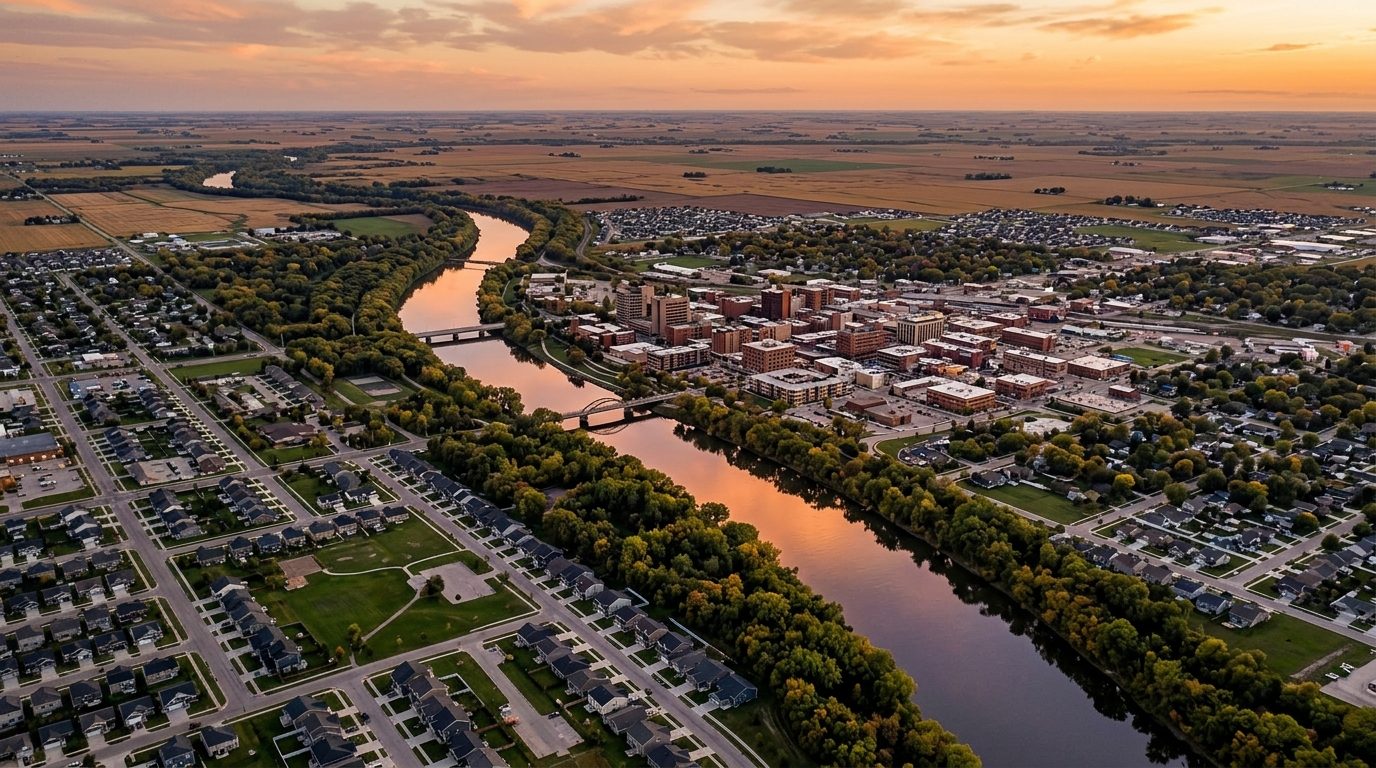
The Fargo-Moorhead metro sits astride the Red River of the North, the border between North Dakota and Minnesota, within the flat Red River Valley, a former glacial lakebed left by prehistoric Lake Agassiz. Fargo and West Fargo sit on the North Dakota side in Cass County; Moorhead and Dilworth sit across the river in Clay County, Minnesota; Casselton, Horace, and Kindred are smaller farmland communities further out. With no hills to constrain development, the metro has grown outward in expanding rings of grid-pattern subdivisions. Housing stock reflects this layered growth: early bungalows fill the historic cores near downtown Fargo and Moorhead, mid-century ramblers ring those cores, and contemporary single-family homes, townhomes, and apartments extend along the newest edges of south Fargo, west Fargo, and south Moorhead.
Newer subdivisions on the growing edges of south Fargo and West Fargo, often built around golf courses, ponds, or trail systems, tend to draw stronger demand thanks to newer construction and proximity to newer schools and job centers. West Fargo in particular has attracted buyers seeking new construction and a fast-growing school system, while established, tree-lined neighborhoods closer to downtown Fargo and the river appeal to buyers who value walkability and historic character over newness. Older central corridors near downtown, along with early postwar subdivisions on Fargo’s north side, sit toward the more affordable end of the market, reflecting smaller homes and older systems. Moorhead’s neighborhoods near Concordia College mix historic and mid-century housing, while Dilworth, a smaller bedroom community east of Moorhead, tends toward more modest pricing tied to its distance from the metro core.
The Fargo-Moorhead economy is anchored by healthcare, higher education, agribusiness, and technology. Sanford Health and Essentia Health both operate major hospital and clinic systems concentrated in Fargo, making healthcare one of the region’s largest employers. North Dakota State University, a land-grant research university in Fargo, along with Minnesota State University Moorhead and Concordia College, anchor higher education and feed graduates into local industries. The region has a long-standing agribusiness and agricultural-technology base tied to NDSU’s research programs and to equipment and processing companies serving area farms. Microsoft operates a large software campus in Fargo, a legacy of its acquisition of Fargo-based Great Plains Software, now one of its largest development sites outside its Pacific Northwest headquarters. Manufacturing, distribution, and logistics round out the job base.
The defining physical risk in Fargo-Moorhead is spring flooding along the Red River, which flows north and is prone to ice-jam and overland flooding given the valley’s extreme flatness; the region has faced repeated major flood fights, prompting Fargo and Moorhead to invest in flood-protection infrastructure. Buyers should verify a property’s flood zone designation, elevation relative to the river, and any flood insurance requirements. Because the metro straddles a state line, buyers should confirm which state, county, and school district a property sits in: North Dakota and Minnesota assess and levy property taxes differently, so a Moorhead or Dilworth address falls under Minnesota law while Fargo, West Fargo, Horace, Kindred, and Casselton fall under North Dakota’s. Transit is limited to local buses, and most residents drive. Zoning is set separately by each city and county, so growth patterns and annexation differ across the metro, and buyers in newer developments should confirm roads, utilities, and schools are fully built out.
Cities and Towns in the Fargo Metro Area
Notable Communities and Neighborhoods
Fargo Real Estate Market FAQ
How is the Fargo-Moorhead real estate market organized geographically?
The metro spans two states along the Red River of the North: Fargo, West Fargo, Horace, Kindred, and Casselton sit on the North Dakota side in Cass County, while Moorhead and Dilworth sit across the river on the Minnesota side in Clay County. This matters for buyers because North Dakota and Minnesota have separate property tax systems and separate school districts, so two homes a short drive apart can fall under different tax rules and different school assignments depending on which side of the river they sit on.
Which areas of the metro tend to be pricier, and why?
Newer subdivisions on the expanding edges of south Fargo and West Fargo, many built around golf courses, ponds, or trail systems, tend to see stronger demand because of newer construction, larger floor plans, and proximity to newer schools and growing commercial corridors. Established neighborhoods closer to downtown Fargo and downtown Moorhead can also command a premium for walkability and historic character, while older central corridors and early postwar subdivisions tend to sit toward the more affordable end of the market.
What should buyers verify locally before purchasing in Fargo-Moorhead?
Because the Red River has a well-documented history of spring flooding, buyers should independently check a property’s flood zone designation and its elevation relative to the river, along with any flood insurance requirements, through the relevant city or county floodplain office. Buyers should also confirm exactly which state, county, and school district a property falls in, since city limits, state lines, and school boundaries do not always align in this metro.
What is the most significant region-specific risk in this market?
The Red River’s flat, northward-flowing course makes spring flooding the area’s most well-documented natural risk, with periodic major flood fights prompting significant permanent and temporary flood-protection investment in both Fargo and Moorhead. The region’s harsh winters are a related seasonal factor that can affect construction timelines, home inspections, and moving schedules, so buyers should account for the local climate when planning a purchase.
Nearby Markets