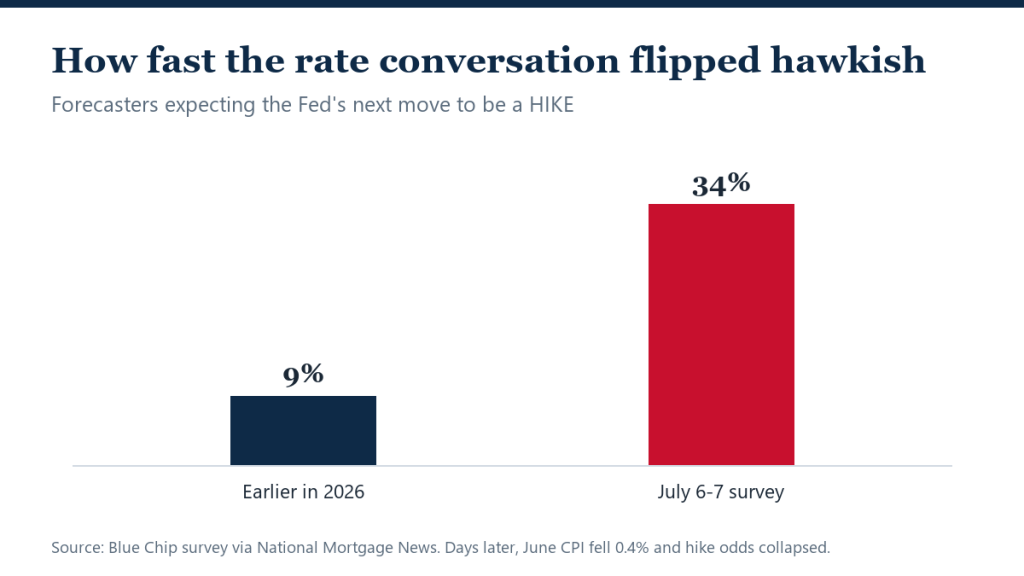
One week can rewrite the interest-rate story. A Blue Chip survey of economists conducted July 6–7 found 34% expecting the Federal Reserve’s next move to be a rate hike — up from just 9% earlier in the year, according to published forecaster surveys. For mortgage lenders staring at 30-year rates near 6.49%, it read as a warning that borrowing costs might grind higher into the fall.
Then the June Consumer Price Index landed on July 14 — down 0.4% for the month, the largest decline since April 2020 — and the hawkish scenario deflated in a single morning. Markets moved to price an 85%-plus probability that the Fed holds steady at its next meeting.
The whiplash, in sequence
- Earlier in 2026: 9% of surveyed forecasters expected the next Fed move to be a hike.
- July 6–7: that share hit 34%, with 30-year mortgage rates around 6.49%.
- July 14: June CPI fell 0.4%; annual inflation cooled to 3.5% and hike expectations collapsed.
What the episode actually teaches
The lesson is not that forecasters are foolish — it is that in a data-dependent regime, expectations are perishable. The survey honestly captured accumulating inflation anxiety after a spring of sticky readings; one cool CPI print honestly reversed it. Borrowers who made decisions in the anxious week — locking at a premium, or walking away from an affordable deal — paid a real price for treating a snapshot as a trend.
It also explains this year’s mortgage-rate turbulence: February’s brief 5.98% low, June’s 6.49% — every swing traces to repricings exactly like this one, the mechanism laid out in how the Fed does and does not move mortgage rates.
What borrowers should do with it
Treat any single week’s rate consensus as weather, not climate. Practical hedges — float-down clauses, honest break-even math before paying points, and the discipline of a written lock strategy — outperform prediction every time the story flips this fast.
The whiplash was expensive infrastructure for lenders, too. Rate expectations drive hedging costs across every locked pipeline; a five-fold jump in perceived hike risk forces mortgage shops to pay up for protection that a week later looked unnecessary. Some of that cost inevitably reaches borrowers as wider spreads — one reason 30-year rates near 6.5% sit further above Treasuries than their long-run norm.
This year has already run the drill twice. Rates touched 5.98% in late February — the lowest since September 2022 — before geopolitics and an inflation scare drove them back to 6.49% by June, per Freddie Mac’s survey data cited across the industry. Each leg looked decisive in the moment; each was substantially retraced. The forecasting community’s July stumble is the same lesson at institutional scale.
None of this makes the next print predictable. It makes over-reacting to any single print predictably costly — for forecasters, lenders and household borrowers alike.
FAQ
Did the Fed actually raise rates?
No. The survey measured expectations of the next move. After June’s CPI decline, markets priced roughly 86% odds of no change at the following meeting.
Why did economists expect a hike at all?
Spring inflation readings had firmed — May’s CPI ran 4.2% year over year — and some Fed officials had signaled discomfort. The July survey captured that anxiety at its peak, days before the data turned.
What should I watch instead of surveys?
The data the surveys react to: monthly CPI and PCE inflation, the jobs report and the 10-year Treasury yield, which mortgage pricing follows far more faithfully than any poll.