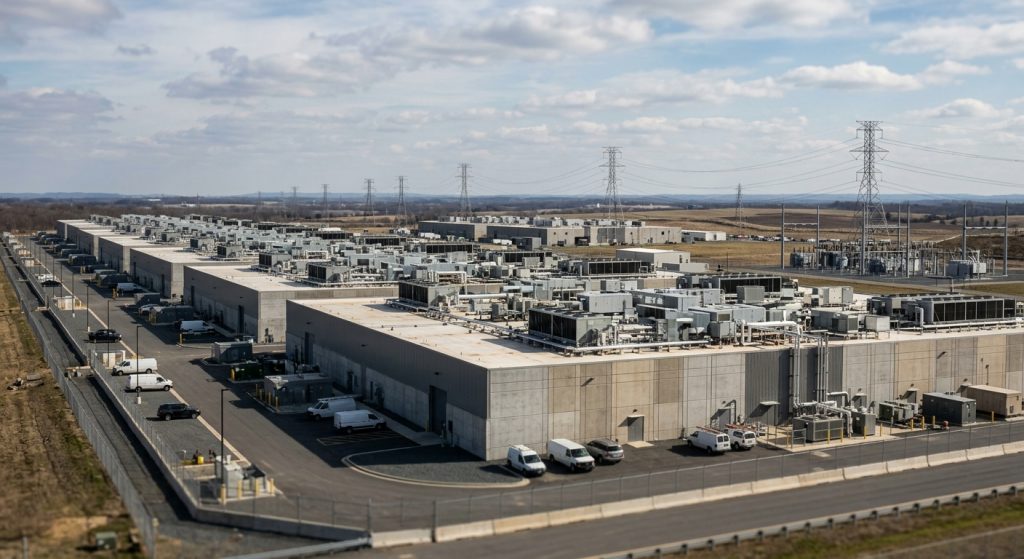
Data center vacancy rates have fallen to record lows across major U.S. markets even as construction activity stays constrained by power availability and permitting delays, according to CBRE research. The firm projects that limited supply through 2030 will keep pushing pricing to unprecedented highs, driven by AI-related demand.
Northern Virginia, the country’s largest data center market, saw vacancy fall to just 0.3%, down from 0.8%, even as the region added a record 1,135.9 megawatts of new inventory. Atlanta’s vacancy dropped to 1%, from 3.6% a year earlier, and Dallas-Fort Worth hit a record-low 1.8% vacancy rate while jumping to become the third-largest U.S. data center market, with inventory expanding 43.7%.
Global inventory growth is even more pronounced outside the largest U.S. hubs: CBRE found Latin America leading all regions with 41.3% year-over-year inventory growth in the first quarter, driven in part by Querétaro, Mexico’s 450.2% expansion, while North America overall grew 33%. Singapore’s vacancy rate held near 2%, which CBRE described as structurally constrained by the city-state’s limited developable land.
Power and permitting are the binding constraint
CBRE’s research ties the tight vacancy directly to constraints on new supply rather than softening demand. In the Chicago market, ComEd’s power-delivery timelines now extend into 2032 or later, according to the report, while in Northern Virginia, Dominion Energy’s grid upgrades are supporting some growth but local zoning limits are capping how much new capacity can actually be built. CBRE found no material improvement expected in Dallas-Fort Worth’s grid interconnection timelines over the next six to 12 months, despite the market’s rapid growth.
Even so, developers are moving ahead where they can secure power: Dallas-Fort Worth’s construction pipeline is 88% preleased, with a record 716.7 megawatts under development, a level of pre-commitment CBRE said reflects continued confidence from hyperscale cloud providers and AI companies despite the uncertainty around power delivery.
Rents climbing alongside vacancy declines
The supply constraints are showing up directly in pricing. CBRE tracked data center rental rates in Chicago rising 14.7% year over year to a range of $200 to $230 per kilowatt per month. Internationally, Frankfurt rates reached $235 to $265 per kilowatt per month — the highest in Europe — while Singapore commanded $330 to $475 per kilowatt per month, the highest rate CBRE tracked globally, reflecting that market’s structural land constraints.
What it means
CBRE’s findings help explain why data centers have become such an intense flashpoint for local land-use fights nationwide: with vacancy near zero and rents climbing double digits in major markets, operators have strong financial incentive to keep building despite grid bottlenecks — which is exactly what’s fueling the wave of local moratoriums, zoning fights and now land-price competition with homebuilders that RealtyWire has tracked across multiple states this year. The dynamic mirrors what CBRE has separately found in traditional apartment markets tightened by tech-driven demand, such as San Francisco’s apartment vacancy rate falling to a quarter-century low amid renewed AI and tech hiring. The research suggests that even aggressive local pushback is unlikely to meaningfully cool the sector’s fundamentals in the near term, since the binding constraint on new supply is the power grid itself, not permitting appetite from developers or capital availability from investors. That dynamic points toward continued friction between data center operators and the communities, and housing developers, competing with them for the same land and electricity capacity.