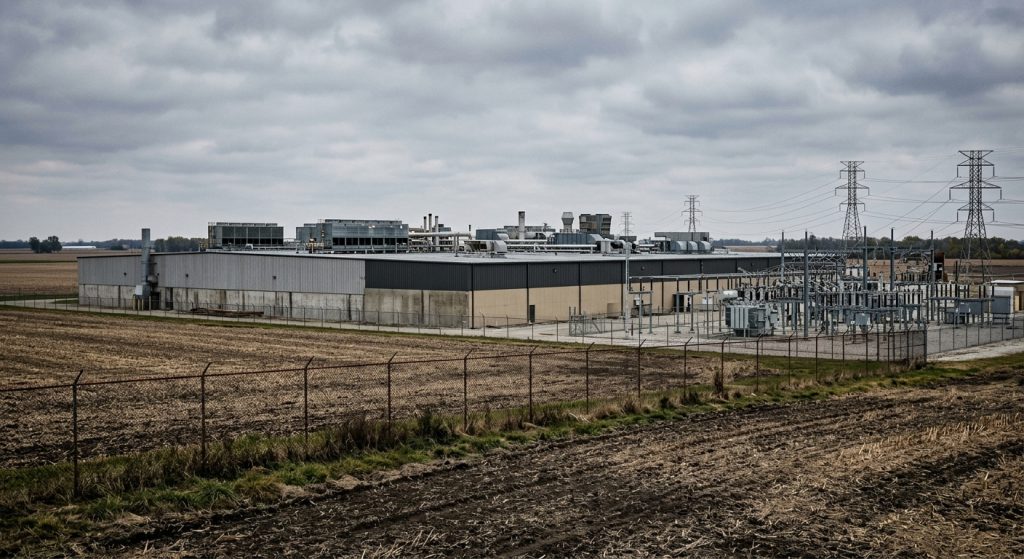
Amazon Web Services will spend more than $1 billion over the next five years on the counties where it builds data centers, the company said Oct. 2, and it will stop using nondisclosure agreements with the government agencies that review those projects.
The commitments came in a long signed essay published by Matt Garman, chief executive of Amazon Web Services, who framed the data center buildout as a national infrastructure project on the scale of the interstate highway system and local resistance to it as a threat to American competitiveness in artificial intelligence. “Right now there are over 100 data center moratoriums being considered across the country,” Garman wrote. “If these measures are enacted, the U.S. could be writing its own losing ticket to this race.”
For the real estate industry, the sum matters less than what it signals. On our reading, the binding constraint on data center development has shifted from capital and equipment to land-use approval — zoning boards, county commissions and utility regulators — and Amazon is now attaching a price to getting through them.
What the money buys
The program, which Amazon calls Built Together, is organized around three pillars and begins in the United States.
The first is education and workforce training. Amazon says it will cover out-of-pocket costs after financial aid for residents of data center communities pursuing certificates or associate degrees in fields including electrical work, HVAC, fiber optics, information technology, health care, education, public safety and advanced manufacturing. The company estimates it will connect more than 300,000 students to free degree access over five years, and says it has begun signing agreements with local community colleges.
Amazon also plans to expand its Modular Training Centers — facilities built on or near data center sites, with simulated data halls and outdoor yards holding fiber vaults and utility poles. Three are operating, six are under development and 16 more are planned under the new spending. Each handles roughly 2,000 to 4,000 learners a year in programs running four to 16 weeks; by the end of 2028, Amazon says, the network should prepare up to 100,000 workers annually.
The second pillar is energy and water. Working with nonprofits, utilities and state energy offices, Amazon will offer grants for efficiency upgrades — heat pumps and HVAC systems, insulation, water heaters, batteries and solar — to K-12 schools, publicly owned buildings and single-family and multifamily homeowners in counties where it has data centers. The company targets more than 300 schools and community buildings and more than 30,000 homes over five years, and says the work is intended to cut monthly energy bills by 20% to 40%, which it puts at roughly $700 a household annually.
The third pillar is unrestricted money. Amazon says it will route millions of dollars a year per community through local nonprofits and community foundations, with the spending directed by residents and county officials rather than by the company. The categories it lists include roads, parks and athletic facilities, fire department equipment, affordable housing, food security, school improvements and disaster preparedness. “This is not Amazon deciding what communities need,” Garman wrote.
The tenets, and the taxes
Alongside the spending, Garman said Amazon has codified its practices into a set of tenets it is calling the Amazon Data Center Commitment. Besides ending government NDAs, these include using backup generators at new sites that meet the Environmental Protection Agency’s Tier 4 emissions standard or an equivalent, publishing energy use, energy efficiency, water use, water efficiency and the share of carbon-free power annually, and working with utilities so that the rates Amazon pays cover both the electricity it uses and the grid upgrades its projects require.
That last point goes to the complaint driving much of the opposition. Amazon’s own accounting of the upside is tax revenue: it says its taxes in St. Joseph County, Indiana, are estimated to exceed $3 billion, against $1.2 million the prior land use would have generated over the same term, and that a project in Montgomery County, Missouri, will pay more than $1.8 billion over 25 years against about $200,000. The company also cites a 2026 report by Mangum Economics for the Northern Virginia Technology Council estimating that without data center revenue, the average homeowner in Loudoun County, Virginia, would pay $5,800 more in property taxes each year.
On construction employment, Amazon says more than 2,300 people are working at its two sites in Madison County, Mississippi, a county of about 116,000, where it expects to employ more than 1,700 permanently, and more than 1,500 are working in Newton County, Georgia, where it expects 400 permanent jobs. Those figures are the company’s, not an independent audit.
Whether it lands
Amazon says it has already put more than $1 billion into U.S. data center communities over the past three years. Measured against that, the new pledge reads to us as a second round of comparable size rather than a step change in spending; what is genuinely new is the attempt to standardize terms — disclosure, generator emissions, rate structures — across jurisdictions instead of negotiating each one privately.
The headwind is substantial. Recent polling put local opposition to nearby data centers at 69%, and tracking of blocked and delayed projects counted $68 billion of development stalled in the second quarter. Homebuilders have their own complaint, saying data center buyers are outbidding them for land at prices homebuilding cannot support — a competition for sites that community grants and training centers do not address.
Amazon says the community college program and the energy grants will roll out over the coming months.