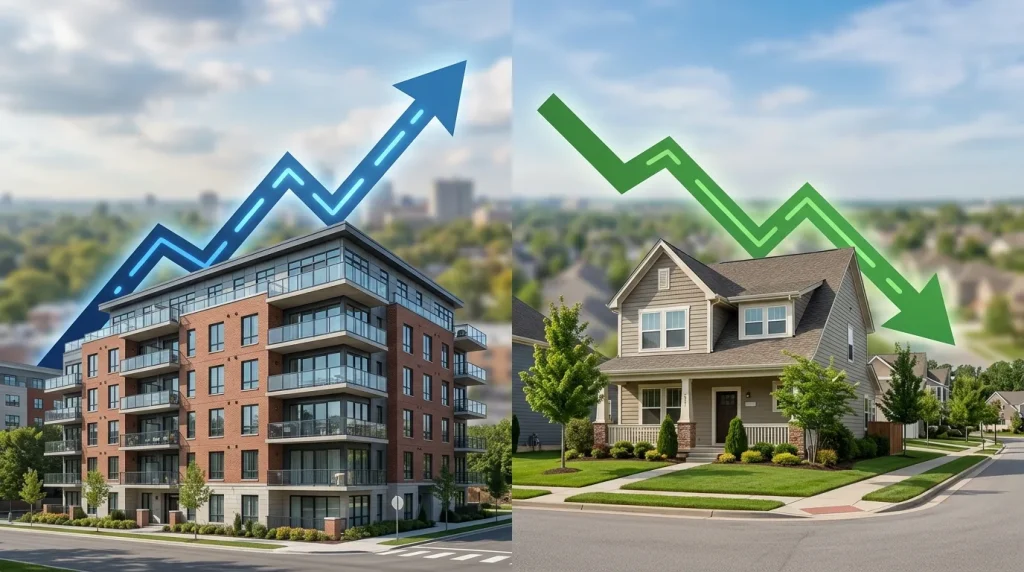
Apartment rents and single-family rents are moving differently in 2026 because they are responding to different supply and demand forces.
Apartments are being shaped by a large wave of multifamily construction. New supply has given renters more choices in many markets, pushed concessions higher and cooled asking rents. Single-family rentals are also seeing slower rent growth, but they serve a different renter profile: households that often want more space, yards, garages or school-district access without buying.
That means the rental market is not one market. It is two related but distinct stories.
Key takeaways
- Apartment rents are seeing more supply-driven relief.
- Zillow said 79.4% of multifamily rental listings were affordable to a median-income household in May.
- Zillow said only 47.3% of single-family rental listings were affordable.
- Cotality reported single-family rent growth of 1.4% year over year in April 2026.
- Single-family rentals remain less affordable because they often offer more space and ownership-like features.
- Renters should compare total cost, not just base rent.
Apartments are absorbing new supply
Apartments have seen the clearest affordability improvement because multifamily construction added many new units.
Zillow reported that 74% of rental listings on its platform were affordable to a median-income household in May 2026, the highest May share in its data. Multifamily listings were much more affordable than single-family rentals: 79.4% of multifamily listings were affordable, compared with 47.3% of single-family listings.
Apartment List also showed a soft national rent trend. Its May report said the national median rent rose 0.5% month over month, reflecting seasonal moving activity, but remained down 1.5% year over year and 4.4% below the 2022 peak.
The apartment story is about supply. When renters have more buildings to choose from, landlords may compete with concessions, slower rent increases or both.
Single-family rentals serve a different need
Single-family rentals are not just larger apartments.
They often appeal to households that want more bedrooms, yards, garages, privacy, school access, pet flexibility, neighborhood feel or ownership-like living without buying.
That demand can keep single-family rentals expensive even when apartment rents soften.
Cotality’s April 2026 Single-Family Rent Index showed national single-family rents up 1.4% year over year, down from 2.8% growth a year earlier. Detached rentals rose 1.1%, while attached rentals rose 1.0%.
Why apartments may show more concessions
Apartments are professionally managed at scale. When a new building opens with dozens or hundreds of units, the owner may offer concessions to lease up quickly.
A single-family rental owner may own one home or a smaller scattered portfolio. If the home is in a desirable school district or has features renters cannot easily find in apartments, the owner may face less direct competition.
That is why renters may see one month free at a new apartment building but not on a detached rental home in the same market.
Regional differences are widening
Cotality reported that single-family rent gains were stronger in parts of the Midwest and Northeast, while some Sun Belt markets were flat or declining. Apartment markets are also local. CBRE said multifamily rent growth is expected to remain low for much of 2026 because of economic headwinds and the amount of new supply still available for lease.
National averages are useful, but renters and landlords should make decisions at the metro and neighborhood level.
What renters should compare
A renter choosing between an apartment and a single-family rental should compare base rent, concessions, utilities, parking, pet fees, yard maintenance, renter’s insurance, commute, school access, lease term, renewal history, maintenance response and move-in costs.
A single-family rental may cost more but offer space and privacy. An apartment may offer a lower effective rent, better amenities or more flexibility.
What this means
Apartment rents and single-family rents are moving differently because renters are not buying the same product.
Apartments are seeing the strongest supply relief. Single-family rentals are being supported by households that want more space but cannot or do not want to buy.
For renters, the best choice depends on lifestyle and total cost. For landlords and investors, the best strategy depends on local supply, tenant demand and expense growth.
FAQ
Are apartment rents and single-family rents moving the same way?
No. Apartments are more affected by new multifamily supply, while single-family rentals are shaped by demand for space, yards and ownership-like features.
Are apartments more affordable than single-family rentals?
Yes, in Zillow’s May 2026 data. Zillow said 79.4% of multifamily listings were affordable to a median-income household, compared with 47.3% of single-family listings.
Are single-family rents still rising?
Yes, but slowly. Cotality reported single-family rents rose 1.4% year over year in April 2026.
Why do apartments offer more concessions?
Large apartment buildings may need to lease many units quickly, especially after new supply is delivered. Concessions help maintain occupancy.
Sources with clickable URLs
- Zillow — May 2026 Rent Report
- Apartment List — National Rent Report
- Cotality — Single-Family Rent Growth Steadies in April 2026
- CBRE — 2026 U.S. Multifamily Outlook