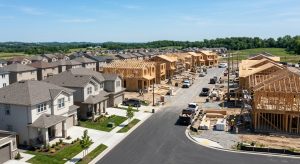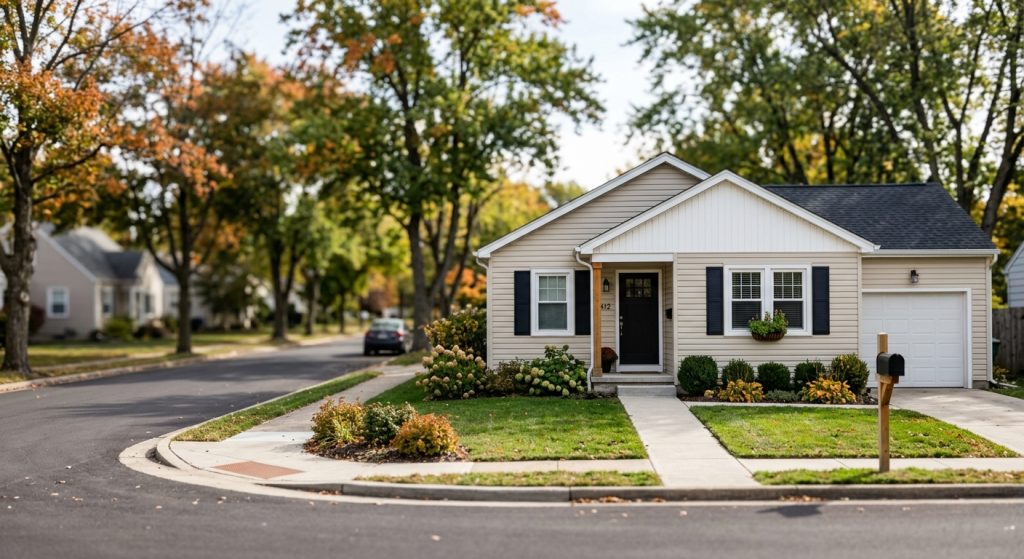
About 8% of all owner-occupied U.S. homes — roughly 6.9 million properties — are now valued at $1 million or more, up from just 2% two decades ago, according to a new National Association of Realtors report covered by Realtor.com. The shift means a seven-figure price tag increasingly buys a modest house rather than a mansion.
Home prices have climbed more than 225% since 2000 according to the Case-Shiller index, far outpacing the 93.6% cumulative rate of overall inflation over the same period. That means a $1 million home today is roughly equivalent in purchasing power to a $308,000 home in 2000, the report found.
Hawaii, D.C. and California lead a lopsided map
The share of million-dollar homes varies sharply by state. In Hawaii, about 40% of all homes are now valued at $1 million or more; in Washington, D.C., 31.5% are, and in California, 31.3% are. Washington state (17.4%), Massachusetts (15.5%) and New York (13.6%) round out the higher end. At the other extreme, NAR principal economist Nadia Evangelou found that fewer than 2% of homes in Iowa, Indiana, Kentucky, Louisiana, Nebraska and Ohio cross the $1 million threshold, and only about 1% do in Mississippi, North Dakota and West Virginia.
“A million-dollar home may be relatively common in one state and very rare in another,” Evangelou said. “Buyers should adjust their expectations to the local market instead of comparing prices across markets.”
Why so many listings end in $999,999
The report also documented “price bunching” just below the $1 million mark — a pattern with both tax and psychological roots. New Jersey and New York impose mansion taxes that add an extra 1% transfer tax on homes over $1 million; New York City’s mansion tax kicks in at exactly that threshold, calculated as a percentage of the full purchase price, so a home priced at $1,000,001 can effectively cost thousands more than one priced at $999,999. Connecticut, Hawaii, Vermont and the city of Los Angeles apply mansion taxes at higher multimillion-dollar price points, while Washington state and D.C. use progressive mansion taxes that hit lower price tiers. Realtor.com currently lists 76 homes in New York City priced at exactly $999,999.
Beyond taxes, the report pointed to the “left-digit effect,” in which buyers reading prices from left to right perceive $999,999 as meaningfully cheaper than $1,000,000, even though the difference is a single dollar. NAR has found that, since 2015, 2.4 times as many homes priced just below $1 million have sold as those priced just above it.
“The $999,999 price tag often says more about marketing than value,” Evangelou said. “The analysis highlights how local housing markets really are.”
Advice for buyers navigating the threshold
Evangelou suggested buyers in states without a mansion tax may get more mileage from asking sellers to cover closing costs or offer other concessions than from trying to negotiate the sticker price down. In markets with a mansion tax, she said buyers can use time on market as leverage, offering just below the $1 million threshold if a home has lingered unsold. NAR Chief Economist Lawrence Yun has estimated the median U.S. home price will cross $1 million around the year 2050 as prices continue to outpace inflation.
What it means
The verified facts are NAR’s own valuation data by state and its documented sales pattern around the $1 million threshold. Evangelou’s specific negotiating advice is attributed guidance from NAR’s own economist, not a universal strategy — its usefulness depends heavily on local mansion-tax rules and how long a given home has sat on the market. What to watch: whether more states or cities adopt mansion taxes at lower thresholds as home values keep rising, which would extend price-bunching behavior further down the market. For related national pricing data, see RealtyWire’s coverage of NAR’s finding that foreign buyers spent $11 billion less on U.S. homes this year, and RealtyWire’s housing market coverage for more on where prices are heading next.