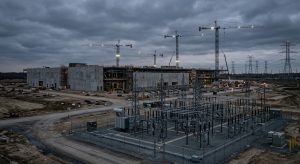
Buildots, whose computer-vision software tracks what is actually built on a construction site versus what the schedule says should be, announced a $130 million funding round on Sept. 14, 2026, and pointed it at the one corner of construction where schedule slippage is most expensive right now: the data center buildout.
The round was led by O.G. Venture Partners, with participation from Lightspeed Venture Partners, Intel Capital, Mohari Ventures, Human Capital, Qumra Capital, Avigdor Willenz, Viola Growth and Poalim Equity, according to the company’s announcement. It brings total capital raised by the Tel Aviv-based firm to $297 million. Buildots said the financing extends a multi-year run of tripling annual revenue; it did not disclose a valuation or revenue figure.
Site video, read against the schedule
The product addresses a problem that has dogged large projects for as long as there have been large projects: nobody on site agrees on how far along the job really is. Buildots’ models turn video footage captured on site into a continuously updated digital twin of the building, reading that imagery against the construction schedule and the 3D model to classify hundreds of types of work as done, partially done or not started. The company says the models were trained on eight years of data gathered from real job sites rather than from general-purpose models or scraped material.
What that replaces is the weekly percentage-complete report assembled by hand, the walk-through, and the superintendent’s judgment. What it produces is a forecast: when a trade falls behind the sequence on a block of floors, the slip shows up in the data before it compounds down the schedule.
Buildots says more than 100 large firms now use the platform, a group that includes owners such as Intel and the data center landlord Digital Realty alongside contractors STO Building Group, JE Dunn, Mortenson, Bouygues and HOCHTIEF. Elsewhere in the announcement the company also names Turner Construction among its users. The list mixes owners building facilities for themselves with the general contractors they hire.
The data center connection
ConstructConnect’s autumn forecast, published Sept. 8, put data centers at $77.4 billion of the roughly $78 billion increase expected in U.S. commercial construction this year — effectively all of the segment’s growth. On those jobs a week of delay is measured against contracted power delivery and tenant move-in dates.
On our reading, that is what makes this round legible. Construction has long been a hard market for software vendors, whose buyers are project teams working on thin margins and short contracts. A wave of very large, very schedule-sensitive projects changes the arithmetic: instrumentation that surfaces a slip early is far easier to justify on a billion-dollar hyperscale campus than on a garden-apartment deal.
Buildots said seven-figure, portfolio-wide, multi-year agreements are now standard in its business rather than exceptional — a claim consistent with selling to owners running many sites at once rather than to a single general contractor on a single job.
“It will soon be inconceivable that anyone managed a construction portfolio without Buildots,” said Roy Danon, the company’s chief executive and a co-founder. “That shift was already underway before the AI buildout, but the buildout has poured rocket fuel on it. Buildots is now used across residential, commercial and — of course — mission-critical projects worldwide, on jobs of every size, from single sites to entire portfolios. The blind spot we solve for a data center is the same one that’s been costing a school or a hospital for decades, just at much greater scale, which is why the world is finally paying attention.”
Ziv Kop, managing partner at O.G. Venture Partners, framed the investment in platform terms: “In 20+ years of backing category-defining companies, the pattern is always the same: the winners build the foundational technology layer that everyone else ends up depending on. Buildots is that layer for construction, trained on a volume and quality of site data that nobody else has.”
Where the money goes
The company laid out three directions for the capital: wider, into more large portfolios across North America and EMEA; deeper, across the full project lifecycle from bidding through handover; and higher, into portfolio-level intelligence for executives managing many projects at once. That last piece is the commercially interesting one — it moves the product from a job-site tool bought by project teams to a system bought by the C-suite, which is where software contracts get large and hard to cancel.
Two investors are new to the cap table: Mohari Ventures and Human Capital, which Buildots described as the San Francisco firm behind companies applying AI to the physical world, including SpaceX, Neuralink and Anduril. Existing backers listed include TLV Partners, Future Energy Ventures, Maor Investments and Tidhar. Buildots was founded by Danon, Yakir Sudry and Aviv Leibovici.
The round lands in a construction technology market that has been consolidating and recapitalizing at pace. Procore agreed to buy reality-capture company DroneDeploy for $845 million, and venture money has moved toward hardware as well as software, with autonomous excavators now working on U.S. job sites. The common thread is labor. Investors are betting the gap between the work in the pipeline and the people available to do it gets closed with instrumentation and automation rather than with headcount.