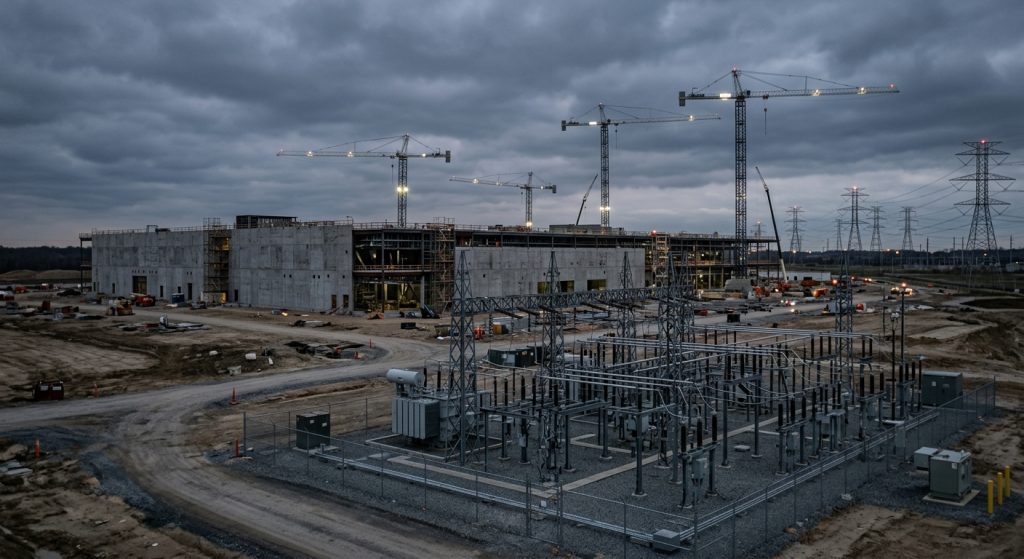
It now costs an average of $17.6 million per megawatt to build a modern data center in the United States or Canada — 21 percent more per megawatt than it did at the end of 2024, according to the 2026 Data Center Development Cost Guide that Cushman & Wakefield released Sept. 3.
That figure excludes the chips and GPUs that go inside. It is the cost of the real estate, the shell, the sitework and, above all, the power.
The guide is a useful marker for developers, lenders and land sellers because it prices the constraint everyone in the sector has been describing anecdotally for two years. Cushman & Wakefield attributes the increase to supply chain strain, rising skilled-trade wages, longer lead times on critical electrical equipment and a land market that has repriced around grid access.
Power is the single biggest line item
Power infrastructure accounts for an average of 21 percent of total greenfield development cost, the largest single category in the guide’s breakdown, the firm said. Contingencies rank second — a telling detail, since contingency budgets are where developers park uncertainty about schedule and equipment delivery.
Land is a smaller share of the total but the fastest-moving one. Powered land in primary U.S. markets — parcels that already have a viable path to grid capacity — traded at an average of $584,000 per megawatt in 2026 through the date of the report, according to Cushman & Wakefield. That is 35 percent above the five-year average and 51 percent higher than a year earlier.
Those numbers put a price on a competition RealtyWire has covered from the housing side: homebuilders in Northern Virginia and other data center corridors have said they are being outbid for residential land at prices they cannot underwrite. When the buyer’s cost basis is measured per megawatt rather than per lot, the arithmetic is not close.
Capital is moving to secure that access directly. Chipmaker Nvidia took an equity stake in Lancium earlier this year, backing roughly 15 gigawatts of powered land, and equipment orders have grown to a scale that reshapes supplier backlogs — HD Hyundai Heavy Industries booked a $675 million transformer and power-equipment order for a U.S. data center, its largest ever.
Labor costs are compounding
Wages in the skilled mechanical, electrical and plumbing trades rose an average of 5 percent a year from 2021 through 2024, the guide found. Those are the trades a data center consumes most heavily, and they are the same workers that hospitals, chip fabs and multifamily projects are bidding for.
Federal data supports the squeeze. There were 326,000 open construction positions in July, up from 298,000 in June and 305,000 a year earlier, according to the National Association of Home Builders’ analysis of Labor Department job-openings data. NAHB chief economist Robert Dietz attributed part of the increase to data center construction running 46 percent above year-ago levels.
A $2.3 trillion pipeline
Cushman & Wakefield sizes the global data center development pipeline at roughly $2.3 trillion, of which $492 billion is under construction and $1.8 trillion is planned or precommitted. For scale, the firm notes the pipeline exceeds the estimated total value of all New York City real estate by about $640 billion.
The guide also projects that capital spending in what it calls frontier markets — the newest, least-developed data center geographies — will grow 6.9-fold to $631 billion. Texas markets stand out as the lowest-cost development environments in the firm’s Americas analysis.
“The data center industry is entering a new phase where access to power, land, and skilled labor are increasingly determining where growth can occur,” said John McWilliams, head of data center insights at Cushman & Wakefield.
What it means
The verified facts are the cost figures above, all drawn from the firm’s own research and presented as its analysis rather than as neutral market truth. Cushman & Wakefield brokers and advises on data center transactions, so the guide is primary for its own dataset and should be read that way.
RealtyWire’s read: a 21 percent jump in per-megawatt cost over roughly 21 months does not, by itself, slow a pipeline this large — demand for capacity has been price-insensitive. What it does is push development toward markets where power and land are cheaper and permitting is faster, which is the mechanism behind the frontier-market forecast. It also raises the stakes on the local siting fights now spreading across the country, because every delay is being priced into contingency budgets that are already the second-largest cost bucket in a build.
What to watch
Two things: whether powered-land pricing in primary markets keeps rising at a 50 percent annual clip, and whether electrical equipment lead times shorten as manufacturers add capacity. Both feed directly into the next edition of this cost curve. For ongoing coverage, see our Technology & AI section.