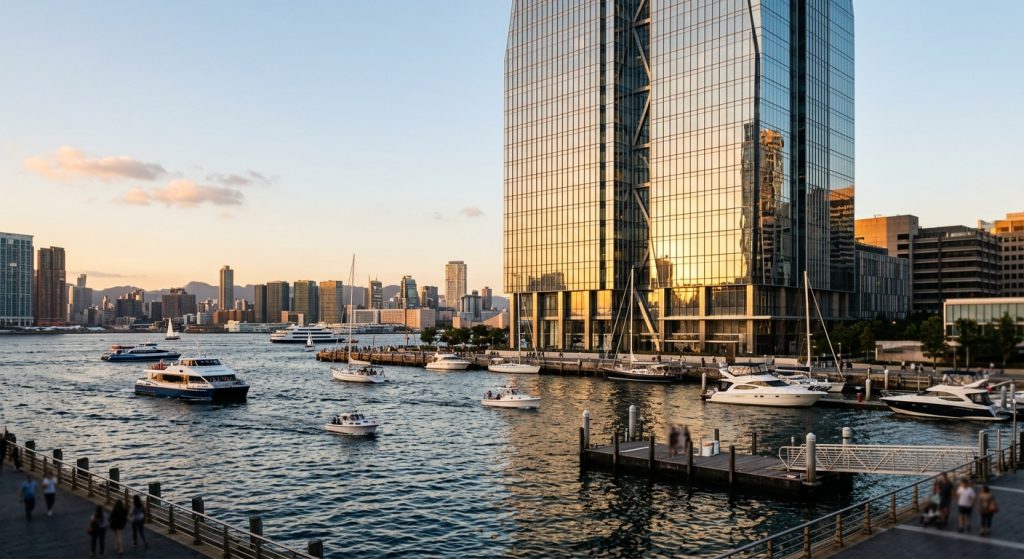
Oxford Properties has bought One Marina Park Drive, an 18-story office tower in Boston’s Seaport District, from Clarion Partners for $435 million — the Canadian investor’s first acquisition of a stabilized U.S. office asset in nearly a decade.
The Class A building is 99% leased to a mix of venture capital, legal and financial services firms, Oxford said in announcing the deal Wednesday. The LEED Gold-certified tower, built in 2010, anchors the Fan Pier waterfront mixed-use development.
The price works out to roughly $885 per square foot across the building’s 492,000 square feet — and to about 10% below what Clarion paid for it. Clarion acquired the tower for $482 million in late December 2019, according to The Boston Globe. Nearly seven years later, a fully leased trophy asset in one of the city’s most desirable submarkets changed hands for less.
A deliberate reversal
The purchase marks a turn in Oxford’s approach to the sector. The firm recycled roughly $14 billion out of office during the low-rate years from 2018 to 2022, selling into a strong market. It has since moved back in, deploying approximately $2 billion into office globally since the start of 2025.
“We continue to see compelling opportunities to invest in premier office assets in gateway cities that are well-located, well-amenitized, and positioned to benefit from the increasing focus on quality,” said Ankit Bhatt, Oxford’s head of U.S. investments. He described One Marina Park Drive as combining “a premier waterfront location, a diverse occupier ecosystem, and exceptional connectivity.”
Deepening a Boston position
The acquisition expands Oxford’s Boston Class A office footprint to more than 3.2 million square feet across three submarkets — the Seaport, Back Bay and Downtown. The firm says it is already one of the city’s largest office landlords, and it leased over 1 million square feet in Boston during 2025 to tenants including Klaviyo, Datadog and DraftKings.
“Boston is a market we know exceptionally well from our position as one of the city’s largest office landlords,” said Brian Barriero, senior vice president of U.S. operations and leasing. “This transaction demonstrates the unique strength of Oxford’s vertically integrated platform.”
Buying into a submarket where it already owns and leases space lets Oxford spread management and leasing costs across a larger base — the vertical-integration argument Barriero invoked. It also concentrates the firm’s exposure to a single market’s recovery.
What it means
Institutional capital has been slow to re-enter U.S. office, and transactions of this size for stabilized towers remain uncommon. A 99%-leased trophy asset trading hands at all is a signal that pricing for the highest-quality, best-located buildings has become legible enough for large investors to underwrite again.
But the 10% discount to the 2019 price is the more instructive number. It suggests that even best-in-class office — full, new, waterfront, LEED Gold — has not recovered its pre-pandemic value, and that the flight-to-quality dynamic Oxford cites has protected occupancy in these buildings more than it has protected price. RealtyWire’s reading is that the trade prices in stabilized income at a reset basis rather than a bet on near-term rent growth; Oxford has not characterized the deal that way, and the firm’s own framing emphasizes long-term quality positioning.
What happens next depends heavily on lease rollover in the tower and on whether Boston’s office recovery broadens beyond a handful of trophy addresses. The flight-to-quality pattern is well documented, but it has concentrated demand into a narrow set of buildings, leaving the wider market’s fundamentals weaker than any single premium trade would suggest.
The deal is the latest sign of capital activity in the Seaport, where WS Development and PSP Investments recently landed a $660 million refinancing for One Boston Wharf. Trophy office trades have picked up in other markets as well, including Canyon Creek’s $208 million purchase of the One Eleven Congress tower in Austin, Texas.