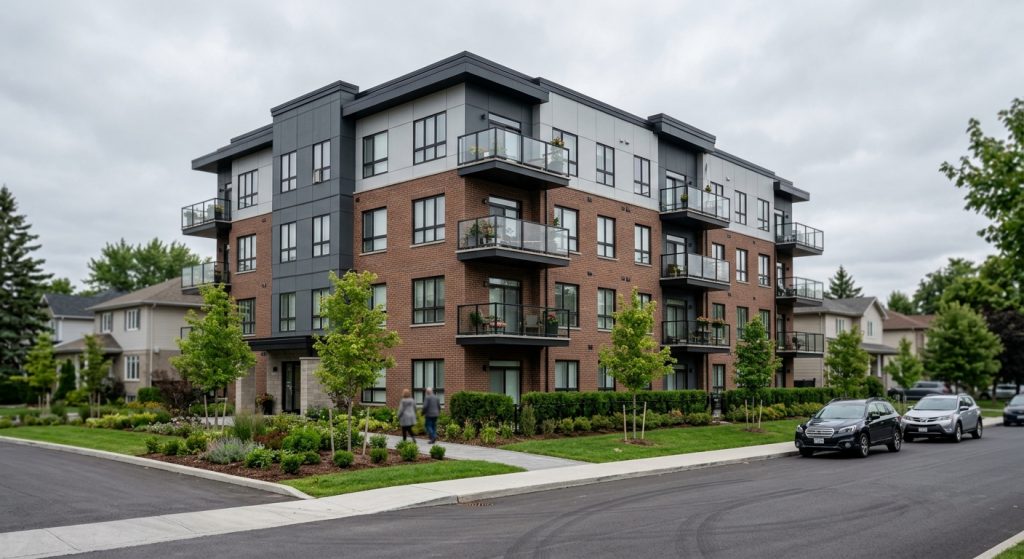
Greystone has closed a $369.6 million cross-collateralized bridge facility from PGIM covering five newly built New Jersey apartment properties totaling 1,340 units, one of the larger single multifamily bridge financings of the year.
Greystone Capital Advisors announced completion of the facility on Aug. 20, acting as exclusive advisor to the borrower, Capodagli Property Company.
Built in stages over two years
The facility was not funded all at once. Roughly $287 million closed across the first four properties in the prior year. The final tranche of $82.6 million funded Meridia Roselle Park 10, a 325-unit property delivered in 2024.
The full collateral pool consists of five Class A multifamily assets, all in New Jersey and all recently developed: Meridia Village Commons in South Orange, Meridia Pompton Lakes in Pompton Lakes, Meridia Linden 1001 in Linden, Meridia Little Ferry in Little Ferry, and Meridia Roselle Park 10 in Roselle Park.
Cross-collateralization means the five properties secure the debt collectively rather than individually. For a borrower, that structure generally allows better terms than five separate loans, because the lender’s risk is spread across a pool rather than concentrated in any one asset.
Drew Fletcher, president of Greystone Capital Advisors, credited the relationship rather than the assets. “Completing this facility reflects the strength of our long-term relationship with Capodagli and PGIM’s continued conviction in their platform,” he said.
The Greystone team also included Managing Director Bryan Grover and Vice Presidents Miryam Reinitz-Kops and Jesse Kopecky.
Interest rate, term and loan-to-value were not disclosed.
What it means
The verified facts are the facility size, the lender, the borrower, the properties and the unit count. The pricing that would reveal how the market is valuing this risk was not released.
RealtyWire’s analysis is that the significance is in the property type and the lender rather than the headline number. Bridge debt is transitional financing — it carries a project from completion through lease-up and stabilization to permanent financing. A life insurer’s asset manager writing $369.6 million of it against newly delivered suburban apartments indicates institutional lenders remain willing to underwrite lease-up risk in high-barrier Northeast markets.
That has not been uniformly true across property types. Blackstone Mortgage Trust posted a quarterly net loss driven by a reserve against a Chicago office loan, a reminder that commercial real estate credit conditions differ sharply by sector. Multifamily has held up better than office through this cycle, and financings like this one are the mechanism by which that difference shows up.
The staged funding structure is also worth noting. Capital advanced as each property completed rather than at a single closing, which is how lenders manage development and lease-up risk when they are willing to lend but not willing to fund unbuilt collateral.
New Jersey suburban multifamily has particular characteristics that support this kind of debt: constrained supply, high barriers to new entitlement, and proximity to New York employment. Those same conditions have drawn other capital into the region’s rental housing.
What to watch
The bridge-to-permanent conversion is the next step and the one that will test the underwriting. Bridge loans have finite terms, and refinancing 1,340 units into permanent debt requires the properties to hit their projected rents and occupancy.
More broadly, watch whether other insurers follow PGIM into large cross-collateralized multifamily bridge deals. Facilities at this scale require a lender comfortable with concentration in one sponsor and one state. If that appetite widens, it will show up as more portfolio-level financings and fewer single-asset loans — a meaningful shift in how newly built rental housing gets funded through its riskiest phase.