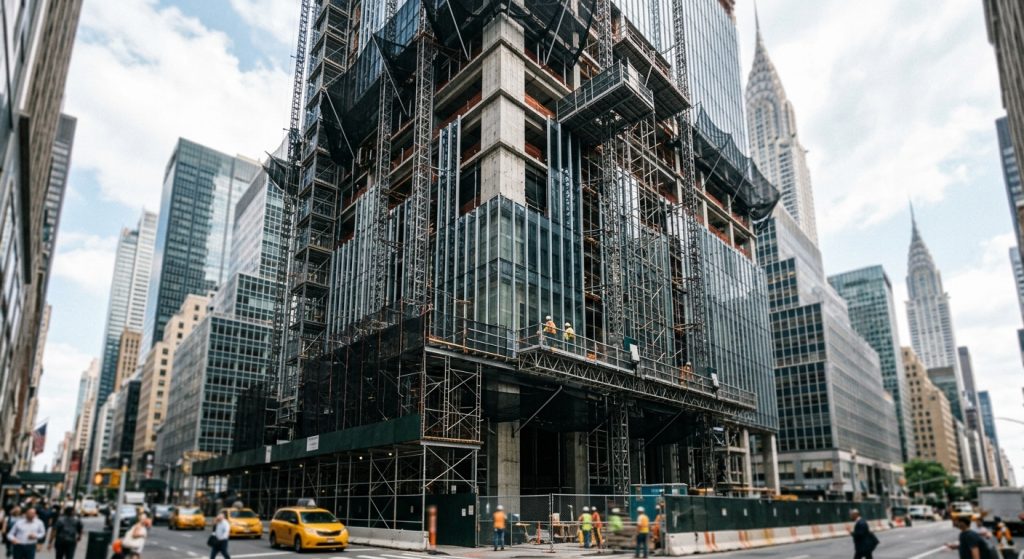
New York City’s Department of Buildings has completed the first wave of a citywide safety sweep triggered by the July 7 structural failure at the former Pfizer headquarters, finding 65 violations across 38 of the 180 job sites inspected but no signs that the incident reflects a systemic risk in office-to-residential conversion projects, according to Gothamist.
Inspectors targeted the 180 sites because each was connected to the project team behind 235 East 42nd Street — the city’s largest office-to-housing conversion, where two structural columns buckled during a 14-story vertical expansion, forcing an evacuation and the shutdown of nearby businesses. Evidence has since suggested that reinforcing steel was never installed on three floors of that building, including the 21st floor where the failure occurred.
Of the 180 sites reviewed, roughly two dozen were themselves office-to-residential conversion projects. The sweep produced 18 partial stop-work orders and one full stop-work order, which halted all construction at a Williamsburg apartment building. “DOB inspectors did not observe any immediately hazardous structural issues that posed an imminent danger to public safety,” the department said.
Second conversion halt, expanded scrutiny
The Pfizer building incident has already prompted at least one other enforcement action: RealtyWire reported that DOB halted construction at GFP Real Estate’s 222 Broadway office-to-residential conversion after inspectors found the project’s contractor and engineering firm had failed to report cracks in two concrete beams — the second such halt tied to the Pfizer scare, and evidence that the city was already widening scrutiny of adaptive-reuse projects before this latest sweep concluded.
As part of the response to the July 7 incident, MetroLoft — the developer behind 235 East 42nd Street — was ordered to hire a third-party engineering firm to conduct a peer review of the project’s structural drawings. DOB’s investigation into the root cause of the column failure remains ongoing, and the department said it plans additional enforcement sweeps targeting other firms involved in similar large-scale conversion projects.
Office-to-residential conversions have become one of the most closely watched strategies for addressing both stubbornly high office vacancy and housing shortages in expensive coastal cities. RealtyWire has tracked similar projects moving forward elsewhere, including Chicago’s groundbreaking on a $162 million conversion of a Michigan Avenue office tower into 320 apartments. New York’s DOB findings — that the conversion concept itself isn’t inherently unsafe, but that execution failures at specific job sites are — will likely shape how closely other cities scrutinize similar projects as conversions accelerate nationally.
What it means
The sweep’s headline finding — no evidence that the Pfizer building’s near-collapse reflects an inherent risk in office-to-residential conversion as a building type — is a meaningful data point for a conversion market that has become central to how cities are addressing office vacancy and housing shortages simultaneously. But the 65 violations and 19 stop-work orders across sites connected to just one project team also show that individual firms’ execution, not the conversion concept itself, is where the city is finding real safety gaps. With DOB signaling more sweeps to come, developers, contractors and engineers working on adaptive-reuse projects citywide should expect continued heightened inspection activity, particularly on projects involving vertical additions or significant structural modification of existing office towers.