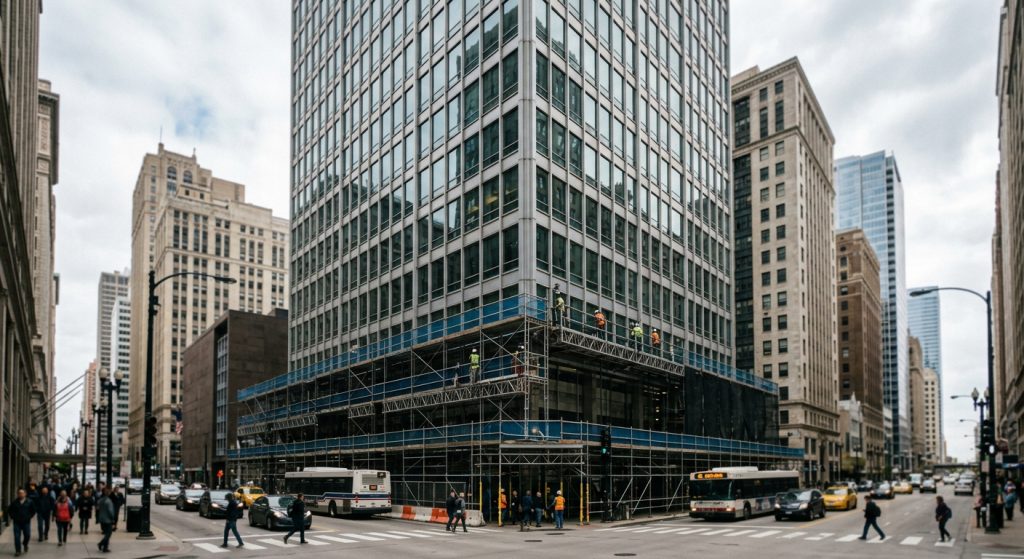
Chicago Mayor Brandon Johnson joined developers July 29 to break ground on a $162 million project converting a 25-story office tower at 500 N. Michigan Ave. into 320 apartments, one of the largest office-to-residential conversions underway on the Magnificent Mile. The city detailed the project in a July 29 press release from the mayor’s office.
Connecticut-based Commonwealth Development Partners is converting the roughly 400,000-square-foot tower, originally designed by Skidmore, Owings & Merrill and completed in 1968, into 256 market-rate and 64 affordable apartments. Skender is serving as general contractor. The building will gain a new 25th floor for indoor and outdoor amenity space, including a rooftop pool, adding about 17 feet to its height. Completion is targeted for late 2027.
“Chicago’s downtown continues to evolve, and projects like this demonstrate how we can create more housing by reimagining existing buildings,” Johnson said at the groundbreaking. “Not too long ago, the conversation on Michigan Avenue was about empty storefronts and the uncertainty of our future. But today’s groundbreaking is proof of the momentum and growth that is happening downtown.”
Department of Planning and Development Commissioner Ciere Boatright said the project reflects a broader citywide pattern. “Office-to-residential conversions are driving downtown investment and supporting a healthy mixed-use environment,” Boatright said. “The project at 500 N. Michigan underscores this trend in the heart of the Magnificent Mile.”
The 64 affordable units satisfy the city’s Affordable Requirements Ordinance, which mandates that 20% of units in qualifying developments be set aside as affordable; most will be priced for households earning up to 60% of area median income, or roughly $53,820 annually for a two-person household. The project includes a $284,282 payment under the city’s Neighborhood Opportunity Bonus System and uses Chicago’s recently updated minimum floor-area guidelines, zoning changes designed specifically to make office-to-residential conversions easier to execute in the city’s highest-density districts.
The project follows a familiar arc for downtown Chicago office towers built in the postwar decades: after decades as commercial space, the building faced rising vacancy as remote and hybrid work reduced corporate demand for older office stock, even in prime locations along Michigan Avenue. City officials have increasingly turned to conversion incentives — including the floor-area guideline changes used at 500 N. Michigan — as a tool to address both problems at once: soft office demand pulling down downtown property values and tax revenue, and a citywide need for more housing, including affordable units, in dense, transit-accessible neighborhoods.
What it means
The groundbreaking adds Chicago to the list of major U.S. downtowns using zoning incentives and adaptive reuse to address both office vacancy and housing supply simultaneously. Unlike some conversion projects that have run into structural complications — New York City recently halted a second office-to-residential conversion in a month after engineers found undisclosed structural cracks — Chicago officials are framing 500 N. Michigan as proof that the model works when zoning and financing incentives are aligned. With roughly two years until completion, the project will be an early test of whether Magnificent Mile office space commands enough residential demand to justify the conversion costs officials and developers are betting on.