
Current real estate market data, news and analysis for the Lincoln, NE metropolitan area — 352,081 residents across Lancaster and Seward counties.
Data as of May 2026. Sources: Redfin Data Center, U.S. Census Bureau.
Latest Lincoln Real Estate News
Lincoln Real Estate Market Overview
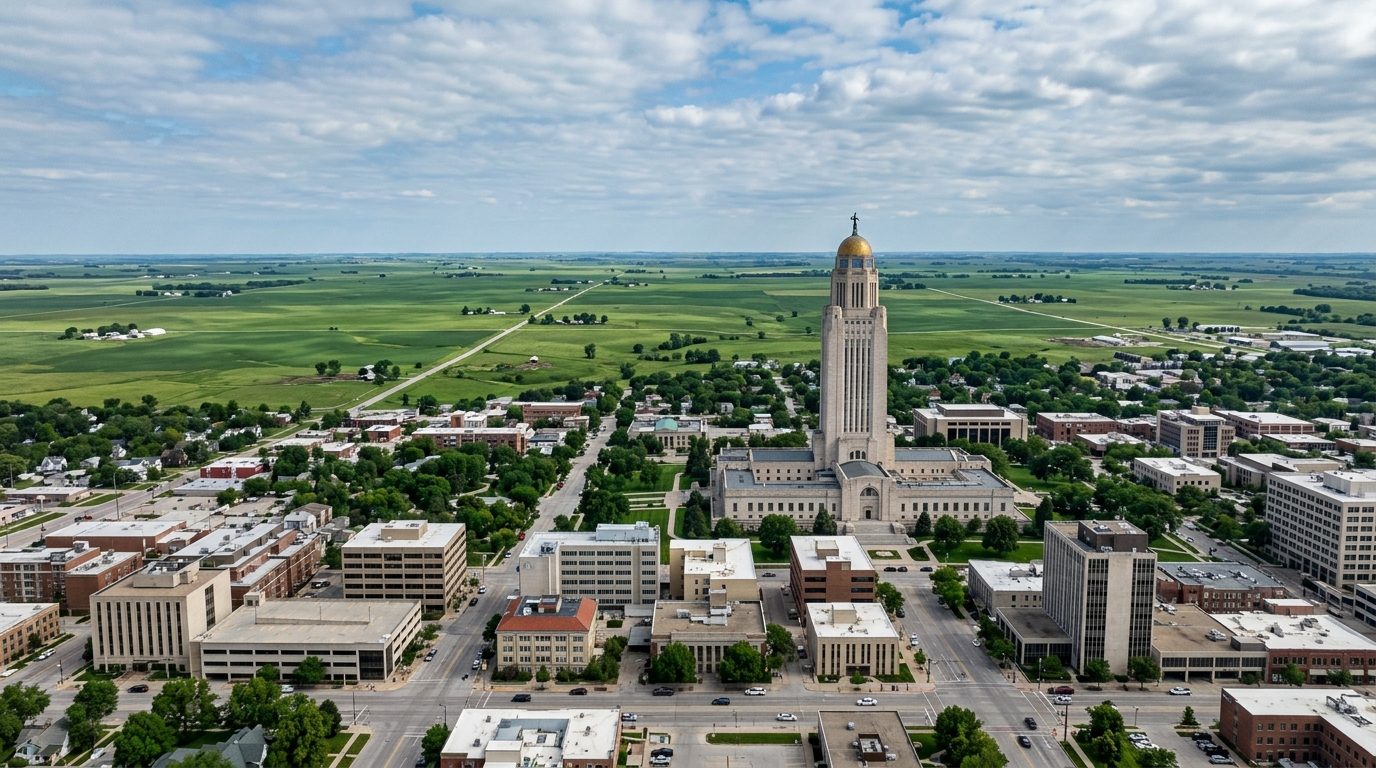
Lincoln sits in southeastern Nebraska along Salt Creek and its tributaries, in the transitional country where the rolling farmland of eastern Nebraska opens onto the broader horizon of the Great Plains. As the state capital, the city grew up around the Nebraska State Capitol and the flagship campus of the University of Nebraska, with Lancaster County anchoring the urban core and neighboring Seward County holding smaller agricultural towns to the north and west. The housing stock reflects that layered history: a dense inner ring of early bungalows, foursquares, and Craftsman-style homes near downtown and the university, surrounded by mid-century ranch homes, and an outer belt of newer subdivisions built on former farmland. Seward, Waverly, Hickman, Milford, Malcolm, and Raymond keep their own small-town housing character, mixing older farmhouses with newer starter-home developments and acreages.
Within Lincoln, the newer subdivisions on the southeast and south sides, many built around golf courses, parks, or preserved prairie and woodland, tend to command the highest prices, reflecting larger lots, contemporary construction, and proximity to newer schools and retail corridors. Established, tree-lined neighborhoods near the university and downtown carry their own premium tied to walkability and architectural character even though the homes themselves are older. Housing in the historic working-class neighborhoods that began as independent villages before being annexed into the city, along with rental-heavy areas near campus, tends to be more affordable. Among the outlying towns, communities within easy commuting reach of Lincoln generally cost more than towns farther from the main highway corridors.
The local economy centers on government, education, insurance, and healthcare rather than any single dominant industry. The Nebraska State Capitol and its associated state agencies are major employers, as is the University of Nebraska-Lincoln, the state’s flagship land-grant and research university, which anchors direct employment along with a broader economy of research, agricultural extension work, and student spending. Lincoln has a long-standing concentration of insurance and financial-services firms, including Ameritas and Assurity, both mutual insurers headquartered in the city, alongside Nelnet, a large student-loan and financial-services company based downtown. Bryan Health anchors hospital-system employment, while manufacturing is represented by Kawasaki’s motorcycle and personal-watercraft plant and Duncan Aviation’s aircraft maintenance operations. In Seward, Concordia University, a private Lutheran college, is a significant local employer drawing students from surrounding rural counties.
Like much of eastern Nebraska, the Lincoln metro sits in a corridor prone to severe spring and summer thunderstorms, including large hail and occasional tornadoes, a pattern worth factoring into insurance shopping and roof or siding inspections on older homes. Nebraska carries comparatively high property tax rates by national standards, and buyers should confirm which school district serves a given address, Lincoln Public Schools or the separate systems serving Seward, Waverly, Hickman, and Milford, since boundaries do not always track town or county lines. Public transit is limited to the city bus network and does not extend to the surrounding towns, so commuting across the metro is largely car-dependent. Buyers in outlying areas should verify well and septic systems, road maintenance responsibility, and floodplain status near Salt Creek, Antelope Creek, and the Big Blue River, along with any homeowners association rules that apply in newer planned subdivisions.
Cities and Towns in the Lincoln Metro Area
Notable Communities and Neighborhoods
Lincoln Real Estate Market FAQ
How is the Lincoln metro area organized geographically?
The metro is built around Lincoln, the state capital and Lancaster County seat, which grew outward from downtown and the University of Nebraska campus in concentric rings of older and newer neighborhoods. Seward County, to the north and west, holds smaller, largely self-contained towns such as Seward, Waverly, Hickman, Milford, Malcolm, and Raymond, which function partly as bedroom communities and partly as their own agricultural trade centers rather than as contiguous suburbs of Lincoln.
Which areas of the metro tend to be pricier, and why?
Newer subdivisions on Lincoln’s southeast and south sides, often built around golf courses, parks, or preserved natural land, tend to be priced higher because of larger lots and newer construction. Established neighborhoods near downtown and the university also carry a premium tied to walkability and character despite older housing stock. More affordable options are generally found in the historic neighborhoods that began as separate villages before being absorbed into the city, and in rental-heavy areas near campus.
What should buyers verify locally before purchasing in this metro?
Buyers should confirm which school district actually serves a property, since Lincoln Public Schools and the independent districts around Seward, Waverly, Hickman, and Milford do not always follow town or county lines. Outside the city, it is worth checking whether a home relies on well water and a septic system, who maintains the access road, and whether the parcel falls within a floodplain along Salt Creek, Antelope Creek, or the Big Blue River. Any homeowners association covenants in newer planned subdivisions should also be reviewed directly.
What regional risk factors are relevant to homeownership here?
The metro lies in a part of the Great Plains that regularly experiences severe spring and summer thunderstorms, including large hail and occasional tornadoes. This makes roof and exterior condition, along with the specifics of homeowners insurance coverage for wind and hail damage, a routine part of due diligence rather than an unusual concern.
Nearby Markets