
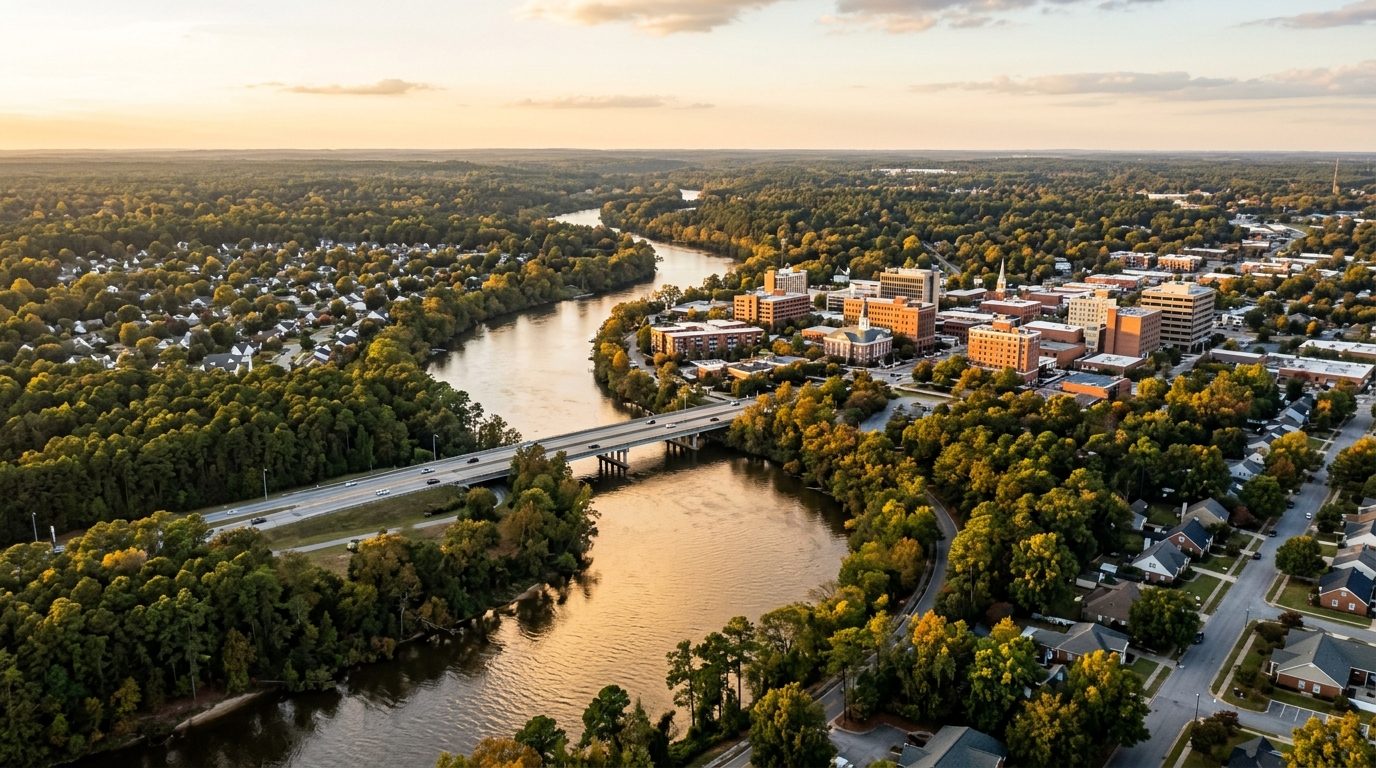
Current real estate market data, news and analysis for the Fayetteville, NC metropolitan area — 395,412 residents across Cumberland and Hoke counties.
Data as of May 2026. Sources: Redfin Data Center, U.S. Census Bureau.
Latest Fayetteville Real Estate News
Fayetteville Real Estate Market Overview
The Fayetteville metro area sits in the Sandhills region of North Carolina’s coastal plain, centered on Cumberland County and extending west into Hoke County, whose seat is Raeford. The Cape Fear River runs through the eastern side of Fayetteville, and Fort Bragg borders the city on the north and west, with Spring Lake sitting against its main gates. Smaller communities such as Hope Mills, Eastover, Stedman, Wade, Linden, Godwin, and Falcon ring the core city along the region’s rural-to-suburban edges. Housing stock reflects this layered growth: brick ranches and colonial-revival homes cluster near downtown, postwar-era subdivisions built for Fort Bragg families spread through the city’s western and southern sections, and newer subdivisions and townhome developments continue filling in along corridors such as Raeford Road, Cliffdale Road, and Ramsey Street, extending toward Hope Mills and into Hoke County.
Certain areas command higher prices because of history, water access, or golf-course and gated amenities. Haymount’s tree-canopied streets near downtown and the Cape Fear bluffs, the golf-and-river setting of Kings Grant, the gated fairways of Gates Four, and the lakefront lots around Loch Lomond and Hope Mills Lake sit toward the top of the local price range. Lower-cost housing sits closest to Fort Bragg’s gates, in Spring Lake and in older homes built for rotating military families, and in the city’s earlier mill-village neighborhoods, such as Massey Hill. Newer growth in Hoke County and the outer edges of Hope Mills prices below the established in-town neighborhoods but above the oldest starter stock, aimed at a broad range of military and civilian buyers.
The regional economy is anchored overwhelmingly by the United States Army at Fort Bragg, home to Army Special Operations Command and major airborne and forces-command headquarters, along with active-duty soldiers, military families, Department of the Army civilians, and contractors who make the post the area’s dominant economic engine. Outside the gate, Cape Fear Valley Health System is the largest civilian employer, operating Cape Fear Valley Medical Center and affiliated clinics. Cumberland County Schools and local governments — Fayetteville, Cumberland County, and Hoke County — employ large numbers of residents, as do Fayetteville State University, Methodist University, and Fayetteville Technical Community College, which also maintains a campus on Fort Bragg. Retail, logistics, and light manufacturing round out the base.
Because so much of the population turns over with military relocation orders, the housing market runs on a different rhythm than most metros: rental demand tracks deployment and relocation cycles, VA loans are common among buyers and sellers, and much of the housing near the post is owned by investors who rent to military tenants. Buyers should confirm a property’s flood-zone status before purchasing, since the Cape Fear River and its tributaries, including Cross Creek and Rockfish Creek, have produced flooding in past hurricanes, and low-lying neighborhoods near the river and creek corridors carry different insurance and building requirements than higher ground. Property tax rates and municipal fees differ by jurisdiction — Fayetteville, unincorporated Cumberland County, Hope Mills, Spring Lake, and Raeford each set their own rates — so buyers should verify the applicable rate for a specific address. Buyers evaluating newer subdivisions should check school assignments, HOA requirements in gated communities, and proximity to Fort Bragg’s gates, since commute patterns and rental demand are closely tied to base access.
Cities and Towns in the Fayetteville Metro Area
Notable Communities and Neighborhoods
Fayetteville Real Estate Market FAQ
How is the Fayetteville, NC metro area organized geographically?
The metro centers on Fayetteville and Cumberland County, with Fort Bragg forming a large military footprint along the city’s north and west sides, and Hoke County, anchored by Raeford, extending the metro further west. Smaller towns — Hope Mills, Spring Lake, Eastover, Stedman, Wade, Linden, Godwin, and Falcon — ring the core city, generally becoming more rural the farther they sit from Fayetteville and Fort Bragg’s gates.
Which parts of the metro tend to be pricier, and why?
Neighborhoods with established tree cover and history near downtown, such as Haymount, and those built around golf courses, rivers, or lakes, such as Kings Grant, Gates Four, and Loch Lomond, tend to carry higher prices because of their setting and amenities. Areas closest to Fort Bragg’s gates and older, smaller homes built for earlier generations of military families tend to be more affordable, as do many newer subdivisions still filling in toward Hope Mills and Hoke County.
What should buyers verify locally before purchasing in this metro?
Buyers should confirm a property’s flood-zone designation given the Cape Fear River and its tributaries, check which municipal or county jurisdiction applies since Fayetteville, Hope Mills, Spring Lake, Raeford, and unincorporated Cumberland or Hoke County each set their own tax rates and fees, review school assignment, and, for gated or golf-course communities, review HOA rules and dues.
How does Fort Bragg shape the local rental and housing market?
Because so much of the metro’s population rotates through on military orders, rental demand and turnover track deployment and permanent-change-of-station cycles rather than typical seasonal patterns, VA loans are common in both purchase and resale transactions, and a substantial share of homes near the post are owned by investors who lease to military tenants.
Nearby Markets