
Current real estate market data, news and analysis for the Goldsboro, NC metropolitan area — 122,278 residents across Wayne county.
Data as of May 2026. Sources: Redfin Data Center, U.S. Census Bureau.
Latest Goldsboro Real Estate News
Coverage of this market is coming soon. Browse all housing market news.
Goldsboro Real Estate Market Overview
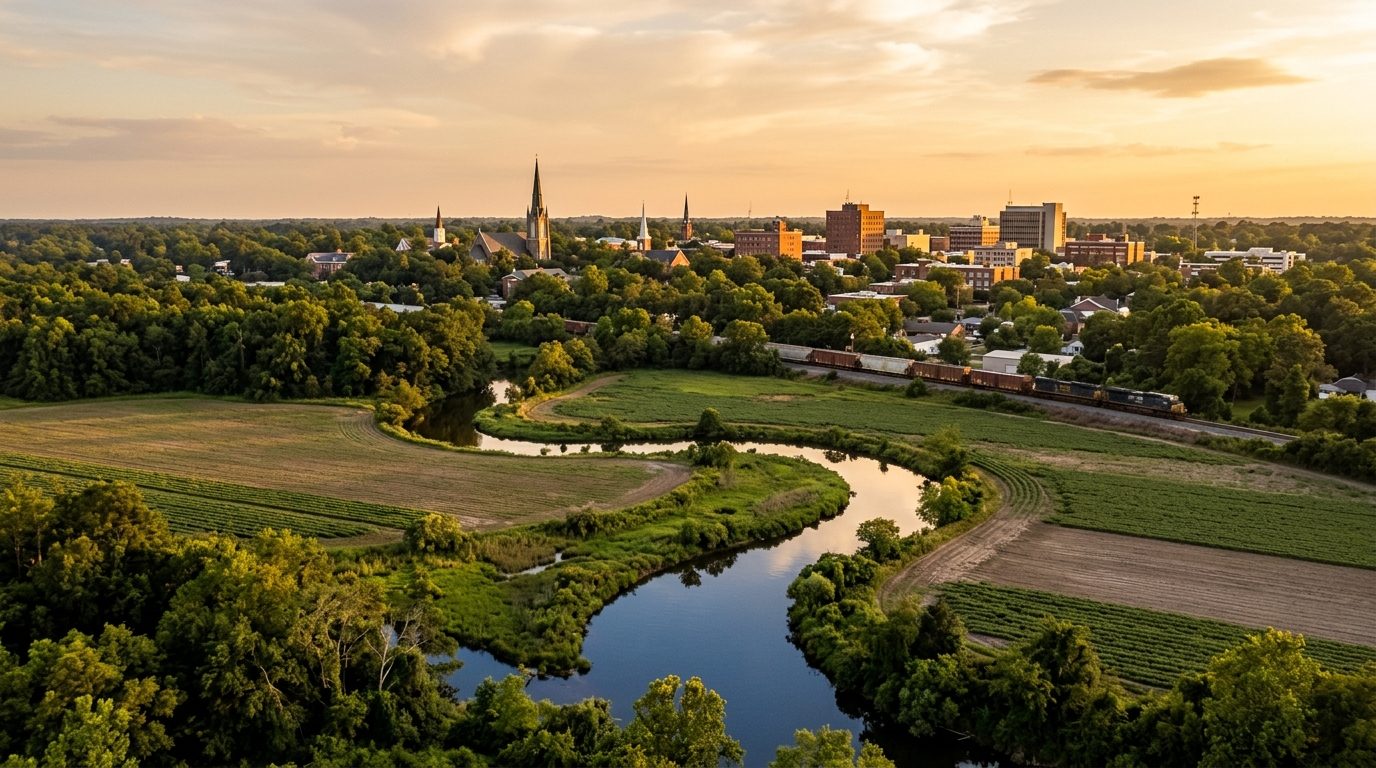
Goldsboro sits on North Carolina’s inner coastal plain, a flat to gently rolling landscape drained by the Neuse River and its tributaries, including the Little River and Stoney Creek. The climate is humid subtropical, with hot, humid summers and mild winters, and the terrain’s low relief has shaped a built environment dominated by single-story and low-rise construction rather than hillside or view-driven development. The city grew up around a rail junction, giving downtown Goldsboro a traditional grid of brick commercial buildings and older frame residential blocks, while the surrounding county remains largely agricultural. Seymour Johnson Air Force Base, an active-duty installation on the city’s eastern edge, has been a defining feature of the area’s growth for decades, drawing suburban subdivisions, apartment complexes, and commercial strips into the corridors connecting the base to downtown and the regional highway network.
Housing patterns across the metro track a few consistent factors: distance from Seymour Johnson AFB, proximity to downtown, and the transition from town lots to open farmland. Neighborhoods closest to the base’s gates and along the main commuting corridors tend to carry newer construction and higher demand because they shorten commute times for active-duty families and civilian base employees. Established in-town neighborhoods near downtown Goldsboro offer older, more architecturally distinct housing stock, with value varying block by block depending on renovation history and school assignment. Outlying areas in Wayne County and the smaller towns of Fremont, Mount Olive, Pikeville, Seven Springs, and the village of Walnut Creek transition quickly into row-crop and livestock farmland, where lot sizes grow larger, housing density drops, and prices reflect rural infrastructure and longer drive times rather than urban amenities.
The metro’s economy centers on the intersection of the military, agriculture, food processing, and healthcare. Seymour Johnson Air Force Base is the area’s most significant employer and economic anchor, hosting fighter and air refueling wing missions that bring a steady rotation of active-duty personnel and their families into the local housing and rental markets. Agribusiness is equally central: Wayne County is a major hog- and poultry-producing area, and processors such as Butterball and Mt. Olive Pickle Company operate significant production and distribution facilities in and around Goldsboro and Mount Olive, supplemented by poultry operations such as Case Farms. Healthcare is another core sector, anchored by UNC Health Wayne in Goldsboro, alongside Wayne County Public Schools and Wayne Community College as major public-sector employers.
Buyers should weigh several region-specific factors before purchasing. The area’s low-lying coastal-plain geography and position along the Neuse River leave parts of the metro exposed to hurricane remnants and inland river flooding, historically the more damaging risk locally compared with direct coastal storm surge; flood-zone status should be checked parcel by parcel rather than assumed by neighborhood. Property taxes and land-use rules differ between the city of Goldsboro, its extraterritorial jurisdiction, and unincorporated Wayne County, so zoning, agricultural-use classifications, and annexation status are worth confirming before closing. Because a large share of area renters and buyers are tied to the base, housing demand can shift with military basic allowance for housing rates and permanent-change-of-station cycles, which buyers and investors should factor into timing and rental-market assumptions. Farmland bordering residential subdivisions can also mean seasonal agricultural activity, odor, and equipment traffic nearby, which is worth confirming in person before purchase.
Cities and Towns in the Goldsboro Metro Area
Notable Communities and Neighborhoods
Goldsboro Real Estate Market FAQ
How is the Goldsboro metro area organized geographically?
The metro is anchored by the city of Goldsboro, the Wayne County seat, with Seymour Johnson Air Force Base on the city’s eastern side. Surrounding it are the smaller towns of Fremont, Mount Olive, Pikeville, Seven Springs, and the village of Walnut Creek, which sit amid the farmland and waterways of the Neuse River coastal plain. Development is denser near downtown Goldsboro and the base and thins out into agricultural land toward the county’s edges.
Which parts of the metro tend to carry higher home prices, and why?
Areas within easy reach of Seymour Johnson AFB’s gates and the main commuting routes into downtown Goldsboro generally command stronger demand because they cut commute times for base personnel and civilian workers. Established neighborhoods with newer construction or well-maintained older homes near downtown also hold value better than outlying rural properties, where lower prices reflect larger lot sizes, farm proximity, and longer drives to employment centers.
What should buyers verify locally before purchasing in this metro?
Buyers should confirm a property’s flood-zone status and elevation given the area’s low-lying river geography, check whether the parcel falls within Goldsboro city limits, an extraterritorial jurisdiction, or unincorporated Wayne County, which affects taxes and permitting, and verify current zoning or agricultural-use designations, particularly for lots adjacent to farmland. Anyone buying near the base should also confirm noise-contour or accident-potential-zone overlays tied to flight operations.
What is the region’s main natural-hazard risk to be aware of?
The dominant risk is inland flooding tied to the Neuse River and its tributaries during and after hurricanes and tropical storms, rather than direct coastal storm surge, since Goldsboro sits well inland from the coast. Slow-moving tropical systems have historically caused significant river flooding in the area, so flood insurance and drainage history are important considerations even for homes that appear well away from the river on a map.
Nearby Markets